
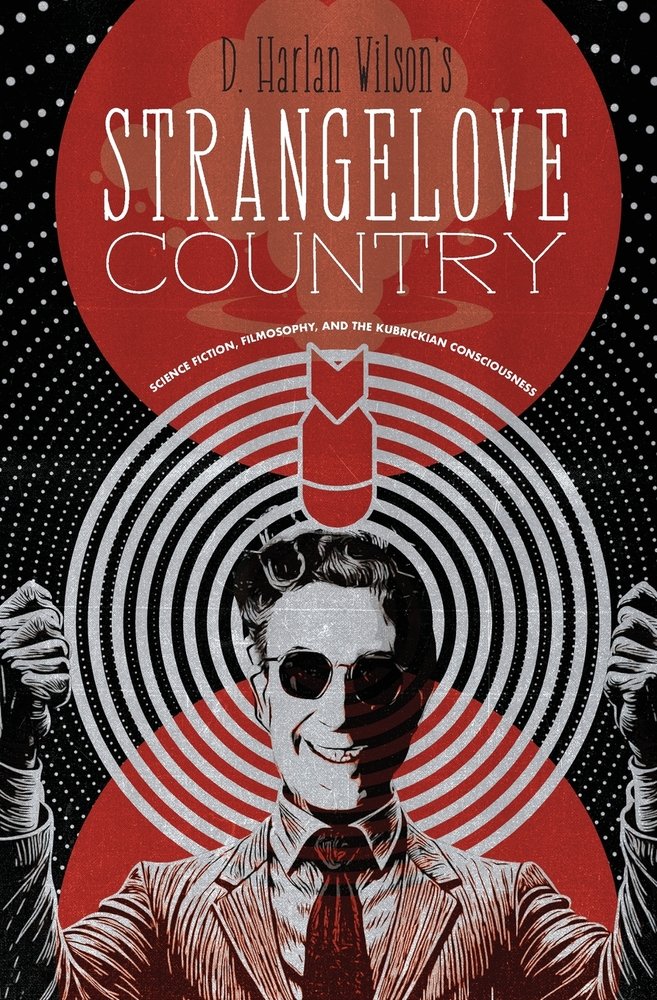

I was having dinner with a few friends, bookish cinephiles all, so I mentioned that I was reading D. Harlan Wilson’s Strangelove Country. I explained the very basic premise of the book: four of Stanley Kubrick’s films—Dr. Strangelove, or How I Learned to Love the Bomb, 2001: A Space Odyssey, A Clockwork Orange, and A.I. Artificial Intelligence—were all science-fiction films that made up a kind of sci-fi consciousness for Kubrick. Like the best works of criticism, this sparked a debate around the dinner table. Is Dr. Strangelove really sci-fi? Surely not Clockwork. I hardly had to say a thing; my friends brought up many of Wilson’s arguments for all four works being part of the sci-fi cannon during the conversation.
They did not, of course, dive to the depths that Wilson does to make his argument. He frames his critique as “schizoanalytic,” which makes sense given that he’s analyzing these four Kubrickian sci-fi (KSF) films as a window into the Kubrickian filmind, or KFM. The filmind concept comes from Daniel Frampton’s book Filmosophy, where cinema is “an organic mind-body entity,” in Wilson’s explanation. A filmind is not the same as the consciousness or even intent of the director or auteur; it is the mind evident in the movies when examined together. Wilson uses this framework “to inspect how the KFM thinks and sees” the Kubrickian through-line of phallic aggression as evidenced by the KSF. It is this multifaceted yet coherent filmind that Wilson puts on the schizoanalytic couch.
All four films examined in Strangelove Country rely on the connection or even symbiosis of humans and technology. One cannot exist with the other in the KFM, according to Wilson. He admits that he, like one of my friends at dinner, thought of Dr. Strangelove as a comedy more than a sci-fi movie. But Wilson also points out that sci-fi and comedy have never been exclusive, and he makes the case for Dr. Strangelove being the prototype of the KSF to come due to its yoking of man and machine, “mapping a gradual descent into the machinarchy of 1960s Western culture.” If you look at Dr. Strangelove himself as a mad scientist trope and kind of cyborg in his chair, Wilson’s point becomes clear, and it leads to this very typical Wilsonian sentence: “Strangelove the meta-cyborg embrains the totality of KSF and the film-thinking of the KFM.” It is a bonkers sentence to write, yet within Wilson’s schizoanalysis, it’s kind of great.
2001’s sci-fi bona fides are hardly in question. Wilson, however, dares to say “2001 is not an SF film.” He argues that is an anti-SF film, a post-SF film, and even meta-SF film, with kinship to fantasy and horror films. “This molecular filmind thinks harder than any other KSF,” he writes, and it’s hard to disagree. But Wilson is not blinded by the futurism of 2001. He sees that there are no non-white people in the future according to the KFM, and that its aesthetic “now tends to come off like Breakfast at Tiffany’s (1961) in space.”
One of my dinner companions actually scoffed at the idea of A Clockwork Orange as sci-fi, but Wilson makes a mostly convincing case. The KSF connection between humans and technology is clear, and the Kubrickian critique of masculinity that could, through some eyes, seem like a celebration of it are present. “We could say that the KFM wears SF like a fancy hat in A Clockwork Orange,” Wilson writes. He admits that most critiques of this film focus on its over-the-top violence and sexuality, but he argues that the sci-fi is evident in the name: a clockwork orange is an absurd melange of the machine and the natural. Likewise, Clockwork, along with its literary predecessors Nineteen Eighty-Four and Brave New World, “portray the use of neuroscientific tools by despotic governments to control the masses.”
It’s hard to argue against A.I. being a sci-fi film, and Wilson doesn’t. He notes that it’s pro-SF and reaches back into the history of the genre as much as it presents the future on screen. (Wilson also goes to some length to clarify the fact that Kubrick always intended for Steven Spielberg to make this film; the two worked together on it before Kubrick’s death in 1999). It’s in this section that Wilson writes the clearest statement of his thesis, and he knows it, because it is in italic type: “In KSF and the KFM, there is no humanity without technology.” Wilson spends less time schizoanalyzing this film and more time merely explaining what happens in it, presumably because it is one of the lesser-viewed Kubrick (via Spielberg) films. The ending of the movie is mawkish, but, Wilson writes, “it’s a perfect ending for Strangelove Country and KSF: everybody dies, no humans remain—mankind has destroyed itself once and for all.”
Strangelove Country is cited and structured in a way that contributes to the academic discourse on film. But it’s also a good read. Wilson’s discussions of each film move along without getting bogged down in too much jargon—though, given the fact that it is film criticism, the term diegesis gets a workout. I had my quibbles, like the (over)use of parenthetical mashups such as “(re)produces” to suggest that cinema both produces and reproduces thoughts in the minds of viewers. But Wilson’s tendency toward neologism and portmanteau in general keeps the book feeling light and even kind of fun for criticism. I’ll be using the term Phildickian myself every chance I get, which is more often than you might think.
Strangelove Country: Science Fiction, Filmosophy, and the Kubrickian Consciousness, by D. Harlan Wilson. Sant Fe, New Mexico: Stalking Horse Press, March 2025. 222 pages. $19.99, paper.
Kristen Hall-Geisler is a freelance editor and author living in the Pacific Northwest. Her work has appeared in the New York Times, TechCrunch, Popular Science, and U.S. News & World Report, among others. She most recently translated the four-volume Memoirs of a French Courtesan by Céleste Mogador.
Check out HFR’s book catalog, publicity list, submission manager, and buy merch from our Spring store. Follow us on Instagram, Bluesky, and YouTube. Disclosure: HFR is an affiliate of Bookshop.org and we will earn a commission if you click through and make a purchase. Sales from Bookshop.org help support independent bookstores and small presses.

