
Back when I was growing up—a good, Christian boy in the suburban South—there were pretty much three cults that everyone knew by place or name: Waco, Jonestown, and Heaven’s Gate. That was the list. Sure, our parents would decry large-scale organizations like Scientology and Mormonism as cults, but (fair or not) that was largely denigratory, and as far as we knew, those groups had never provoked any massacres or mass suicides. And so, for a long time, the big three were it. Amid vague imagery of white robes and poisoned Kool-Aid, the very idea of what a cult was and did remained so narrowly defined as something small and crazy—distant and rare—that the word gained a kind of supernatural power all its own, leaving us to speculate in hushed tones: Who were these people? How did these groups happen? Why on Earth would anyone ever fall for this stuff?
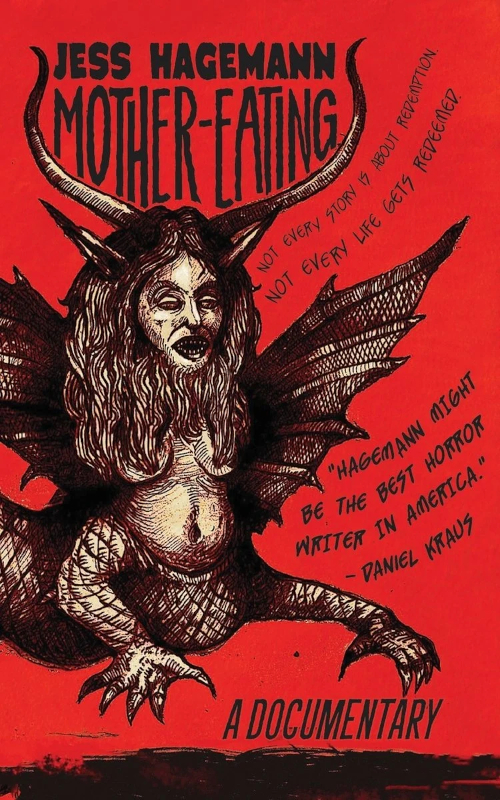
These are the questions that author Jess Hagemann looks to explore through the aggregate voices of the Sashes, the members of the fictional Texas cult Simon’s Sorrow, in her long-gestating new novel Mother-Eating. Beginning in the 1960s, and employing the oral history format to stunning effect, it weaves four decades of disparate, patchwork accounts into a grisly iconic tapestry depicting the rise and fall of its charismatic charlatan founder (King Louie), his child-bride-cum-Queen-Mother (Mary Toni), and all the catastrophically misguided souls drawn into their orbit along the way. And if you’re perking up and noticing these names right just now, well done. They are indeed no coincidence. Mother-Eating, in addition to being a book about a sadistic sex cult, is also a loose reimagining of the life and reign of King Louis XVI and Marie Antoinette. How much that qualifies as a spoiler really depends on how well you know your history, but it’s right there on the back cover, and even if you’re a Francophile buff, rest assured Mother-Eating still has plenty of surprises in store.
With those devilish surprises in mind, I will try to eschew too much more plot summary, but to nutshell, Simon’s Sorrow is devoted to the would-be-Apostle Simon Magus (namesake of simony—the sin of attempting to buy or sell one’s way to Spiritual power), and the idea of “Restoration” to Christ through pain and suffering (namely, a smorgasbord of truly gnarly tortures). In claiming to “speak for God,” King Louie recruits people into his mad fold with promises of boundary-obliterating, on-demand sex, and then keeps them there via the more insidious shackles of panoptic complicity. By putting into grisly practice his eloquent perversions of Biblical ideas, he effectively creates his own mythos and dares all around him to disbelieve. Or put another way, he shows them things they can’t unsee, and evokes in them feelings they can’t unfeel, until the enormity of what they’ve done together overwhelms any individual conceptions of “right” and “wrong.” As one Sash notes fairly early on, they were free to leave at any time, but most everyone who left ended up committing suicide within the year.
Upon devoting their lives to Simon’s Sorrow, Sashes subjugate themselves fully to the mission, going so far as to relinquish their names and be known only by their assigned roles within the community. As such, most of the book’s myriad viewpoints are attributed to the likes of “The Butcher,” “The Tutor,” “The Groundskeeper,” “The Whore,” etc., which, after a while, begins to function as a kind of entrapping meta-connivance all its own; an avenue by which we may well find answers to those incredulous, first paragraph questions—Who are these people? Why did they fall for this?—that shock you for just how banal and understandable they are. Maybe not in a literal “this could totally be me” sense—the book does open with a viscerally squirmy blood orgy, after all—but still.
The overall impression is that they’re mostly normal people, looking for something more. And whether they name that something freedom, or purpose, or community, or love, it’s ultimately that vaguer notion of “more” that they find and are unable or unwilling to resist. A depraved excess. A life larger than life. Hagemann writes about blasphemy in such a way that makes you understand in your bones why it’s a sin—that, at times, makes you feel guilty just for reading it—but also makes you feel its intoxicating allure. And in keeping you reading in spite of yourself, she effectively mirrors her cult’s magnetism, such that once she has you tuned in to the group’s hive-mind echo chamber wavelength, it becomes insidiously difficult not to empathize and rationalize right along with them.
Fascinatingly, though many of them recall their time with Simon’s Sorrow with wistful fondness, the group portrait they paint is rather one of grim, atmospheric tension and ruthless mistrust around every corner. Indeed, one of the most unsettling things about Mother-Eating—Hagemann’s rigorously disciplined descriptions of the group’s casual, day-to-day evils—is also one of its greatest strengths. While the book briefly threatened to lose me in its latter half, making feints toward the supernatural, the Rashomon-ian format establishes enough ambiguity to stay largely grounded in reality. Despite these people living and working for years inside the same tight-quartered compound walls, and in nominal service to the same sacrilegious ideals, amid the collective fog of their closed-circuit brainwashing, almost none of them feels remotely reliable. It’s not even that they’re lying, so much as that they all, to varying degrees, exist outside of objective truth, which by the time we hear tell of the “miracles” witnessed inside Simon’s Sorrow, makes it more than fair to wonder if any of them were even real.
This book, if it wasn’t clear already, is a lot, and I’ll admit I didn’t understand at first why Hagemann chose to do so much. Her cult story felt huge on its own, and I feared the weight of the Marie Antoinette tie-in would topple it; an ostentatious, Versaillesian hat on a hat. But I also love a big swing, and this one paid off in spades. Though we never hear her tell it herself (for obvious reasons) the story of Mary Toni—a precocious young girl who loses her father at six, and is sold to King Louie at 14 by her junkie mom—is the one through which we most come to understand how it feels to be indoctrinated.
She’s young. She’s (perhaps permanently) grieving. She’s vulnerable. And while she resists fiercely at first, through some combination of resignation, Stockholm Syndrome, gut animal instinct, and yes, love, she ultimately grows to accept (if never quite relish) her role atop the group’s hierarchy. Being the only Sash of note who doesn’t join of her own free will—a true victim of circumstance—makes her a relatable bridge between the nutjob true believers and the folks who go along to get along. History, Mother-Eating reminds us, is something even Queens rarely effect—it’s simply what happens while we all push against the tide. And by overlaying her plot atop its existing framework, and largely stripping her competing narrators of their identities, Hagemann renders them, and by extension us, little more than cogs in a fiendish machine, locked into the same kind of rapturous/torturous contraption Simon’s Sorrow employs in their rituals, helplessly watching the screws tighten.
More than that though, I think Hagemann wanted to draw some lines—connect some era- and continent-spanning pushpins with some telltale red string—as to exactly what the word cult has come to mean in the 21st century. King Louie and Mary Toni meet their inevitable ends in 2002, and without them Simon’s Sorrow too ceases to be—joining the slim ranks of its legendary, whispered forebears. But fast-forward to the 2020s, and you’d be forgiven for thinking that cults are absolutely everywhere and always have been, walking among us, hiding in plain sight. As with so many once-shadowed, fringy things, the internet has exponentially broadened both our definitions, and our horizons. Open any streamer you subscribe to, right now, and you’re all but guaranteed to see a cult-related docuseries beckoning to you from the front page. Check “wherever you get your podcasts” and you’re sure to be invited into a thousand more. Diets and exercise programs are cults. Therapies and support groups are cults. Depending on who you ask, no longer just Scientology and Mormonism, but virtually all denominations of all religions are now just good old-fashioned cults. The differences largely come down to numbers and branding. And of course, the far wings of both the Republican and Democratic parties regularly decry one another as cults (just as Democracies do with the pro-regime citizens of most monarchies and dictatorships). The word has gone, in the span of a couple decades, from something devilishly specific to something broadly meaningless.
Terrifyingly, one of the many Texas-specific factoids Hagemann trots out in localizing her tale, is that all Texas politicians are required to declare their belief in a higher power. She clearly sees the writing on the compound wall. Call it tribalism or identity politics all you want, but there’s a growing tendency to look around at our world today and label all who disagree with us as cults by any other name. Crazy, and brainwashed, and impossible to defend. Wherever two or three are gathered and doing some crazy shit, there a cult is also. Wherever people are vulnerable, and being fed promises of something more, there a cult has all it needs to begin. Sometimes small press horror fans can even feel like cults. So watch out for Hagemann. She’s got a hell of a pitch. She’ll suck you right in.
Mother-Eating, by Jess Hagemann. San Antonio, Texas: Ghoulish Books, October 2025. 362 pages. $21.95, paper.
Dave Fitzgerald is a writer living and working in Athens, Georgia. He contributes sporadic film criticism to DailyGrindhouse.com and Cinedump.com, and his first novel, Troll, was published in May 2023 by Whiskey Tit Books. He tweets @DFitzgerraldo.
Check out HFR’s book catalog, publicity list, submission manager, and buy merch from our Spring store. Follow us on Instagram, Bluesky, and YouTube. Disclosure: HFR is an affiliate of Bookshop.org and we will earn a commission if you click through and make a purchase. Sales from Bookshop.org help support independent bookstores and small presses.

