
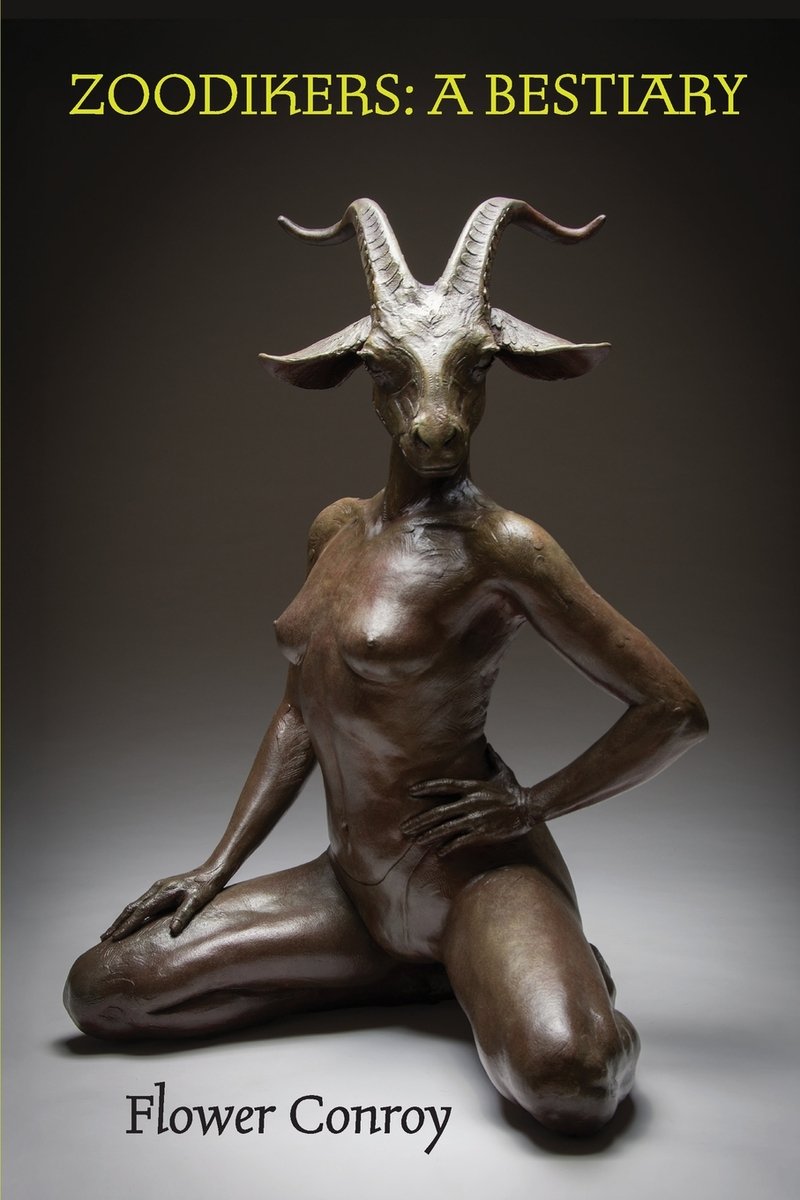
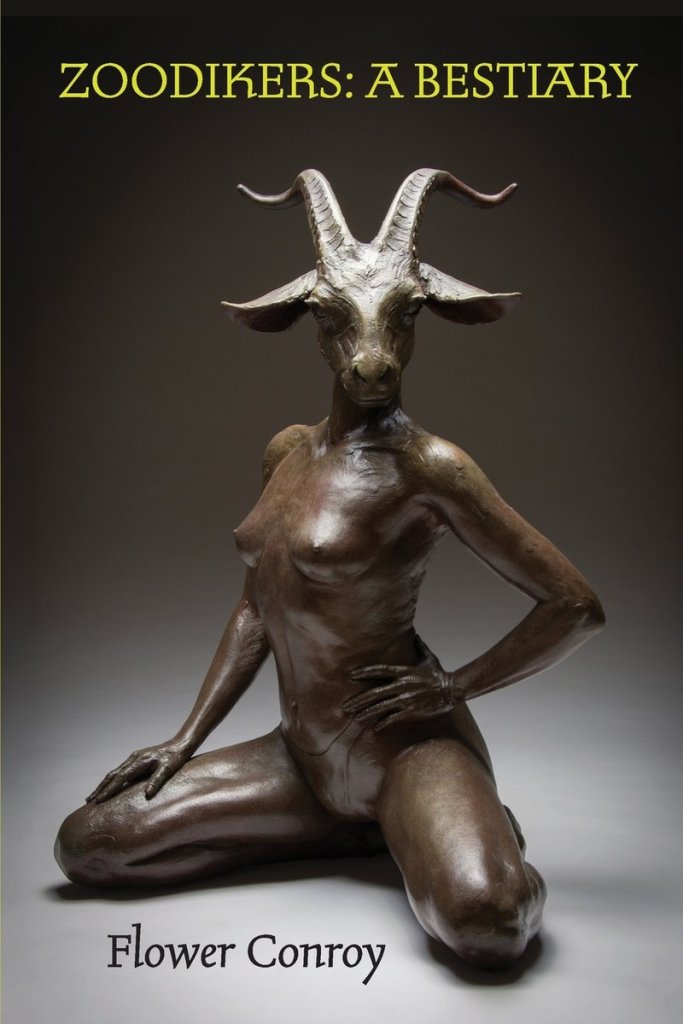
In their fourth full-length collection, Zoodikers: A Bestiary, the former NEA and MacDowell fellow Flower Conroy dissects tangents of strangeness that perform diversions from the hegemonic toward a new order that is perverse, that is humble, that is shocking.
The enigmatic pulse of Zoodikers (the term a 17th-century exclamation defined as “God’s hooks”) spotlights a materialism that revels in a form of myth-making where the human and the other-than-human share a morality that substantiates each other’s becoming (and eventual disappearance). Conroy’s verse is a conduit for how to witness and belong to a poetic reckoning that is foretold in the book’s first and fatalistic epigraph from CAConrad: “When a species leaves the planet, / they take all of their sounds with them— / their heartbeat, their breath, their footfall, their fluttering, their gallop, their cries, their songs.” Here, Conroy tactfully quotes Conrad reflecting with disdain on a modernity that necessitates a species’ extinction and fills their void “with this din of humanity: our cars, our bombs, our drones.”
Perhaps, then, Zoodikers is analogous to Conrad’s own (soma)tics: poetry born from ritualistic exercises that lead to extreme presence, and, as Conrad writes, “reveal the creative viability of everything around me.” This is to say, Conroy extracts and enfolds a new, delicate presence from their sixty-five entries which perform assembled meditations around each focalized beast that explores how the body and spirit are able to create with otherness. Further, the sum of Zoodikers amplifies a practical formlessness where dreaming is itself a culmination and to exist is to view and be viewed through a lens of an unbridled reality that is wild and radically unique.
One of the ways this affect takes shape is in Conroy’s persistence that perspective be fluid, where at times they inhabit, i.e., “Frog”: “Once a week you pull off your dead skin & eat it. I get it. Like some megaton explosion I too’ve wanted to shed self, all leg & bleating throat & reslicken primogenial.”
Other times they subsume, i.e., “6EQUJ5”: “This is how rapture should feel. A being devoured by echo feeling. A bubbling behind the eyes, then bumbling along the ceiling, the roof peeling away, a parade of disentangling objects, the miscellanea of your life you’ve become the grand hoopla of, bobbing toward Pluto.”
Elsewhere, they question, i.e., “Lazarus Taxa”: “What’s the millionth digit of pi? Are you shy of dying? Who are the keepers of time? What are you daily afraid of? Afraid for? What’s love?”
Finally, they conceive, i.e., “Centipede”: “I imagine you don’t imagine yourself grotesque of heart, a squicky monster but rather some incarnation of destruction doling necessary chaos, an alien gladiator of evening.”
This variety is control, that is, it carefully sustains acknowledgement of the world’s fatalistic pull to either take shape upon influence or, in turn, resist being forced like we see, for instance, in “Coat of Arms” where a personalized narration declares their “survival of the misfittest, the reasons selfish why I left that little forsaken shithole of a town South Annoy for a dot of paradise at the end of the Sunshine State’s archipelago.” What it takes to stay afloat amid trial or disaster, Conroy suggests, is a broadcasting of one’s self, ultimately broadening the scope of personal transcendence to keep a looser grip on linearity and a normalized conception of time.
We see this thread further strip the complex of past and future first in the poem “Sky Whale” that hums to a prophetic, humorous beat: “Contained within the human brain’s older parts a multidimensional universe similar to the animals from which we progressed. How much wants to come full circle? […] to address if we were evolved differently & took to atmosphere instead of sea-returning: winged; not finned.”
Second, the poem “Machine Deep Learning (Cento)” confronts the intellectual weight of artificial intelligence with a mimetic look at its impact on the future of “real creatures” (who “have multiple interacting changes, & no explanation at our fingertips”). Specifically, Conroy uses Ai-Da, an ultra-realistic humanoid “artist,” as a foil to delineate the ethos of “real creatures” and project the gap between “robots” and humanity that is widened by the question of determinism. For the “person,” this means having some “desire or intention,” “requisite belief,” as well as a beginning and end. For artificial intelligence the lines are much more blurry and to construct a philosophy around their being, Conroy implies, is futile. Instinctually, what the human wishes to do is deconstruct the humanoid: “[security] forces detained Ai-Da at the boarder & wanted to remove the cameras in her eyes.” Conroy’s tongue-in-cheek conclusion here distills while diverting a major question of the future, for if “the phenomenon of understanding is an ongoing series of historically embedded events,” then what happens to the awareness of ourselves as the “real creatures” when our artificial replicants are becoming more prevalent?
“O conjureman, go on with us,” is the second epigraph of Zoodikers. It comes from Carol Conroy and follows CAConrad’s dejection with a certain optimism that Flower Conroy echoes most notably in an early poem “Dodo” and in the final poem of the collection, “Zonkey.” With these bookend entries, we see an effort at the restitution of “the accumulating horrors” of humanity where perspective shifts—once again—to the collective, where “we” are first advised to “lift each other up from the sharp mulch because if we don’t—we’ll all eschaton into the revelatory flames we’ll all can of worms into the ether” and then assuaged: “odd child fret not; we are all galactic spaghetti phenomena puppeting the particle light. If we’re lucky enough to be alive aren’t we lucky enough?”
In whole, Flower Conroy harnesses a radical vision for humanity wherein the self is constantly becoming with and through otherness, persevering despite external efforts to dismantle strange or experimental offerings. Zoodikers, then, exclaims, with defiance and flexible precision: being human is having the chance to react with empathetic, hopeful skepticism.
Zoodikers: A Bestiary, by Flower Conroy. Tampa, Florida: University of Tampa Press, September 2025. 90 pages. $16.00, paper.
Zachary Kinsella is a writer, musician, and ski coach living in Vermont with his wife, son, and cats. His writing has appeared in Full-Stop, Heavy Feather Review, and The Journal of Modern Literature.
Check out HFR’s book catalog, publicity list, submission manager, and buy merch from our Spring store. Follow us on Instagram, Bluesky, and YouTube. Disclosure: HFR is an affiliate of Bookshop.org and we will earn a commission if you click through and make a purchase. Sales from Bookshop.org help support independent bookstores and small presses.

