
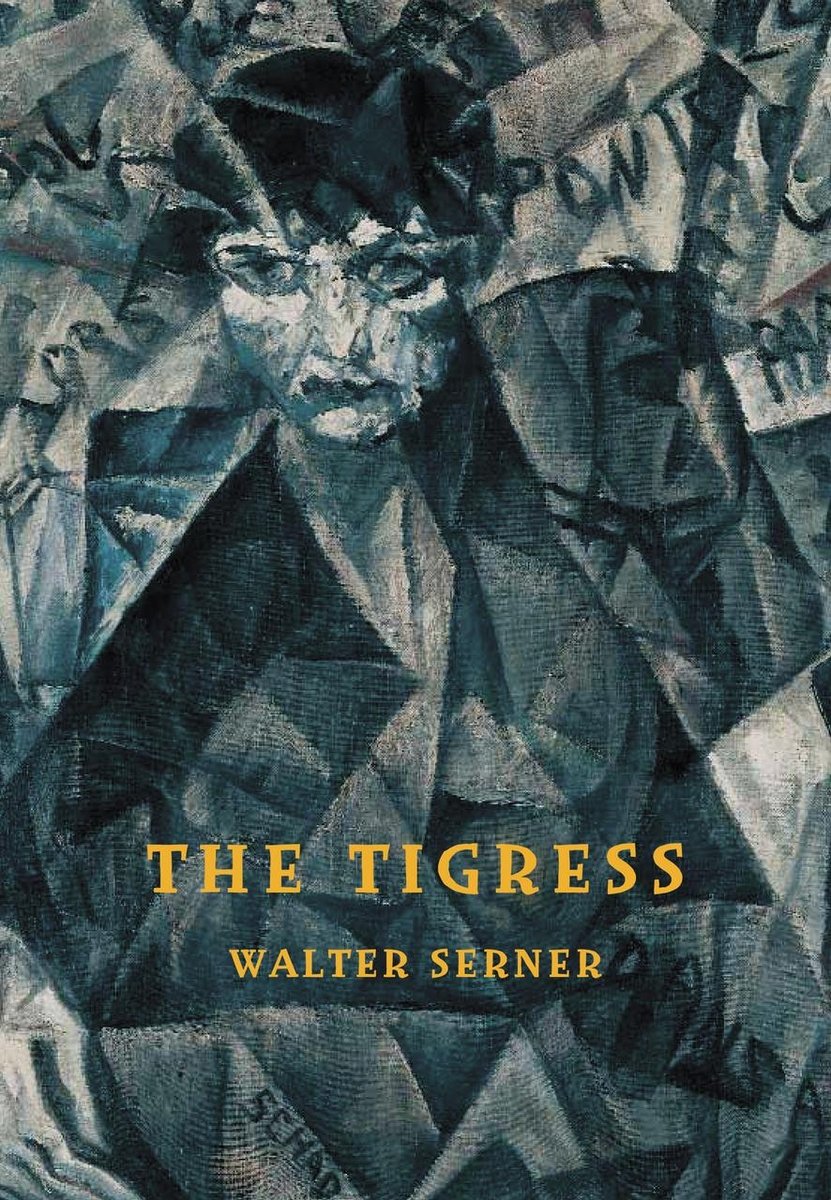
Some years after Walter Serner helped bring Dadaism to Zurich, he broke away from the movement. The Tigress, perhaps Serner’s most famous work, emerged in the period after Serner’s detachment from the art world, and like much of Serner’s other writing, takes place in seedy underworlds—the characters that entice him are criminals and conmen. Serner’s Dada roots peek through the darkness of The Tigress; there is something of the absurd within its chaos. Using his characters as a vehicle, Serner carefully breaks down the rules and systems of language, and in this decay and inversion, he creates a madness that spreads like a virus.
The titular tigress is Bichette, a Parisian prostitute. She rules the city’s nightlife, and is never short on lovers, though she discards them as quickly as she picks them up; she bores easily. Suddenly, miraculously, she falls in love with the con artist Fec, formerly known as Henri Rilcer; he abandoned his predictable wealth and family for the chaos of the street. The two leave Paris together, and in an effort to create something exciting enough to endlessly stave off their boredom, they construct an elaborate ruse. This con swells and grows, and they both fall under its spell.
Much of The Tigress is written in dialogue form. The book is mostly a series of conversations, conversations that churn faster and faster until they reach fever pitch. We become instantly entrenched in the madness of Fec and Bichette because we are able to witness their dialogue; their thoughts, their internal insanity does not matter. It does not matter, also, what exactly their dialogue entails, or whether we can understand their language; what matters is the rhythm and pitch of their voices:
“That’s it! That’s it! Picked-up stuff! Picked-up stuff!”
Bichette laughed even more crassly and loudly. “Are we doing us, Monsieur Baron? Or are we not doing us?”
“That’s it! We’re doing us.”
“Rotter! . . . What is it? Well say something already!”
It’s the heat of two animals snarling at one another, rabid, engaged in some fanged dance. Serner creates this madness carefully through the specific language of his characters, and the difference between their use of words. There is a gap between the language Bichette uses and the language Fec uses, and something rushes to fill that gap.
When Bichette typically speaks, her sentences are long, confused, and muddled:
I just can’t keep living like that, so . . . This is . . . idiotic, that’s what it is. I’m not saying we should go in for the whole phony tralala thing, like those syrupy chippies and their pimps. It’s just run-of-the-mill louche, the silly little hoodlum games, the disgusting lovey-dovey sham and gazing into each other’s eyes and the deceitful brutality, this whole trade with heart and ass and . . . Rotter! But in the end it’s also nada.
Bichette’s dialect, born from the streets of Paris, is barely comprehensible to us. Her use of words like “tralala” and “rotter” convey no meaning to anyone besides Bichette; these words have more in common with a dog’s bark or tiger’s growl than any human language.
Fec’s rhythm, on the other hand, is born from short, formal sentences, and although his words are feverish at times, they are always real words, with a distinct separation between them. His thoughts are well-reasoned, and if Bichette’s language is animalistic, Fec’s language is human:
And yes, this idling is idiotic. If you don’t want anything more, if you don’t want to do anything more, it would be better for you to turn the corner, into the sweet air. But it’s different with me. It’s been like this for two years now. Before that, I was up to all sorts of things. Until I just got fed up with everything. Everything. Everything. Everything. Then idling was almost a pleasure for me. Over the past few weeks, though, I’ve even gotten tired of that. Of course, without admitting it to myself. As for your sobbing today, I know what that was, too.
From the very first conversation between Fec and Bichette, Serner allows their two modes of language to infect one another; this is the reason behind both of their sudden changes in behavior—falling in love is technically out of character for both Fec and Bichette. This infection, for the pair, is exciting, and as The Tigress continues, the infection develops, until both occasionally start to employ the other’s language: in Bichette’s final monologue, she uses Fec’s reasoning, and in Fec’s final monologue, he’s infected by Bichette’s long, muddled sentences.
Bichette, at the end of The Tigress:
I was masterful, eh? Didn’t you fall for it hook, line, and sinker? It’s all on you. Because you bought me that yellow wool cap. You took the three hundred francs. And you took the bait when I suggested we do us. I didn’t imagine your lovely deal, but something like it. I wanted you to make the effort to fall in love with me, and then end up really being in love with me.
Fec, at the end of The Tigress:
But then the fantastically voluptuous idea came to me that this time I should do nothing, just push it all to the edge, curtail the final conversation about the consummation of my genius scheme, which was to bring us the magnificent success and millions, and thereby give her and myself an unprecedented experience, such pleasure, such perplexity, such happiness finely ground . . . unknown . . . bewildering . . . that was to meld us together forever into an ineffable, perhaps unsurpassable, oneness . . .
Both characters, at the end of The Tigress retain forms from their original languages, but these forms have now bent to accommodate the other’s mode of speaking—Bichette’s dialect is now constrained into Fec’s rhythm, and Fec’s structured language is stretched out; the walls of his usual syntax have now fallen, and words must fill that empty space.
The filling of the space between the characters’ separate languages is the madness in The Tigress. Both characters fall prey to an external force, a force stronger than their own mental systems, stronger than their own personal language. As the languages mix, both characters begin speaking something outside of language—their words, to the reader, signify one thing, but to the characters, signify something entirely different, something irrational and impossible to understand. Once entangled, these languages are impossible to separate. So, Serner cuts the Gordian Knot with a sword: Fec, in the final scene, is shot and killed at random on the street. It’s a sudden, strange ending, but the chaos created by the folie à deux seems to will into existence such an implausible event, for the purpose of returning order to the world and to language.
Each word in The Tigress is chosen carefully by Serner to lead to this chaos and death. It is a fascinating study of language and its role in madness, and Serner’s precision is unbelievable.
The Tigress, by Walter Serner. Translated by M.K. et al. Prague, Czech Republic: Twisted Spoon Press, December 2025. 171 pages. $18.50, paper.
Ria Dhull is an artist and critic living in NYC. You can find her weekly film reviews at Spectrum Culture and her other writing spread across the web. Her animated short film Seraglio Row is forthcoming.
Check out HFR’s book catalog, publicity list, submission manager, and buy merch from our Spring store. Follow us on Instagram and YouTube. Disclosure: HFR is an affiliate of Bookshop.org and we will earn a commission if you click through and make a purchase. Sales from Bookshop.org help support independent bookstores and small presses.
 Heavy Feather Review