
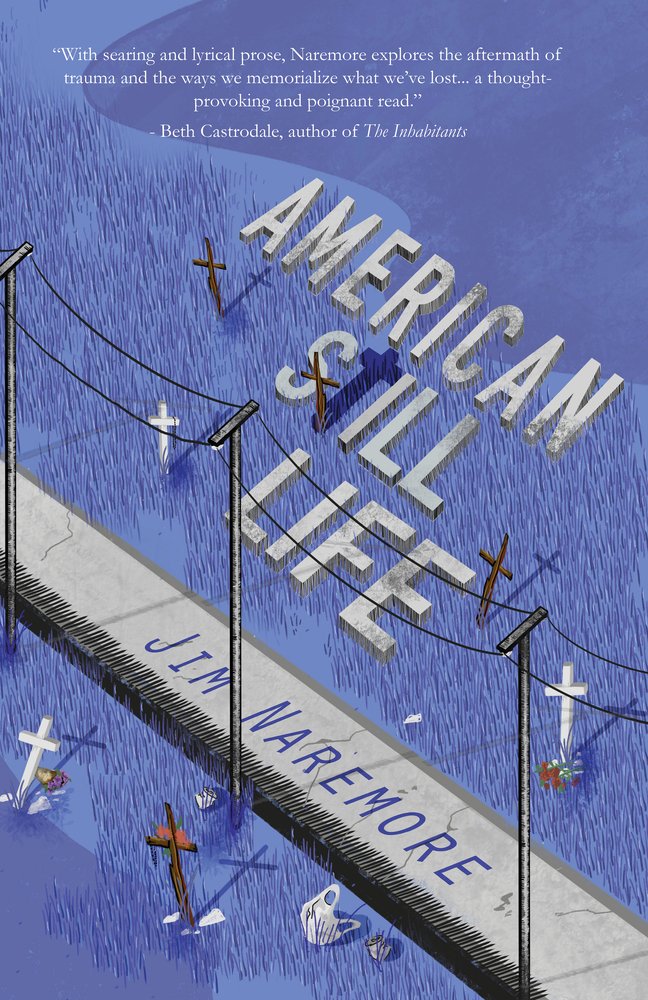
A pair of Nike high-tops, a stuffed rabbit, a vinyl suitcase, a laminated graduation photo framed with dried marigolds: these common yet intimate relics are the defining features of descansos. These roadside memorials created on the occasion of someone’s tragic and untimely death are the subject of photojournalist Skade Felsdottir’s big break. As “one of the young lions of documentary photography today” captures the final shots and drafts her commentaries for an overdue book in a cheap motel room, Skade battles the ghosts of her past and the addictions of her present while her uncertain future finds itself variously threatened and redeemed by her homecoming.
Part Künstlerroman and part cultural history of an underappreciated folk art, American Still Life is full of vibrant matter. Jim Naremore captures the pure force of these objects—the surprising vitality of the white PVC crosses that one can purchase on Amazon and the concrete-reinforced totem poles not far removed from “drainage ditch[es] filled with hard black mud, roadkill, and beer cans.” The trash that surrounds the memorials is not simply refuse, but rather a testament to what happens when the shock of the death wears off, when the site of the accident becomes less a hallowed ground, and when the descanso becomes a mere peripheral presence, one that passersby vaguely remember is there but no longer actively see on their daily commutes.
At its best, American Still Life positions descansos and their photographic reproductions as invitations to regard the pain of others. This is, perhaps surprisingly, not an invitation entrenched in exploitation for monetary gain and artistic self-importance; rather, descansos become multilayered mementos defined by a chorus of voices. The deceased, a voice otherwise silenced, is represented in icons, carefully curated by loved ones, carved into the material or strapped to its base. Visitors act as caretakers, pilgrims, voyeurs, or defilers, with some going so far as to strip the site entirely when the memorials are deemed an obstruction. The photographer becomes the curator of descansos for wider public consumption; no longer does the memorial site belong only to the community initially impacted by (or implicated in) the tragedy. By reproducing the descansos, Skade demonstrates how each is representative of a much larger cultural phenomenon, a tradition that sits at the seam between grief and mourning, “forg[ing] a link between the living and the dead.”
A refreshing counterpoint to the descansos is the joyful yet strange amateur puppetry of Kitten “Kit” Dyer, a Dickensian figure of exaggerated proportions whose “puppets are like salvage come to life.” Kit, once tasked with removing descansos as a member of a construction crew, now becomes their savior in a poignant moment where her art and Skade’s intersect:
Kit had not only fixed the angel’s arm, she had transformed the entire tableau. Before, the angel had been standing erect, arms over her head; now she was kneeling down on one knee with her hands held before her in a gesture of giving and supplication. The figure had been transformed from a lifeless object to a living emotional being with a quiet and profound energy.
The budding friendship between Skade and Kit proves the extent to which creativity can provide a much-needed sense of purpose and a reprieve from battling one’s demons.
American Still Life is a novel where professional and amateur art intersect. Kit’s initial resistance to thinking about her puppetry as an art, much less one that could provide a lifetime of performing for adoring, young fans and the opportunity to travel—no, live—far beyond the outskirts of her hometown, stems from the discomfort of professionalizing something that, until this point, has belonged solely to her. This is the power of artistic mentorship, especially the kind that stems naturally out of an otherwise sororal bond.
At times, the prose of American Still Life feels slightly overwrought. If you can get past its visceral grittiness and Skade’s various indiscretions, such as driving under the influence even though she is on assignment taking photos of the worst-case aftermath, it’s hard not to appreciate how this novel is as much about labels as it is about descansos. Skade’s journey towards redemption and forgiveness prompts us to think deeply about the harm that stems from the burden of childhood monikers that are near impossible to shake even in adulthood. For Skade, being called “Wonder Woman” was like being forced to wear “an albatross around [her] neck” and become a walking projection of other people’s fantasies. She may dismiss the genius label and the unfair pressure it bears, but American Still Life, a fiercely intelligent novel in its own right, shouldn’t.
American Still Life, by Jim Naremore. Raleigh, North Carolina: Regal House Publishing, December 2024. 296 pages. $19.95, paper.
Gabrielle Stecher Woodward writes essays and criticism centralizing the stories we tell about creative women. Her book reviews have been published in American Book Review, Film Quarterly, Harvard Review, and Woman’s Art Journal, among other venues. Explore her portfolio at gabriellestecher.com.
Check out HFR’s book catalog, publicity list, submission manager, and buy merch from our Spring store. Follow us on Instagram and YouTube. Disclosure: HFR is an affiliate of Bookshop.org and we will earn a commission if you click through and make a purchase. Sales from Bookshop.org help support independent bookstores and small presses.
 Heavy Feather Review