
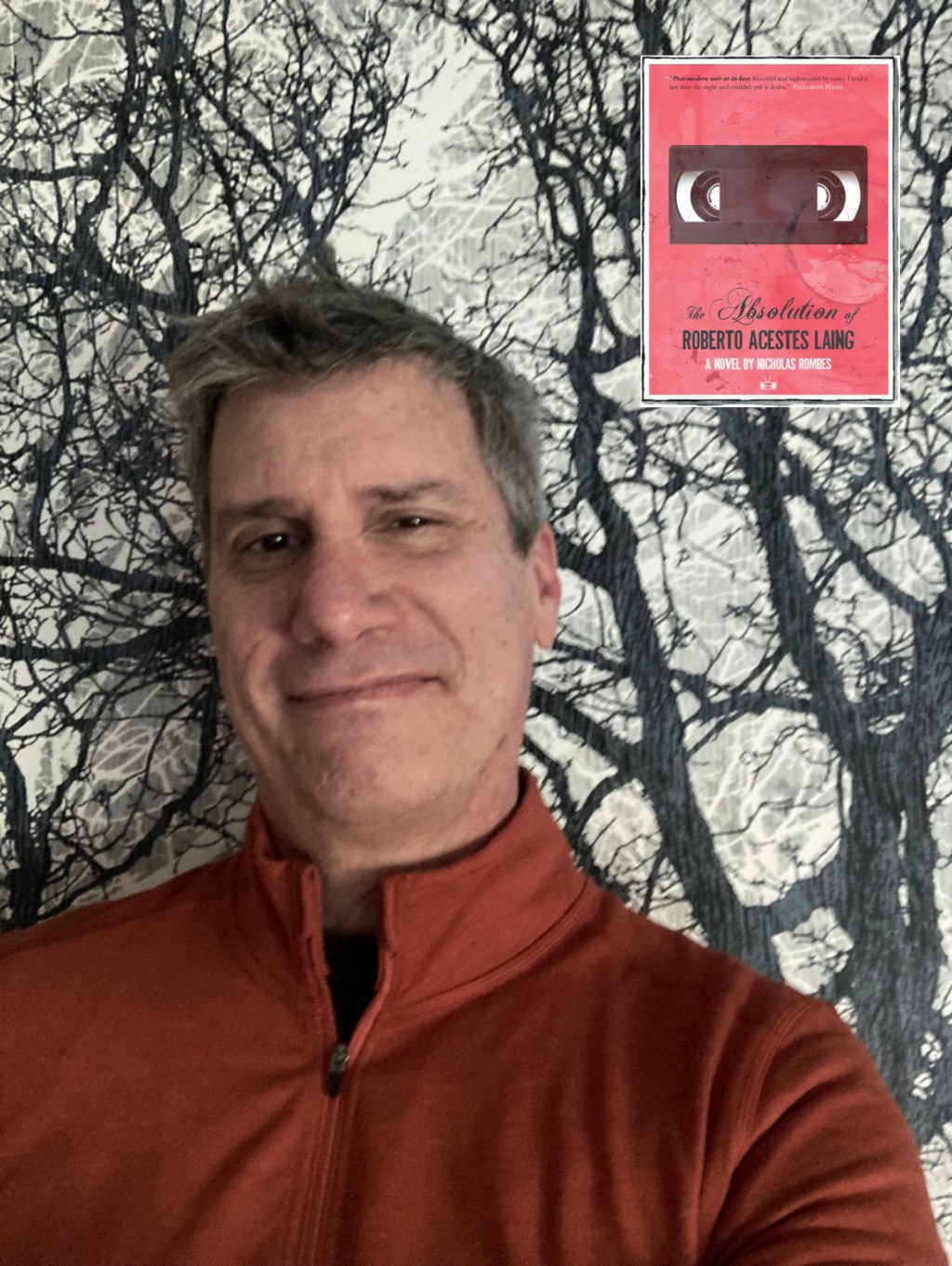
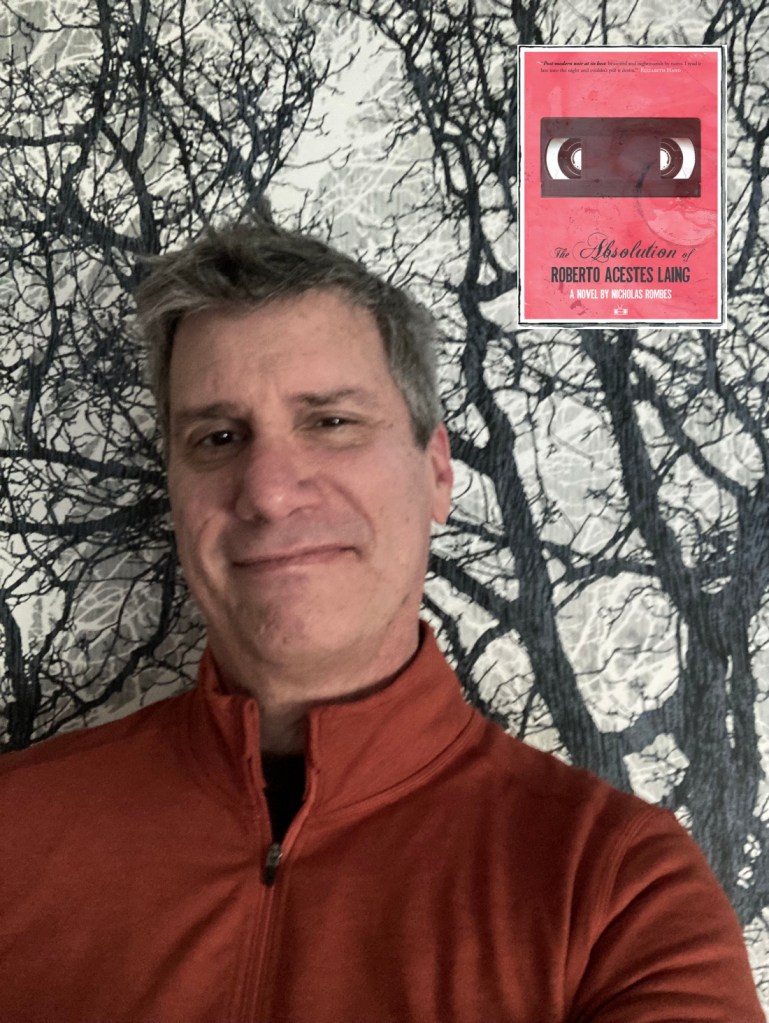
Released just over a decade ago, the mystery of The Absolution of Roberto Acestes Laing from Nicholas Rombes only deepens. In the mid 90s, a journalist tracks down and interviews a rare film librarian who once burned a stockpile of film cannisters and disappeared for many years. The head-twisting neo-noir follows Laing’s descriptions of these lost, inherently evil, films. I spoke with Rombes over Zoom about the novel, the influence of Lynch, and his many writings on music and cinema. Afterwards, I sent some questions over which we completed by email.
Matthew Kinlin: In the first few pages of The Absolution of Roberto Acestes Laing, the chair that Laing is sat upon and being interviewed by our narrator is described as, “reupholstered recently in blue velvet.” Can you speak about how you first encountered David Lynch’s Blue Velvet and the impact it had?
Nicholas Rombes: I was an undergrad at Bowling Green State University in 1987 when our nonfiction creative writing class professor told an anecdote about his bitter divorce, and in telling this would mention that he’d recently rented a film called Blue Velvet, the most remarkable thing he’d seen since Apocalypse Now. He probably rented it at Video Spectrum on Washington Street, a few blocks from our apartment, where they stamped your membership card with bright red lips for each rental until you got to your tenth rental, which was free. His anecdote involved a barn at night in Nebraska that he wandered into (I don’t remember how he got there) where he witnessed a cow in the act of its slaughtering and where, he said, he stood stunned as its heart was removed. In class he held up his arm and, shaking his fist gently as if he was holding his own heart there, said this is what my wife did to me, tore out my heart. Of course, I was hooked, and rented the film soon thereafter. He said Blue Velvet made him feel like he felt in that barn that night. Like many others, I thought the film expressed a vision of the world that I hadn’t seen before, one that preserved the very mysteries its plot was trying to solve. Its humor (the coroner: “I don’t recall anything coming in minus an ear”) felt authentic to lived experience that squared with the sort of Midwestern pragmatism and flatness. Plus, there were so many rewatchable parts, little set pieces that worked almost like distinct music videos. And as I got older, I discovered new folds within folds in the film.
MK: In Blue Velvet, teenager Jeffrey Beaumont tells Sandy Williams, “I’m seeing something that was always hidden. I’m involved in a mystery. I’m in the middle—of a mystery. And it’s all secret.” In The Absolution of Roberto Acestes Laing, we listen in on a series of descriptions from Laing about various disturbing films that have since been destroyed by him, incinerating them inside their metal cannisters. Their absence deepens and expands the mystery. What is your relationship to lost films and can you describe their pull?
NR: Everything everywhere all at once. If everything is available all the time at any moment with a few keystrokes then what happens to what Walter Benjamin called aura, the specialness, the uniqueness of a work of art in its specific time and place? Of course, it’s a bit romantic to pine for obscure, hard to find films or books or music or art. But when there are so few mysteries left in the world maybe it’s vital to preserve some spaces for the unknown, the undiscovered. The Laing novel embraces this romanticism which, I hope, is countered by a sense of danger and even cruelty. The films, for the most part, that Laing describes are not happy films. He is not a well person, and part of his journey into these lost films is an act of exorcism. Chased by personal demons he finds solace in his project: tracking down lost or obscure films, or people who know about them and who can describe them for him.
MK: Fred Madison in Lynch’s Lost Highway explains to two detectives visiting his home, “I like to remember things my own way … How I remembered them. Not necessarily the way they happened.” In the novel, we as readers are subjected to the reconstruction of Laing’s memories where moments of these destroyed films are implied, edited, erased. How does memory operate in the novel?
NR: Are memories based on recalling past events out of the blue, or are they based on photos, videos, and other recordings? What parts of memory are automatically edited/enhanced/erased through the act of recall? What’s the relationship between memory and truth? In a sense we are all first-person narrators of our own life stories (“You won’t believe what happened to me last night …”) and yet we see ourselves from the outside, too. One of the fascinations of Lynch’s films is that they don’t respect the boundaries between interior and exterior experience. They aren’t narrated in the traditional ways that most films are, such as first person (Steven Soderbergh’s Presence or The Blair Witch Project) or third person in all its variations, with the camera being the de facto narrator. It’s difficult to detect when we are inside or outside of a mind in Lynch’s films, especially Lost Highway, Mulholland Drive, or Inland Empire, and even Blue Velvet to some extent (does everything exist only in Jeffrey’s dreamworld from the moment we enter the ear near the beginning until near the end of the film when the camera slowly pulls out of Jeffrey’s ear as he’s lounging in the sun in the backyard?)
MK: The Absolution of Roberto Acestes Laing plays with time; the films are described in present tense, whereas the narration is past. At one point, Laing is seen shuffling through some papers with, “The blank intensity of a person teleported back and forth through time so often that his very self becomes stretched into something that exists both then and now.” What is this queasy relationship between then and now; or past and present?
NR: There’s a short story I really love by Sarah Hall called “Naomi” that begins: “When I was eight, my mother died and Naomi arrived.” It turns out this is the same person, just someone who seemed to change for the narrator from the mom she knew as “Mom” to Naomi (her first name) after her illness. Near the end of the story, as the narrator is reflecting on this change, her instructor (she is studying art, as an adult, in Japan) tells her that her mother couldn’t have changed, that identity is singular and unchanging. The narrator’s feeling that something happened to her Mom after her illness (she wasn’t the same person) is incorrect. But then the last line is this from the narrator: “It had seemed, then, such a beautiful denial of concept.” Does this line refer to the way the narrator used to think of her mother pre- and post-illness (as two separate people) or does it refer to her instructor’s philosophical claim that there is only one, singular identity and that, by implication, the narrator’s mother didn’t “change” at all? I’m afraid I’ve completely talked around your question!
MK: In another moment, the narrator notices a tattoo on Laing’s neck of a film projector shutter and thinks how, “The brain needs to be tricked into seeing still images as moving images is something that actually breaks the continuous motion of images… this darkness that comes between us and the images we want to see.” Frank Booth standing inside a Francis-Bacon-pink-black room, mutters, “Now, it’s dark.” What does darkness offer and what is accessible through it?
NR: I come from a fundamentally religious family from the American Midwest. Maybe religious isn’t the right word as it can be suggestive of narrow-mindedness. Spiritual is better. Spiritual in the protestant Christian tradition. We were members of the Baptist church until my sister died and then began attending the Methodist church where I served as an acolyte. Growing up in the 1970s in that family and in that community we believed—fundamentally—that darkness was real. Evil was real. Satan was not a myth or a metaphor but an actual being who was chained in a pit for 1,000 years, after which he became free to be in and of this world. We prayed to God for deliverance from temptation and believed and strove to be in this world but not of it. I could give examples of how this played out but they would seem petty now and are embarrassing. However, there was also a deepness and a complexity to all this, one that made me feel I was a non-conformist in many ways. Our belief in a world beneath this world (beneath the grass, the beetles) subject to forces that transcended human agency was so deeply ingrained in me that that’s probably what led me theorists like Terry Eagleton, Derrida, and Foucault in graduate school, as they also deconstructed the world, albeit from a secular direction. “For now we see through a glass darkly, but then face to face,” from Corinthians was a way of thinking that squared with postmodernism’s suspicion about meta-narratives and ideology. “The fully enlightened world radiates disaster triumphant.” Thank you, Horkheimer and Adorno.
MK: The films that Laing describes are cold and evil: the discovery of a Nazi uniform in a wardrobe, a red line dividing the screen. There is a sense of invasion that we as viewers, and readers, are vicariously becoming complicit with. At one point, the narrator describes, “A sort of absence that is so seductive and so powerful that to look upon it is to corrupt a part of your soul.” What is this supernatural and abhorrent force we are slowly encountering?
NR: There’s a film critic I love, André Bazin, who helped pioneer the art of film criticism that blended close analysis and philosophy and aesthetic appreciation. He was a champion of the unbroken long take (Orson Welles) as opposed to montage, or aggressive editing (Sergei Eisenstein) in part because the long take with no cuts respected reality, the reality of the created world, God’s created world. This deeply spiritual way of understanding representation—how to depict the created world without dishonoring it—supercharged Bazin’s writing. In “The Evolution of the Language of Cinema” he describes the director Erich Von Stroheim this way: “He has one simple rule for direction. Take a close look at the world, keep on doing so, and in the end it will lay bare for you all its cruelty and ugliness.” Bazin takes the methods of editing so seriously! They are not just tools to tell a story, but maneuvers for revealing a larger hand at work. Implied in his writing is a danger, the danger of looking, which is what cinema is all about. To look too closely is to become corrupted.
MK: Laing holds a malevolent gravity in the motel room; the objects of the motel room almost seem to orbit him as their uncanny epicentre. At one point, Laing’s face looks, “like that of a man that expects Satan himself to appear in the doorway.” He is like a possessed scarecrow at a crossroads, communing with spirits through his bourbon-fuelled words. What is his terrible power?
NR: I love the scarecrow analogy. For me, Laing’s terrible power is that he—like the directors he admires—sees himself as an auteur. To be an auteur you need a fantastic ego and a kind of obliterating confidence. There’s that Emerson quote: “To believe your own thought, to believe that what is true for you in your private heart is true for all men—that is genius.” I think of Orson Welles and maybe even Terry Gilliam, and certainly the late-period Francis Ford Coppola. But Laing actually has no power, or else he has a power that can’t be expressed in its familiar exercises. He controls no one, he doesn’t make films, he doesn’t write, he’s not an influencer except in the smallest of circles. He’s a void. Like the scarecrow you mentioned, his power is symbolic.
MK: Throughout the novel, you present different genre tropes in the films described; Antonioni paranoia, Lynchian horror, 1940s caper, science fiction. How did you decide on these varied styles?
NR: Laing is an omnivorous devourer of films. He and I are in agreement that even the “lowest” of genres, like found footage, can be great art. Truth obliterates categories like high and low, and each of the films in the novel are truthful in that there is something about them that pierces through platitudes and conventional ways of representation. There is a secret core to each of these films—a kind of hot spot—that makes its presence known even if it’s undetectable. I also been reading about the Hollywood Production Code during the writing of the novel and was fascinated how so many of the films that were subject to censorship—Gun Crazy comes to mind—managed to be subversive. In film noir, for instance, the femme fatale (who usually dies at the end) is often the character we really identify with. As sophisticated and the Jesuits who wrote the Code were, they overlooked the fact that plot (making sure the right characters are rewarded and the wrong characters are punished) is only one level at which films operate.
MK: The lost films have some great titles, particularly The Murderous King Addresses the Horizon, which includes the image of a film still and then builds up all these violent meanings on top of it. Can you speak about the decision to include this visual piece and its haunting effect?
NR: I can’t remember if I’d read Thomas Ligotti’s story “Gas Station Carnivals” at the time of writing Laing, but I’m convinced it’s one of the best story titles ever, as well as one of the best stories ever. Subsequently, I’ve come to associate The Murderous King Addresses the Horizon as the title of a film, with “Gas Station Carnivals,” as the title of a story. I believe I discovered that photo somewhere in the Library of Congress’s vast online Moving Image Research Center, though I may be mistaken. That site led me to the Paper Print Film Collection:
Because the copyright law did not cover motion pictures until 1912, early film producers who desired protection for their work sent paper contact prints of their motion pictures to the U.S. Copyright Office at the Library of Congress. These paper prints were made using light-sensitive paper the same width and length as the film itself, and developed as though a still photograph. Some motion picture companies, such as the Edison Company and the Biograph Company, submitted entire motion pictures—frame by frame—as paper prints. Other producers submitted only illustrative sequences.
This is a long quote, but who knew of such things? Submitting entire films, frame by frame? This in itself is an act of obsession, if not violence. To be honest, reading about these paper prints terrified me, and I wrote the Murderous King section in the grip of that fear.
MK: The motel in The Absolution of Roberto Acestes Laing offers a lonely and liminal site for Laing’s reconstructions. It took me to the motels dotted along the highway at the end of Twin Peaks: The Return, where Dale Cooper and Diane Evans are driving towards an Edward Hopper kind of purgatory. What are motels like where you are from?
NR: I love the connection you make to the Twin Peaks: The Return episode. I teach in northwest Detroit on McNichols Road, otherwise known as 6 Mile Road, south of the 8 Mile Road made a little bit famous by the Eminem film 8 Mile. This is the stark dividing line between Detroit and the suburbs to the north. Along the road are some great older motels, just small buildings with tiny parking lots where you pull up right in front of the door. I’ll call them seedy motels that rent rooms by the hour, but what do I know? I sometimes read reviews of these motels on Yelp and other places:
The room reeked of cigarette smoke. The bed was small and the cover had holes and snags in it and it did not smell like it had been washed. The AC did not work and the windows were nailed shut.
Here’s another one:
The walls were a seedy sea-green. The paint job was sloppy. The bedding and sheets had cigarette holes. The towels were few and small.
I’m honestly not sure why I set the motel in Wisconsin instead of Michigan. It might have something do with not wanting to align the novel too closely to where I live and work. A bit of distance. But I was inspired by those 8 Mile hotels for sure.
MK: The novel ends of a sincere note. Laura Dern, as Sandy Williams in Blue Velvet, describes her dream where, “All of a sudden, thousands of robins were set free, and they flew down and brought this blinding light of love.” How do you relate to this balance of light and dark?
NR: I think we both appreciate the open and vulnerable sincerity in Blue Velvet, as it makes the pain and darkness all the more awful. Sandy’s heartfelt, lay it-all-out-on-the-table monologue about the robins puts everything at stake. I think this is what distinguishes Lynch from other auteur directors of the same vein like Nicolas Winding Refn, although Drive has its moments that play very close to the sincere/ironic line. I wonder if the fact that Lynch didn’t really hang around with Hollywood folks preserved something in him, some pure vision that goes back probably to his childhood and to his art school time in Philadelphia.
MK: You have written extensively on punk music, specifically The Ramones. Can you speak about what you relished in the research, writing and the inherent contradictions you found in the business of punk?
NR: The Ramones book is part of the 33 1/3 series of short books on single albums. Mine, which came out in 2006, is #20; I think there are around 200 now. I was fortunate to have noticed the series before it caught on, reaching out directly to David Barker, who came up with idea for the series and was its editor. I loved the research that went into that project, collecting obscure alternative newspapers, fanzines, and ephemera from the period surrounding that first Ramones album, whose demos had been recorded in 1975. What surprised me most was the contradictions surrounding the band and their music. While we usually associate punk with a DIY, anti-corporate, deliberately marginal attitude and sound, the Ramones really saw themselves as a top 40 band and wanted a hit. The album was professionally recorded, produced by Craig Leon. And of course, the album itself, although quite aggressive, is also really melodic and even sweet at times, especially songs like “I Wanna Be Your Boyfriend.”
MK: You co-edit TIMECODES from Bloomsbury with Nadine Boljkovac; a series of books offering minute-by-minute analysis of a single film. Can you explain the ethos behind this slow approach to cinema?
NR: I find the tradition of using formal constraints as a spur to creativity, such as Oulipo, Brian Eno’s Oblique Strategies, and the “Vow of Chastity” cooked up by Lars von Trier and Thomas Vinterberg as part of the Dogme 95 movement, to be so exciting. In academic film studies—and maybe humanities academia in general—you tend to have a thesis or a governing idea and then go in search of evidence in whatever you’re exploring: books, movies, the historical record, etc. This path-dependency can be stifling, as you often have to shoe-horn really complex works of art into oddly narrow and restrictive thought structures. For instance, if my general thesis/project idea is something like “David Lynch’s films blur interior and exterior realities” well, then, I’m going to find x number of examples to prove my point. But so what? To what end? (The answer: to get published, to get tenure.)
A constrained approach doesn’t solve all these problems but it does open up space for chance, randomness, and risk. Rather than seeking out the parts of a film that support my argument, I’m willingly forcing myself to take the film, more or less, on its own terms. If I’m truly open to the film, who knows what I might find? It also forces me to sit with parts of the film that, on their surface, aren’t that interesting. Boredom is underrated.
MK: The first book in the series was one from yourself, a reading of Gus Van Sant’s Gerry, which is a kind of Waiting for Godot in the desert, about two friends hiking, both known as Gerry. What drew you to this film?
NR: I was committed to writing a book about a film where nothing happens and, on top of that, a film with long stretches of literally no plot, no narrative momentum except two guys walking in silence. There’s a 7-minute sequence like this and I wondered: what could I possibly say of value about each of these minutes? I loved the film but wasn’t sure why I loved it. On the one hand it felt like a European art film while on the other it was funny in parts, alive to the sparks between two people that are part of the alchemy of any friendship. The sound design is also subtly terrifying, these dim, low-intensity metallic noises and rumblings. It turns out parts of this were sourced from the old Tomb Raider video games, which was a surprise to me. Ultimately, I was curious about why certain films stay with us, why we keep walking with them, so to speak. To answer that question, I needed to write Gerry.
MK: Lastly, if you could write a deleted scene for Blue Velvet, what would happen?
NR: I’ve always been curious about Mike, Sandy’s boyfriend, who appears only briefly a few times. The scene I’d write would involve Mike crying, just as Sandy does.
INT. MIKE’S BEDROOM – NIGHT
Mike is slouched in a red beanbag, his back against a wall. His hair is tousled. Dark circles under his eyes. He’s been crying. He holds a framed picture of him and Sandy at their high school prom.
MIKE (to himself)
Stupid, stupid! Why are you so stupid!
Mike starts bawling again. He angles the picture so his own face is reflected in the glass of the frame. He’s really sobbing, barely able to choke out the words.
MIKE (to himself)
Sandy I don’t understand! Sandy I want to go back.
Can’t we just go back? Sandy please, Sandy please . . .
Matthew Kinlin lives and writes in Glasgow. His published works include Teenage Hallucination (Orbis Tertius Press, 2021); Curse Red, Curse Blue, Curse Green (Sweat Drenched Press, 2021); The Glass Abattoir (D.F.L. Lit, 2023); Songs of Xanthina (Broken Sleep Books, 2023); Psycho Viridian (Broken Sleep Books, 2024) and So Tender a Killer (Filthy Loot, 2025). Instagram: @obscene_mirror.
Check out HFR’s book catalog, publicity list, submission manager, and buy merch from our Spring store. Follow us on Instagram and YouTube. Disclosure: HFR is an affiliate of Bookshop.org and we will earn a commission if you click through and make a purchase. Sales from Bookshop.org help support independent bookstores and small presses.
 Heavy Feather Review