
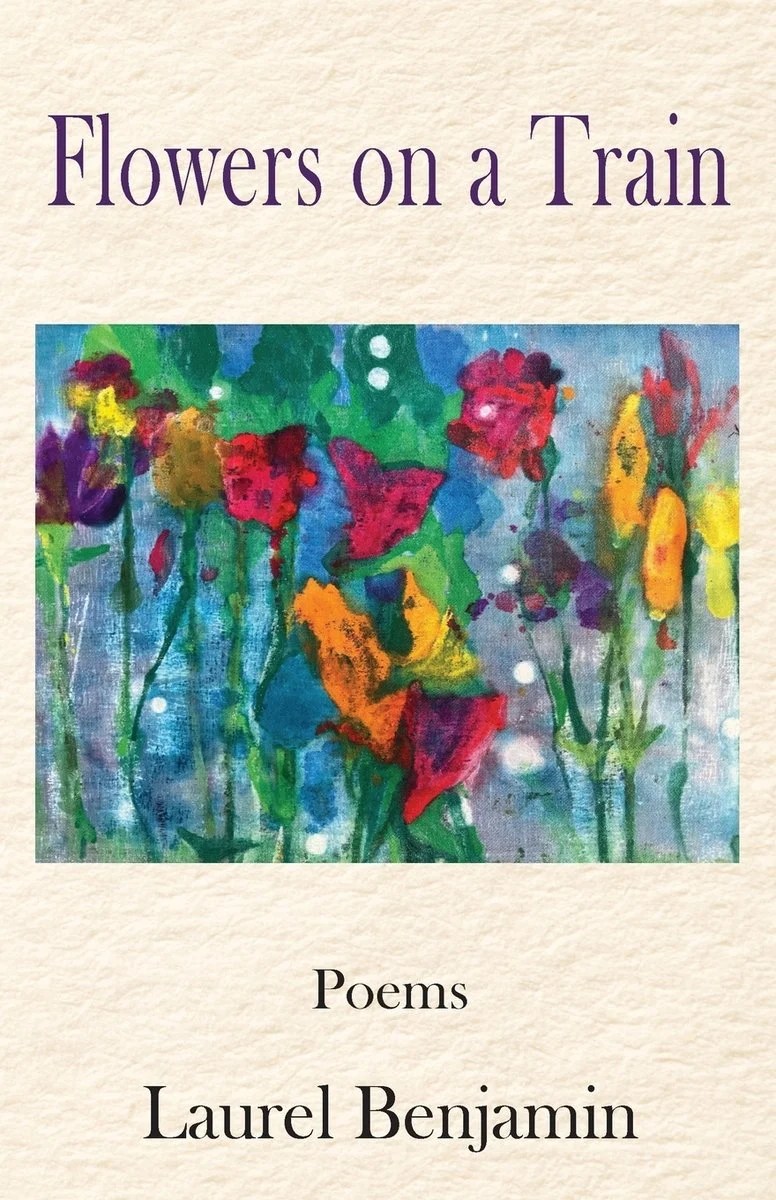
In her debut poetry collection, Flowers on a Train, Laurel Benjamin reminds us of what’s possible if we are willing to revisit broken relationships and allow something else to blossom in their place. As the collection’s title suggests, nature permeates these pages. While we might be tempted to assume these will be nature poems, they are, in actuality, landscapes of the self in the world. That world, for Benjamin, revolves primarily around the San Francisco Bay Area but also extends to New Jersey, Hawaii, and elsewhere. It’s a place brimming with family stories and everyday moments.
Benjamin is an astute observer whose quest for reconciliation leads her to reexamine relationships and self. Her parents’ deaths set in motion the central questions of the collection, and the poems are unwavering in their search for glimmers of meaning and hope. The result is a rich mosaic of insights into forgiveness, human frailty, and connection.
Benjamin begins her exploration by looking at childhood. The poem, “Visionary,” for example, considers parental constraints. In the poem, the speaker and her brother sneak outside to stargaze in order “to avoid [their] parent’s radar”—the father’s scrutiny and the mother’s expectations. The speaker asks:
What did we fear—
father’s analysis, the Rorschach blots,
mother’s card catalog schedule
and neatly buttoned shirtwaist dresses
slipping us into slots?
These precise portrayals capture the childhood predicament. The “slots” prove difficult to escape and to do so requires courage and the vision alluded to in the poem’s title.
The poem, “While She Blotted Her Lipstick,” presents a different perspective. Here, Benjamin explores regret. The speaker, a daughter, longs for emotional and physical closeness to her mother. Surprising imagery and evocative word choices create a telling maternal portrait. In the poem, the mother delivers the “lunge of a scorpion” rather than praise. The speaker says, “I wish she had ceased-fire the missiles she couldn’t resist / so I could rest my hand in hers before the stroke, not after.” The tenderness of hands takes the place of the destructive missiles but can’t undo the damage. Intimacy comes too late.
In the book’s penultimate poem, “Inside Bird,” a daughter searches for acceptance. This poem is among the collection’s most lyrical. The title introduces the central image: a blown glass bird ornament. The ornament belongs to her mother and gets broken by the cat. The rare glass bird, however, represents the daughter, who says:
[My mother] built a home of vases and glass,
shelves to see through to outside birds
but did she hear the inside cooing bird,
did she imagine the glass bird could fly?
The cooing of the inside bird evokes the feeling of lament. The final couplet, introduced by the word “but,” makes an important turn to two unsettling questions, both unanswerable. Did her mother hear the cooing but ignore it? Did she appreciate her daughter as a person in her own right?
The collection wisely and elegantly concludes with the titular poem, “Flowers on a Train,” which is among my favorites. Here, Benjamin shifts our attention to two strangers, two women who are riding a train. The poem’s speaker, one of the women, observes the other woman crying while “flowers fall off [the woman’s] shirt.” Empathy arises as the speaker recalls that she, too, has cried. Benjamin concludes this poem and her collection with these visually astute lines:
Do you see me
a few seats away—
your flowers crawl
up my legs thick velvet pilesilent wet.
The lines are constructed as a question but one devoid of a question mark. They become an appeal: “see me.” This appeal is addressed to the other woman although I can’t help but wonder if the speaker isn’t ultimately addressing herself. It is no accident that the words of this poem fall down the page like flowers. The flowers symbolize the reconciliation the speaker has been seeking all along. The poem assures us that human connection can happen anywhere, even on a train, and with anyone, even a stranger.
Flowers on a Train is a masterful collection of gorgeous poems that transports us through a landscape unique to Benjamin’s experience and poetic vision. Each encounter with the self and the world reveals one more possibility for how to navigate the boundaries of loss. Benjamin invites us along on this journey. She offers no certainty about how the journey will turn out. But there is wisdom and hope. The collection reminds us that beauty and repair can happen if we embrace our hunger and see our lives and ourselves anew.
Flowers on a Train, by Laurel Benjamin. Los Angeles, California: Sheila-Na-Gig Editions, August 2025. 92 pages. $16.00, paper.
Sandra Fees is an ordained Unitarian Universalist minister, living in southeastern Pennsylvania. Her first full-length poetry collection is Wonderwork, published by BlazeVOX Books (2024).
Check out HFR’s book catalog, publicity list, submission manager, and buy merch from our Spring store. Follow us on Instagram and YouTube. Disclosure: HFR is an affiliate of Bookshop.org and we will earn a commission if you click through and make a purchase. Sales from Bookshop.org help support independent bookstores and small presses.
 Heavy Feather Review