
In her debut novel, Hollay Ghadery blends a refreshingly unique premise with a natural gift for voice, delivery, and cutting straight and deep, deftly exploring the roots of grief and pain, internalized shame, isolation, and self-disregard. In tracing these headwaters, she reveals how we make it all bearable, somehow. And more importantly, what the elusive secret thereof boils down to.
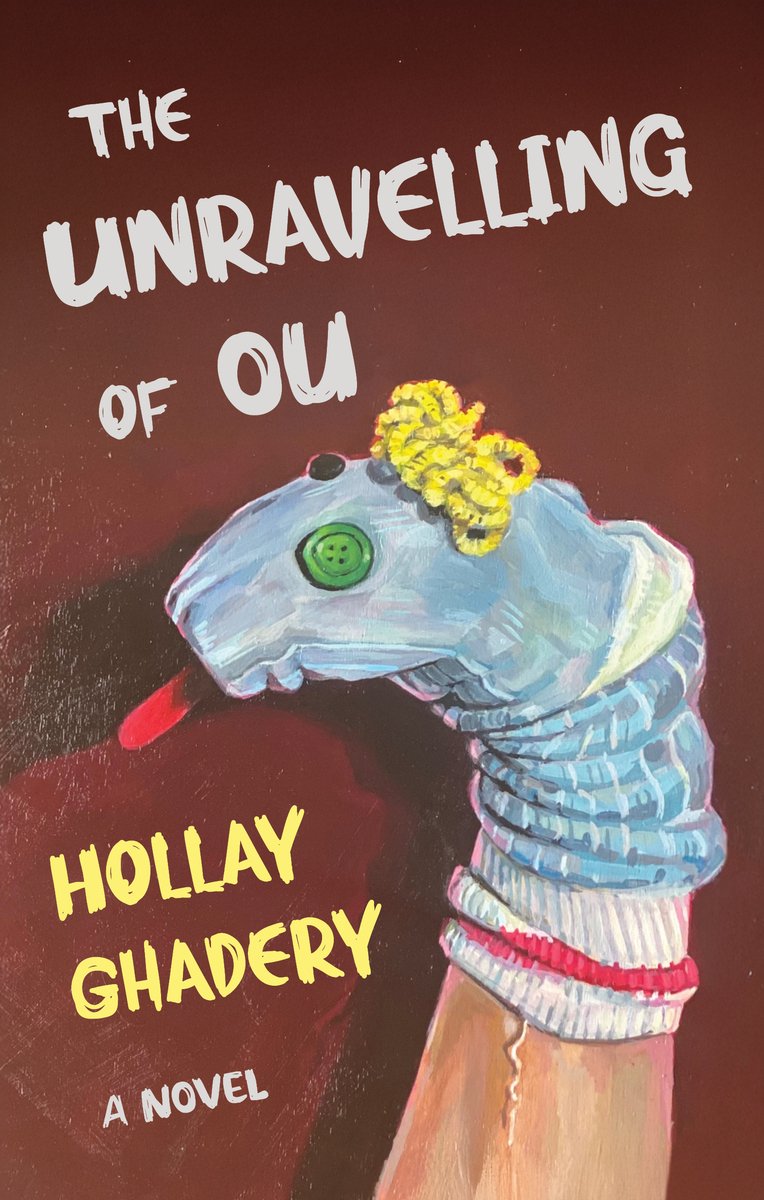
The Unravelling of Ou takes us through the life of Minoo, told through the eyes of a homemade sock puppet named Ecology Paul (no, I won’t explain the origin of this appellation—personally, it was one of my favorite moments in the whole book). Bouncing between the present—where we witness the nadir of Minoo’s relationship with her daughter, Roya—and her past, we learn from Ecology Paul’s perspective how defining moments made Minoo into the person she is today: principally, moments with her own caustic, critical mother; her childhood in Iran and later Canada; and her son, conceived when she herself was not much more than a child, and raised by Minoo’s mother in Iran, not knowing who his real mother is.
Her upbringing in a conservative culture with especially restrictive attitudes toward women notwithstanding, the sources of Minoo’s internalized shame and repression can be traced to comments by her mother at formative moments. These words that infect and warp, often permanently, our very self-perception and self-concept:
I don’t care how hot it is. Cover your forearms, Minoo.
A bottom like that—like two big balls of dough! It’s indecent for your age! At any age!
And after Minoo first began menstruating, inconveniently occurring in the middle of the night:
Couldn’t you have waited for your father to leave in the morning?
And so at present, Minoo is a middle-aged woman who, more often than not, wears a sock puppet on one hand, which she communicates with and who communicates with other people. This idiosyncratic dependence has increasingly strained her relationship with her daughter over the years, with Roya growing embarrassed of and frustrated at her mother, and Minoo, unable to come to terms with her daughter’s inexplicable aversion to puppetry and feeling increasingly isolated, becoming more reliant on Ecology Paul to function at all.
It can’t be overstated just how human Ecology Paul is. Even with the full awareness that Minoo is the source of this character’s thoughts and words, I’m still tempted to hold Ecology Paul as a separately intelligent entity. EP speaks directly to us; we hear EP’s thoughts. All I can faithfully attribute that to is to the unfailingly authentic voice with which Ghadery has gifted our narrator:
Understand, Minoo was not born to performance, but she was born to loneliness, and that’s a precursor. The morning of her doctor’s appointment, while Minoo was trying to sway me from my decision not to accompany her to the clinic, I watched the light burn mist off our still quiet street. We’d lived on this street for twenty-seven years, with its Victorian red brick houses with gingerbread trim and original wood floors that were, in the case of our home, warped in places and blanketed with Persian rugs.
Naturally, the novel focuses heavily on mother-daughter/parent-child relationships. Heartbreakingly cyclical in the patterns that are often observed passing from one generation to the next, these dynamics have an indelible impact on both parent and child, rippling across the surface, little waves of pain lapping and etching far-off shores. Ultimately, like most things in life, it comes down to expectations—being able to separate desire from reality. How we want people to be versus how they are. This point is driven home early in the novel, with Ecology Paul reminding Minoo:
Roya had to learn early the same lesson you did: our mothers aren’t always who we want them to be. But that doesn’t mean they don’t love us. It doesn’t mean we shouldn’t try to love them anyway. I shouldn’t have to tell you this. Roya is upset because she loves you so much.
Minoo, take a deep breath. Now ask yourself: were you who your mother wanted?
Don’t let the sock-puppet premise fool you: this novel delves deeper into the very meaning of it all than our narrator’s unserious exterior might suggest. Far from a silly or fanciful narrative, what Ghadery has produced is an exceptionally insightful and prescient look into the human soul. Namely, how we process pain, and how that informs how we become and perceive who we are. In her formative years, Minoo never had true self-love represented for her to understand, never received the foundational, essential assurance that she was worthy of love simply for being exactly who she was:
She simply didn’t know how to fight to stay in. She had never learned to fight for the people she cared about. From a young age, she had never seen the people she cared about fight for her. At least, not for the person she was, only for the person they wanted her to be.
My biggest question before, and, for different reasons altogether, after reading The Unravelling of Ou was ”Who, or what, is Ecology Paul?” But this was the wrong question. It doesn’t so much matter what Ecology Paul is “supposed” to be or represent, but rather, “What keeps us from listening to our own thoughts?” Are we too unwilling to accept we might have the answers to our problems, or is the truth too much to hear, even, or perhaps especially, coming from ourselves? Maybe it’s, as the novel suggests, “[b]ecause saying something out loud makes it easier to bear.”
The “truth” is, of course, in and of Minoo all along. But without Ecology Paul to bring the words to life, it’s inaccessible to her. And still without Minoo to give life and voice to EP, it’s just as out of reach. Ecology Paul. So much more than a vessel; a beautiful symbiosis.
The Unravelling of Ou, by Hollay Ghadery. Windsor, Ontario, Canada: Palimpsest Press, February 2026. 200 pages. $21.95, paper.
Kevin McMahon is a writer from Illinois. He received his B.A. in International Business from North Central College, where he also studied German and contributed to the International Brecht Society’s Communications. A native of New Hampshire, he lives in Chicago’s southwest suburbs with his wife and two cats.
Check out HFR’s book catalog, publicity list, submission manager, and buy merch from our Spring store. Follow us on Instagram and YouTube. Disclosure: HFR is an affiliate of Bookshop.org and we will earn a commission if you click through and make a purchase. Sales from Bookshop.org help support independent bookstores and small presses.
 Heavy Feather Review