
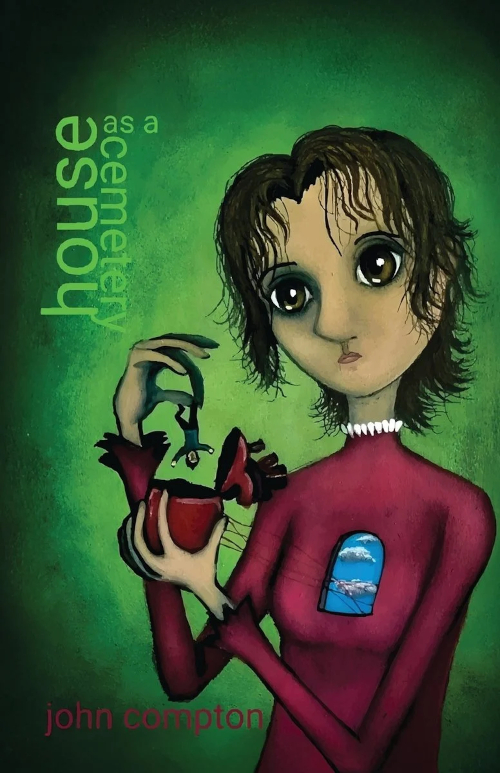
In john compton’s book house as a cemetery we find a feast of sound, of image, of dream-states that blur in and out of place and time. As with all of compton’s poetry, we are immediately in the ether, there are no strings holding the puppets, there are no intermediaries between the void and the word, there are no safe sidewalks which are not flooded at unpredictable intervals. As opposed to narrative poetry, compton begins story-less, but stories emerge as the shadows and shades fill with blood. it is a pleasure to dive into his salty soup of birth, death, longing, regret, and taut emotional tension and swim without shores and survive from what we take from our own bodies.
compton’s poetry tends to project us out of the skin into spirit, while also feeling every slice of flesh. There is a bubbling of drums and thunder, a low wet heartbeat, a whistling breath which we all hear in our own dark houses. The book opens mid-stream as expected:
“we can be beautiful again”
quavers through empty
space, the white noise,
the shapeless lips curling
around each word. we can be
beautiful again—the noun,
the adjective: a second endeavor.
Rapidly we are drawn into a liminal world, one in which words create what words cannot create. As the lips speak, the “quarry mouth / struggles / breaking into a landslide // heavy against your tongue.” There is sensuality lurking here also in the soft chaos, as “he understood the mathematical equation / referencing a blowjob. / his smile creased like a dog-ear.” Yet, as always, the sex is fraught with filtered fear: “the room has a quiet whisper— / the television behind the door. / something is dangerous to ride.” Queerness is a color and a magic here, and a foreboding spell: “the word fag is not engraved in the bones. gay is a death-sentence. that body is a funeral.”
Nothing stays rooted but is rooted in a larger ocean where all the roots go down into the depths, a returning: “i panic because there is nothing i can do to save you except wake up & return to sleep.” In its flickering and unnerving tone, compton’s work moves like a gritty movie on a rickety projector:
we dance to hollow buffalo genitalia: hard work & labor camps that pay pennies until we sweat gold & call it a cure but you throb like an elephant’s heart & all i can do is hope to remember your birthday.
The juxtaposition of birth and death pervades the book where the end is infused into the beginning: “the mortician finds all the debris, cleans the wounds, & lets you know where the dying hides. inside you like a fetus, ready to claim the embalming fluid like warm milk.”
There is a sense of dying in the middle of life, a battle with the ache and pull of declining mental health. Take, for example, “alternate names for depression”:
1) hoodwink smiler
2) but dying feels sophisticated
3) trapped in a suffocating hexakaidecagon
4) heating unit installed in a dark room brimming with mattresses
5) commitment without reality
6) unwanted phone calls forwarded to a speechless voicemail
7) shoestrings, blades, belts, straws, forks, writing utensils, sheets & pills secured in a locked location
8) foreshadowing death-notes
9) a bobber on a tranquil lake
tugged under
10) a poem, any poem, this poem
compton’s brilliance is in his candor, his boldfaced staring at the bones in the mirror, and speaking it as a medicine into the mirror and to all of us:
to remove it causes sadness but also pleasure i moan & am relieved when it falls but it is not a tree but a memory of what grew nesting of thoughts without eggs: no flower no bloom just a briefness before the dirt swallows it yet the earth will mouth us all in her throat her tongue will take our hair & teeth & make us mannequins.
He finds warmth and healing in small places as sensory detail and memory: “summer is my grandmother’s voice / asking if i’d like a bowl of chili.” He makes small leaps toward the light among the closed doors. In one of the last poems of the book, titled “emily dickinson,” he explains how to lose and then find our identities, even in a present climate which seems to nullify hope and crush our sparkle. Although he begins lost, he is never masked or erased:
so they washed their feet
for their journey ahead
covered themselves in sheets
until their bodies were hidden
and names erased:
later found.
In house as a cemetery compton voyages into the terrifying underworlds of self and brings back wonderful and strange threads to weave into this shimmering river and share it with all of us. I, for one, am thankful for his vision and his bravery.
house as a cemetery, by john compton. New Orleans, Louisiana: Queer Mojo, March 2026. 158 pages. $16.95, paper.
Scott Ferry helps our Veterans heal as a RN in the Seattle area. His most recent books are 500 Hidden Teeth (Meat For Tea), Sapphires on the Graves (Glass Lyre), and dear tiny flowers (Sheila-Na-Gig).
Check out HFR’s book catalog, publicity list, submission manager, and buy merch from our Spring store. Follow us on Instagram and YouTube. Disclosure: HFR is an affiliate of Bookshop.org and we will earn a commission if you click through and make a purchase. Sales from Bookshop.org help support independent bookstores and small presses.
 Heavy Feather Review