
The yolk was orange and soft and it ran over the white, ruining the egg’s sun in the middle. The light was glaring outside the kitchen window, where I sat at the table facing Tehran’s dry ranges in the horizon. It was my first morning in the country, still jet-lagged. I was back for a short visit, after eight years, and was staying with my aunt as my parents had left by then. Tehran was still. The air stagnant under the heat of early afternoon. A flock of pigeons dozed on the ledge of the roof across from me. All grey except for one, white despite the smog.
The yoke was runny around the plate. An orange line now encircled the white, like a danger sign. I didn’t move. I let it run. I let the glare pour over my face. Sarah, dear Sarah, I started to remember. I was becoming one with the heat.
We were on the rocks, right around the first refuge looking for her white headscarf soiled with brown or red or a mix of the two—a shade of orange. Her leg was sticking up when we found her, caught on a brittle tree. We could not find her shoe. It must’ve tumbled down to the bottom of the cliff. The dry earth and rocks were always sliding down under our trekking shoes. The stones bouncing off each other sounded like drizzles.
We had to lean towards the mountain to keep from falling. Sarah knew that. We had done this many times before. Her legs were long and skinny. We worried they couldn’t bear her weight as she sprinted from one landing to the other. She was faster than all of us. She removed her headscarf as soon as we hit the gravel path. Her short brown hair caught the wind, standing up straight on her head. Then one could see her almond eyes with the thick eyeliner she had drawn on the short bus ride. Her hands were steady. Lots of practice, she said.
We all called her name, “Sarah, stay where we can see you!”
God knows how many times I called her name. My face to the hazy sky, on every stone at every steep turn, even as I kneeled by the cliff, my chest close to my knees. I called for her down where a narrow stream carved its course into the dry orange-brown soil, leaving patches of green here and there. I called until every time I opened my throat nothing but her name flew out like a tiny bird.
We never found her other shoe.
The Blue Refuge was the first stop, where you could get fresh water bubbling up of small springs within the rocks. From there the path became more narrow and steep. It circled around the mountain with sharp curves that grew more and more difficult to climb, especially without proper equipment and a guide. We had never made it to the second refuge.
Where we found her, there was an exceptionally bad drop. “The dryness didn’t help,” the guides told us. “It made the slope very slippery. She probably couldn’t latch on, but we’d never know for sure. Not without an autopsy.”
There were three of them and three of us. We hadn’t called the cops. We wanted to find her first. Her father was adamant they would arrest her if she was still alive or worse, not release the body back to the family.
“You never know with these bastards,” he had said, pacing around the parking lot where we first huddled with the search guides. They all had neck covers and their foreheads were peeling. They wore long khaki socks under their trekking shoes. They showed us the map, although those of us on the trekking team already knew. They gave us poles and whistles and flashlights.
“We have to leave early,” they said, “and be vigilant.”
“You have the whistles. We will spread out but never lose sight of each other. The mountain has many secret places,” they said. “We cannot leave any stone unturned.”
When they said it like that, I glanced at Sarah’s father. His face didn’t flinch. He already had his fist ready around the pole, his knuckles paling under the pressure. No one dared to ask where Sarah’s mother was.
Her father didn’t make it to the Blue Refuge. He sat on a rock, hands on his knees, trying to catch his breath. I kept turning back to look at his hunched body sticking out of the earth. He had unbuttoned his shirt and the sweat on his chest gave the soil on his white undershirt an orange shade. As we moved higher up, he became smaller. His figure gathering more dust against the mountains—an unfinished sculpture.
The day before Sarah went missing, I had picked her up from their building. We both lived in gated apartment complexes in the margins of the city at the foot of the Northern ranges. Their building was newer with a white stone exterior that shone under the sun. I had never been inside.
She closed the metal gate with a loud bang behind her. Her eyes were red and puffy.
“Why were you crying?” I asked.
She held her palm up flat between us. “You think they sell individual cigarettes at the kiosk?”
“Cigarettes again?” I said, trying to catch up to her.
“Are you coming or not?” She yelled, “If you’re gonna be so slow, life’s not gonna wait for you, you know! And you’re not gonna catch any boys—that’s for sure! Like that neighbor boy you fancy—what’s his name? Idin?”
I walked faster. I liked boys. Boys were fine. I had even held hands with Idin. But I also enjoyed watching Sarah’s pink lips gather around the cigarette to suck in the smoke as if it was the only thing in the world between us.
“Let’s go trekking tomorrow,” she said, lighting up another one for me. We were sitting on the shady part of the grass across from the playground, where two little girls were on the same swing, one sitting down, the other standing above her with her legs spread. We let our headscarves fall down on our shoulders.
The next day at dawn we were on the bus. From where we lived, it took us only fifteen minutes to reach the trailhead. The path started off easy and flat, turning more narrow and steep as we hiked. As the climb became more difficult, it was also less and less maintained, which meant less people and hopefully no morality cops and we could remove our headscarves completely, unbutton our long overcoats, let out chests feel the fresh mountain air. Sarah had already dressed down to her tank top. I was more cautious.
On that day, we made it to Blue around ten in the morning and ate our sandwiches. It was a small shack with tables and chairs and deep holes in the ground for toilets.
“You know what I want?” Sarah said, her face close to mine. She was drawing eyeliner for me. I could see the tip of her cleavage from under my nose.
“You mean beside my raisin cookies?” I said, moving only my lips. She laughed, hitting me in the chest.
“I share everything with you bitch!”
She was right. When she got boys’ phone numbers by the school entrance, she always shared them with me. I never called but she claimed she lost her virginity to one of them. I knew she was lying, but I asked her for details anyway. I could imagine her naked. I had walked in on her in the shower before. So pale, her body was almost pale green. If I closed my eyes, I could see her breasts, too large for her skinny waist. One time she let me touch them.
“I wanna make it to the second refuge by sunset. Wanna come with me?” she whispered.
I frowned. “You know we need a guide for that! Or a parent at least!”
Her face turned serious. She didn’t like it when I shut her down, or when I brought up parents.
“You want your parents, little baby?” she mocked me. “When are you gonna learn, Maya? Our parents cannot do shit for us. We’re on our own.”
“Fuck you!” I hissed, my face so close to hers because I still had one more eye to be lined.
Those were my last words to her. After she painted me, she put on her backpack with her headscarf tied to the straps and her top shirt wrapped around her waist, and she headed out to the narrow path that curved above the shack and disappeared behind a rock.
I called her name, even followed behind her for a few steps. But my legs were aching from the morning climb and she had vanished. I felt so alone without her. The mountains were suddenly daunting. They grew on you. You thought you conquered one summit and another one would appear right behind it. And when you thought you were high enough to be undisturbed, some rifled men would show up to follow you. And you had to be quick with the head-cover because there were rumors about what they would do to girls like us. We heard the hungry wolves and stray dogs in herds as the night drew closer. No matter how much you might scream and wail, we knew no soul would be there to hear you.
I was so scared, I ran back down the mountain.
We found Sarah’s body near sunset. The sky was orange. I had lost my voice a long time before that and my lips were cracked. I could not feel my toes—in the days that followed my nails turned various shades of purple and fell off. I didn’t care. I chain-smoked out my window without coughing.
The climb down was going to be riskier in the dark so we had to act quickly. We formed a human chain down the slope until one of the guides pulled Sarah’s body up by the ankle— the shoeless one that was sticking up. I twisted my face away. I heard her skin had become clay-like.
“It’s freezing at night and dry like an oven in the morning,” the guides explained.
“She could’ve fallen, but we’ll never know for sure—maybe she jumped or was pushed.”
“We see all sorts of things in these mountains, but no one does autopsies these days anymore. They prefer not to know.”
They talked and talked as they wrapped her stiff body in a tarp and helped one guide tie her to his back and set out downhill.
“We’re lucky we found her,” they told us. “One time we searched for ten days straight.”
“The mountain likes to keep its secrets,” they said.
She didn’t weigh much but the guides had to take turns carrying her anyway. They said it was the high altitude but I believe it was the weight of death that was heavy on their backs.
The orange from the fried egg was drying on my plate. I sprinkled salt on it. My aunt had left a fresh pot of brewed coffee for me before leaving for work. She had asked me to stay with her on this visit. It was too quiet in her apartment, she told me, now that the kids had left the country and only returned a couple of times a year. She said it was like a part of her had died. Every year, it became harder for them to come back to visit. It was the distance, the smog, the noise pollution that entered your brain and stayed in the dead of the night. My aunt was right. Parts of us were dying, year after year.
I left the plate and took another nap. I ate some of the egg afterwards with cold coffee. I was relieved when I heard the keys turning in the door.
“Auntie, is that the living room lamp buzzing?”
“No dear, I don’t hear anything. Maybe it’s the street lamp by your window.”
My aunt had crazy curls that had turned completely white. She painted her cheeks a pink hue that made her look blushed, even when she was dozing off on the couch. We always had tea and biscuits together after her work.
“I think someone is just banging behind my wall, like with a hammer.” The tea was steaming. “Who would do such a thing?”
“It’s the pipes. They clink clank all year! They have air trapped in them.”
“It’s not letting me sleep.”
“Put a pillow on your head.” When she sipped her tea, her eyes disappeared behind the rising vapor.
“These thoughts just pop into my head,” I told her. “Even the pillow doesn’t help.”
She offered me her lorazepam to take the edge off. I took it, with hot tea.
It felt good, I told her, growing old together. She laughed. I could see tears sparkling in her eyes because it was not true. None of us were growing old together. Not us. Not she and her kids. Not me and the mountains with all their orange soil.
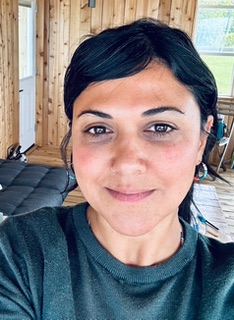
Mehr-Afarin Kohan is a Toronto-based writer. Her fiction appears in The Missouri Review, The BLR, The Citron Review, The Los Angeles Review, Malahat Review, and Necessary Fiction, among others. Her flash fiction was selected Best Small Fiction 2021. Born in Tehran, Iran, she immigrated to Canada as a teenager. She is a psychiatrist and psychoanalyst by profession. She currently lives in Toronto with her family that includes her young daughter. More: mehrafarinkohan.com.
Check out HFR’s book catalog, publicity list, submission manager, and buy merch from our Spring store. Follow us on Instagram and YouTube. Disclosure: HFR is an affiliate of Bookshop.org and we will earn a commission if you click through and make a purchase. Sales from Bookshop.org help support independent bookstores and small presses.
 Heavy Feather Review