
art by Sean Riley
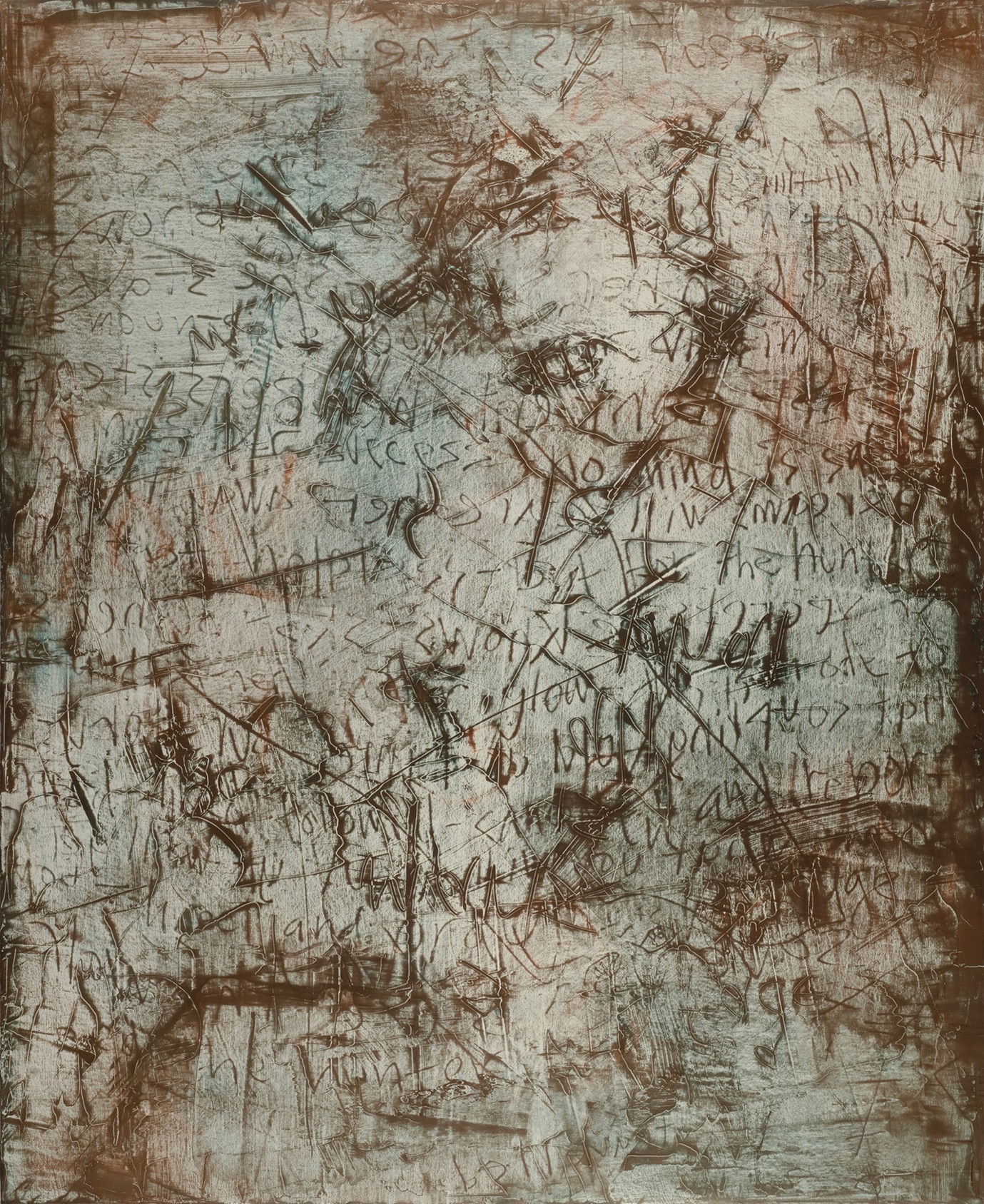
The Wolf and the Hunter, Right Panel of the Ballads Triptych, 2025
oil on canvas, 44″ x 36″
the comet and the receding sea
words by Alex Gregor
it began with a comet on the Espigò d’Antoni Gutiérrez Díaz.
the musician saw it first, telling the astronomer over the phone, who was in the Delta de L’Ebre watching the perseids fall like rain from the cloudless night sky.
on the beach, the musician had been flying a kite, whistling a song that he had been writing, watching the tail flutter in the viento terral above the churning sea, when he spotted the comet, which sprang forth from a cluster of meteors before landing in the bowl of the big dipper.
the astronomer listened, drinking a glass of tempranillo in a lounge chair by the pool of a campground in the Bahía de Fangar, his wife swimming backstroke in the light of the moon, which hung above them in a waxing gibbous.
the comet now in the bowl of the dipper, a gust of wind blew the kite directly between the musician’s line of sight to the celestial body. but when he changed his location on the beach, trodding through sand to the north, the kite remained in the same position; when he moved to the south, the kite remained in the same position still.
the astronomer shifted his focus away from the pool and up into the sky, calculating the position of the sighting.
the musician tried spooling the thread on the handle but could not. as he pulled, the kite seemed to pull back. this tug-of-war continued until finally, the kite pulled the thread—handle and all—out of his hand.
the astronomer’s eyebrows furrowed, his eyes in a squint.
the musician stood on the beach staring at this kite fixed in the night sky, as the thread and the handle slowly ascended to the tail, when the wind picked up and carried the kite off to sea, the bowl of the big dipper emptied.
***
the astronomer called his friend at the European Space Agency to inquire about the sighting. there had been no other reports. he thanked his friend, hung up the phone, took off his clothes, and slipped into the pool to join his wife for a swim. they were both a little drunk from the bottle of tempranillo at dinner, and now they were making their way through a bottle of cava.
***
the musician returned to the beach the next night with a new kite. he walked out to the end of the breakwater where the surf crashed into the rocks. at the line where the sky met the sea, he saw a massive cloud formation moving towards the shore. first, he heard thunder; then, he saw lightning, bursting out of the clouds and striking the surface of the water.
as the clouds approached, he unspooled the thread, allowing the kite to be carried by the wind up into the sky, humming the same song he had been whistling the day before.
with the clouds overhead—the thunder and lightning all around—he kept unspooling, until the kite disappeared into the clouds.
***
the astronomer found the musician on the breakwater at dawn. he gave him a light kick in the ribs and watched as the dishevelled man came to.
at the Base Nautica, the astronomer invited the musician to a coffee. but when the musician opened his mouth to speak, nothing came out. he just stood there, his mouth ajar, his bottom jaw opening and closing, his tongue twisting and turning on his palate between his teeth, without a single sound surfacing from his parted lips.
the astronomer ordered them both carajillos, thinking the orujo in the coffee would awaken the musician’s senses—the liquor in his own a little hair of the dog for the hangover he was nursing from his getaway down the coast at the Delta de L’Ebre.
***
the musician and the astronomer met on the breakwater that night. the skies were clear—not a single cloud for as far as the two could see.
the musician handed the kite to the astronomer, who unspooled the thread and watched as the kite floated into the sky above.
first, there was one meteor. then there were many. out of one of these bursts emerged the comet again, before it was flung into the bowl of the big dipper.
the astronomer watched as the kite darted to the comet. moving quickly, he began walking up the breakwater. this time, the comet moved with the kite. the astronomer and the musician moved from a walk to a jog to a run, until they arrived at the edge of the breakwater, where a rising ocean swell was crashing onto the rocks, soaking their shoes and pants with cool seawater.
the astronomer moved the kite from left to right, and up and down, so that it swerved in the sky with the comet, until finally, he maneuvered the kite—and thus the comet—high into the sky above them, at its zenith—before yanking down on the handle towards the ground, so that the kite crashed into the sea.
it was then that the waters of the sea retreated, revealing the floor of the coastline from the beaches and breakwaters to the seawalls and artificial reefs beneath.
***
the musician and the astronomer climbed down the rocks at the end of the breakwater onto the barren sand and wandered through what the waters left behind—the bloated bodies of dead whales, the fossilized skeletons of birds, the vacant seabeds of dolphins; fields of black stones, sponges, and bottles of spring water covered in a black viscous goo.
it wasn’t until they reached the drained Port Vell that the musician found it: a large clay tablet atop a mound of trash.
the musician picked up this clay tablet, running his fingers over the characters that had been inscribed into the surface, when he opened up his mouth to speak, and out came the words of a language he didn’t think he had ever seen or heard before.
at the base of the mound of rubbish, the astronomer was sifting through the contents when he came across a water-filled condom, which he held up to the sun, discovering that in its tip, there was a tiny fish, alive and well.
from atop the mound, the musician’s voice had gone from a whisper to a speech and now to a song, the same tune of the song that he had been whistling and humming, but now with the words on the tablet, singing with all of his might, breathing in deeply, his stomach rising as his diaphragm filled with the viento virazón that was blowing along the barren seafloor, the words seeming to take shape in his chest before being funnelled out through his throat and mouth, his tongue curling on his palate, his jaw dropping and clenching, his lips flapping wildly.
the astronomer looked over at the musician, eyes furrowed in a squint, before looking back at the condom—inside, the fish was looking right back at him, its tiny mouth mouthing the words that were coming from the mouth of the musician, harmonizing in song.
Mini-interview with Alex Gregor & Sean Riley
HFR: Can you share a moment that has shaped you as collaborators (or continues to)?
AG: Sean and I met in Rome at work. One weekend, he invited me and my wife, Kemi, to lunch at Lago Turano outside of the city, where he has a studio and an apartment with his wife, Valeria. I remember the trip vividly for so many reasons—driving a stick-shift for the first time in snow, the handmade gnocchi prepared by Valeria and the sausages roasted by Sean in the fireplace, Sean’s artwork hanging from floor to ceiling in his studio—but what I remember most is the lake—how still the water was, how the surface reflected the trees on the hills rising out of this flooded valley. Valeria talked about the history of the village while Sean talked about the lake—how it was always changing, depending on the sun and the trees and the water. That was the moment that I realized that the way Sean felt about the lake was similar to how I felt about the sea. Years later, we met Sean for lunch outside of Washington DC—where Kemi is from and where Sean and Valeria had moved—and he handed me a stack of his artwork with excerpts from one of my poems (which, coincidentally, had been published by Heavy Feather Review). When I got back home to Barcelona, we started experimenting with our work separately and discussing everything through correspondence until we were satisfied. Once we were, we started submitting, which led to some acceptances (including Volume 13 of Heavy Feather Review!). Naturally, I asked Sean if we could use his artwork for the cover of my recent collection of short stories, What Shapes These Clouds. Lunch by the lake and then receiving those early works from Sean definitely shaped me as a collaborator—but so have our meetings, correspondences, and collaborations since.
SR: Around 2020 I began sneaking my own poetic fragments into drawings and paintings and exploring ways to integrate text and image. I asked Alex if I might be able to use some of his writing in my work as a way to stimulate some new imagery and ways of working. I had a lot of fun “illustrating” an entire poem of his (The Shrimpboat Captain), line by line, resulting in 27 new drawings with the text. Since then we have found that because we have a lot of experiences and sensibilities in common, our work pairs nicely and naturally, without either of us having to illustrate the other.
HFR: What are you reading?
AG: A Spanish translation of Rachel Carson’s The Sea Around Us (El mar que nos rodea, translated by Rubén Landa)—a poetic account of the history and science of the world’s oceans. Other recent books I’ve read have been Ta-Nehisi Coates’ The Message and Blake Butler’s Molly. I have been rereading Italo Calvino’s essay, “The Traveler in the Map,” as well as Calvino’s Invisible Cities, Raymond Queneau’s Exercises in Style, Alan Lightman’s Einstein’s Dreams, and a stack of books from Calamari Archive, Ink, including work by Peter Markus and David Ohle.
SR: I am finally reading Dante’s Paradiso—long overdue, while joyfully chipping away at Jack Whitten’s Notes from the Woodshed and The Book of Rain, a new translation by David Larsen.
HFR: Alex, can you tell us what prompted “the comet and the receding sea”?
AG: One night after having dinner with Kemi and our friend Abi in Barcelona, I biked to the sea. When I looked out at the horizon, I noticed these shapes in the sky. Puzzled, I watched these objects moving, realizing they were attached to string, which was being held by the hands of dozens upon dozens of people out on a breakwater – they were kites. This image of these kites at night—with the stars and the moon and other celestial bodies as the backdrop above a churning sea—has stayed with me. When I started building a framework for a short story collection that takes place in Barcelona, I knew I wanted to include a kite flying at night from a breakwater, so that’s where I started. The rest was an exercise in patiently waiting to see what came from that image.
HFR: Thank you. Sean, what inspired The Wolf and the Hunter, Right Panel of the Ballads Triptych?
SR: This piece was the final panel of a triptych titled, The Ballads. Each panel of the triptych contains a reflection on survival strategies for living in and with the uncertainty of the current era. This painting employs a boustrophedon style of writing to describe a symbiotic relationship between a wolf and a hunter. The forward and backwards facing text speaks to how these two beings, like two sides of the same coin, coexist between a state of respect and antagonism.
HFR: What’s next? Are you working on another collaboration?
AG: Our collaboration doesn’t involve sitting down together and working on a project; rather, it involves working separately to dig two different wells—knowing that we’re drinking from the same aquifer. That being said, I’m working on another short story collection that takes place in Barcelona. As I work on the stories, I peruse Sean’s work—mostly his 2025 paintings—and see if anything resonates aesthetically with what I’m writing. When it does, I pair his art with my words, send it to him for his review and approval, submit the work, then move onto another story. When the collection’s ready, I would like to use his artwork again for the cover.
HFR: Take the floor. Be political. Be fanatical. Be anything. What do you want to share?
AG: Cross-pollinate, readers. I can’t stress this enough. Do it for yourself and do it for others. Think of something you’ve always really wanted to learn and sign up for a class to start learning and doing it. Diversify your friend groups. Hang out with these friends often. And when your friends aren’t available, make more friends. And if you can’t make more friends, find a good therapist. And if all else fails, consider moving elsewhere—ideally a place with already-existing infrastructure that facilitates meeting people and pursuing your hobbies and interests.
SR: Well said Alex! I don’t know what else I would add to that except—go out and experience art in person too.
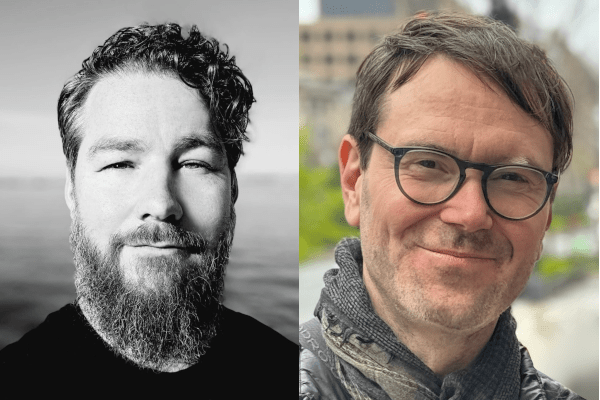
Alex Gregor is a writer and editor based in Barcelona, Spain. His most recent book is the collection of short stories, What Shapes These Clouds (Orbis Tertius Press, 2025). More information can be found at www.marginalcomets.com.
Sean Riley was born in 1977 in Wareham, Massachusetts. In 1999 He received BFA in Painting from the Massachusetts College of Art and Design. In 2004 he received an MFA in Sculpture from the University of Pennsylvania. His work has been shown in solo and group exhibitions throughout the Northeast United States including: Hillyer Gallery in DC; Danese/Corey in New York City; TSA NY in Brooklyn, NY; Gallery 263 in Cambridge, MA; Lamont Gallery in Exeter, NH; Arthur Ross Gallery in Philadelphia, PA; The Arts Center of the Capital Region in Troy, NY; and several others. He has received grants from the Joan Mitchell Foundation, The Rhode Island State Council on the Arts, and the Berkshire Taconic Foundation. He has been an artist in residence at the Joan Mitchell Center, Yaddo, and the Vermont Studio Center. His work has evolved and shifted over time, being shaped by experiences living in Western Massachusetts, Brooklyn, NY, Philadelphia, PA, Providence, RI, Washington, DC and Rome, Italy. In 2022, Riley became an Italian citizen. He currently lives and works in Washington, DC and maintains a studio in Colle di Tora, in Italy’s Turano Valley.
Check out HFR’s book catalog, publicity list, submission manager, and buy merch from our Spring store. Follow us on Instagram and YouTube. Disclosure: HFR is an affiliate of Bookshop.org and we will earn a commission if you click through and make a purchase. Sales from Bookshop.org help support independent bookstores and small presses.
 Heavy Feather Review