
And now they’re sending a search party out looking for wonder. It worries me—are they using the correct searchlight? Will I be missed again? These concerns keep happening—like the continuous tense of fall—bloody maples dredging an exhausted world, where the line between hidden and lost is sodden. Like my mother complaining she could never find the housekey my dad hid around the porch. It’s a safety precaution, he insisted. Till one Sunday, he forgot the precise doormat and jacket pocket, and front door, then the entire cul-de-sac. Now he keeps losing the memory of the key. All the while, the reddest leaves are falling as a mantle of dusk hits my feet like a blessing, or just honest yolk suspended in abeyance. Except now we’re starved for the truth.
It’s hard to tell the face of mercy from the loaded clock. In the yard, workers find the bones of a woman my age and proudly reconstruct a dusty universe, which, despite time, may implode again to prove us wrong. I’m thinking she (and all found relics) are safest in a museum, locked up with that whalesong that keeps looping in my earpods, even when I’m dying. It’s hard to stay enamored like the ads promise. Sometimes, the mother and child are counterpoints of jazz that never quite touch. Still, lilacs are persisting to cover the trails of some ongoing labor we’ve lined up. Our hands extending just to refuse the bucket. They’ll come again searching where to set up camp, only to notice how things are already leaving. The foundation, the empirical stones, the soft bodies under silt. The rabbits and the terrible fire ants we fear most, despite our size. Or in spite of theirs. I guess it’s the small things in the end that call judgement.
What’ll soak up all the red to come? Are there periods too heavy for men after all? I worry the lake will turn rusty from some part of me they’ll blame for contamination. So I let its waves slip between my thighs and consider that beautiful documentary scene, which my friend said was impossible: the best of us, alive, inside a whale’s stomach, praying in our own final ways. Its insides gleaming ruby like my mother’s lipstick when she (many years ago) carried me close for comfort. I noticed that red like live music or off-season geraniums. It’s the other world where ice encases the beehive, as a sign to stay. How, while I’m still in this one, I must keep hiding—even if that means ash as camouflage. Hiding things relative to me. The olive deer, the song of the lapwing, my sick bear sisters—and the golden shovel. It’s the animal rule—how you must bury the thing you used to bury them. Even then, something gives us away. Even then, wonder is radioactive.
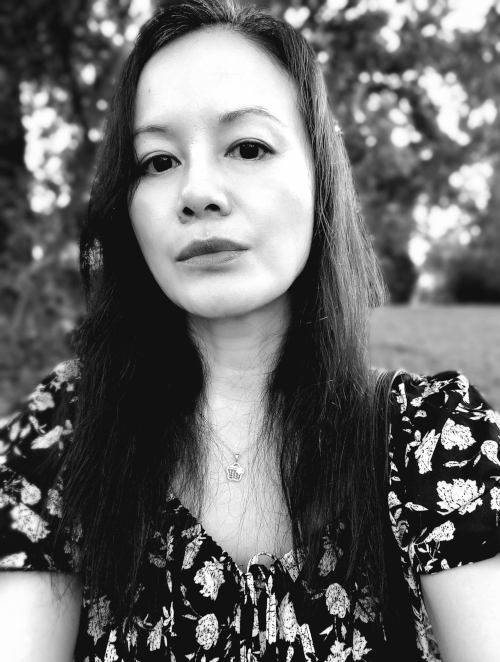
Vikki C. is a poet, essayist, and musician whose writing appears in over 80 venues worldwide such as Grain Magazine, EcoTheo Review, The Inflectionist Review, The Ilanot Review, The Blue Mountain Review, Psaltery & Lyre, Sweet Literary, Up the Staircase Quarterly, ONE ART, Cable Street, Ice Floe Press, Feral, Dust Poetry, Black Bough Poetry, and elsewhere. She has been nominated for The Pushcart Prize, Best of the Net, and the Orison Best Spiritual Literature Award, and was shortlisted in The Bridport Prize 2025. She is the author of The Art of Glass Houses (Alien Buddha Press, 2022), Where Sands Run Finest (DarkWinter Press, 2024), and the hybrid collaboration In the Blueprint of Her Iris (Ice Floe Press, 2025). She serves as a contributing editor at The Winged Moon Magazine, and is a guest editor for the Ice Floe Press hybrid project Process-Marginalia-Otherworlds. More: linktr.ee/vikki_c._author.
Check out HFR’s book catalog, publicity list, submission manager, and buy merch from our Spring store. Follow us on Instagram and YouTube. Disclosure: HFR is an affiliate of Bookshop.org and we will earn a commission if you click through and make a purchase. Sales from Bookshop.org help support independent bookstores and small presses.
 Heavy Feather Review