
Way back in the 2010s, being interviewed by Emilia Phillips over at 32 Poems about his Graywolf Press collection Missing You, Metropolis, Gary Jackson had this to offer on the topic of superhero comics: “… I wouldn’t say comics are the equivalent of my whole life (my ten-year-old self would feel betrayed); they just serve a pretty damn good vehicle for me to explore the usual suspects: sex, race, loss, death, navigating the world and my place in it. And I think that’s what comics have always done for the people who create them.”
The comic book genre isn’t given enough credit as a literary form, though there’s been a shift with more respect shown to the semi-highbrow graphic novel format, and the popular success of Marvel movies in recent years. Comic book superheroes have complex backstories and often struggle to find a place in a world that both needs and rejects them for their talents. These characters can hold a strong appeal among people who feel somehow apart from society: the nerds, yes, but also kids on the outer fringes due to poverty, disability, or racial othering. Comic books have a fraught history in their explicit treatment of race and disability, so it’s complicated at best.
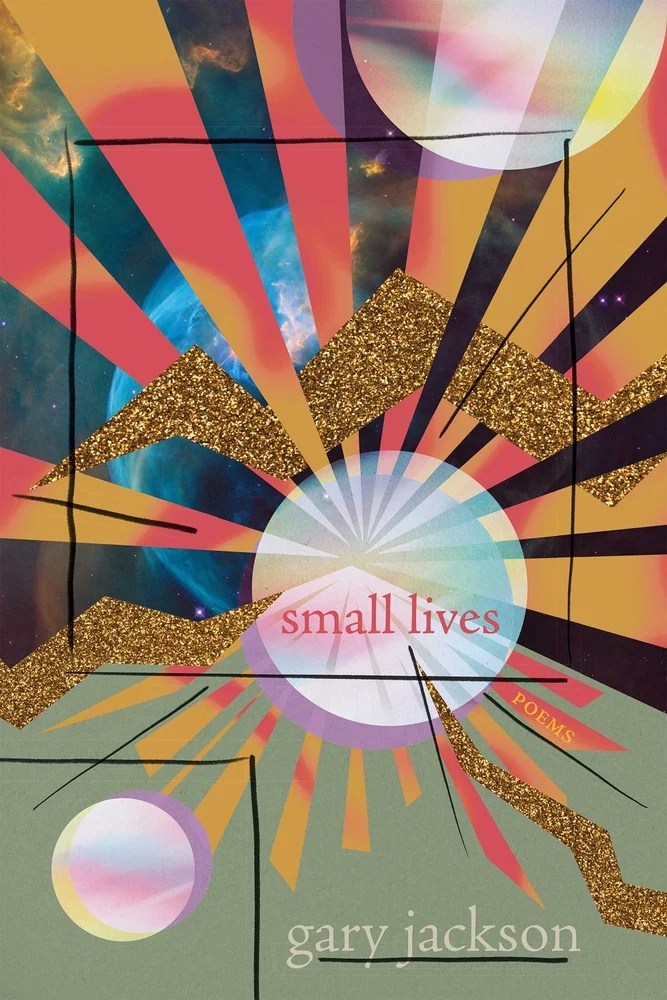
Jackson’s small lives is billed as a graphic novel in verse. Through a sequence of mostly-prose poems, we follow the story of a band of Black superheroes as they navigate an alternately grateful and hostile public. Their powers are various: telepathy, invincibility, and in the case of Willpower Man, the ability to simply make things happen. As with Black people in America, the prosperity of the nation is predicated on their current and historical labor. As with Black people in America, the nation isn’t sure how it feels about that fact. “I was sold, she was adopted, you were orphaned, all of us raised by a system that taught us how to be what we did not want to be but are,” explains the narrator in the book’s opener, “comic book plots & origin stories.” And what are they? “Weapons to be used, stars to be touched, animals to be brought low. Fearsome things. Built to withstand the country that built us.”
Throughout small lives, Jackson highlights parallels between superhero powers and vicious anti-Black stereotypes: physical prowess, imperviousness to pain, the body that is viewed as a threat. “The bipartisan crowd applauds when the Governor pins a medal on you. He’s not delicate with the sharp point because he assumes you can’t feel it pierce your chest,” begins the prose poem “on acceptance.” Later in the story, “you’re watching tv in your own home / when the police arrive on your doorstep to inform you that your body is a dangerous weapon, and do you have a license for your body?” After all, “Normal // everyday people don’t care how many times / we save them, a recent poll says they trust // the police more than us.”
Heroic figures like The Telepath and The Invincible Woman are held up as exemplars somewhat in the way of pro athletes, multi-millionaire musicians, or Barack Obama—what W.E.B. Dubois called “the talented tenth,” the successful few who seem to prove that all obstacles can be overcome. In a piece titled “assembly” Jackson tells of the superheroes putting in an appearance at a high school gym, and one student’s ambivalence about this display: “He had never seen one up close before, only on television. His teachers always remarked how they were a sign of progress, how they represented us. He called bullshit.”
Jackson pulls no punches; his allegory is crystal clear, but at the same time he isn’t heavy handed. It would be possible, if a bit blind, to read small lives as pure entertainment. Comic books have been doing this sort of thing for decades, sliding social commentary underneath a rip-roaring story. Jackson’s innovation is in translating a plot-driven graphic medium into poetry, and poetry into something that can sustain book-length momentum. It’s an exciting experiment that can potentially introduce disparate readers to media we wouldn’t otherwise touch with a ten-foot pole. Should a comics fan be moved to check out the work of, say, Amiri Baraka, or a poetry reader give a second look at The X-Men, this could only be a good thing. It’s even possible that Jackson might get a few people who’d never sport a “Black Lives Matter” sticker to think more deeply on those issues.
Superheroes, like popes, rarely get to retire, but it’s been known to happen. After the violence, there is some degree of peace in leading “small lives,” the kind in which you “head to your morning shift where the tips are decent and the regulars are quiet drunks who ask you by name for another beer and nod in thanks, give you small and constant offerings: dirty dollar bills, handful of coins, sometimes a treat—tin of cookies their adult children dropped off for the holiday, so sweet you swear you can taste every grain of sugar. Your favorite.” Might not be flashy, but by now we’ve learned that you could do far worse.
small lives, by Gary Jackson. Albuquerque, New Mexico: University of New Mexico Press, September 2025. 128 pages. $18.95, paper.
Dawn Macdonald lives in Whitehorse, Yukon, where she grew up without electricity or running water. She won the 2025 Canadian First Book Prize for her poetry collection Northerny (University of Alberta Press).
Check out HFR’s book catalog, publicity list, submission manager, and buy merch from our Spring store. Follow us on Instagram and YouTube. Disclosure: HFR is an affiliate of Bookshop.org and we will earn a commission if you click through and make a purchase. Sales from Bookshop.org help support independent bookstores and small presses.
 Heavy Feather Review