
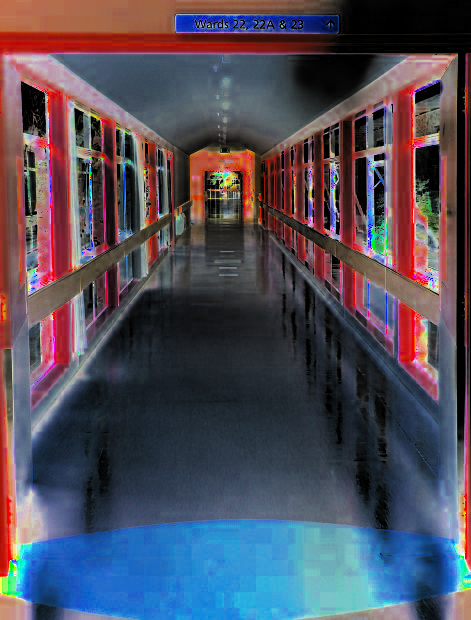
One: Philadelphia, 1965
Only the Ward Clerk, Gladys van Pelt, knew the full nature of the syndrome that tore through and perhaps, in some underlying sense, generated my family, and she shared her findings with no one except those who received me in the end, when it was far too late for that knowledge to do me or my family any good.
When my father moved to Philadelphia in the fall of 1965 to study sculpture at the Philadelphia Institute of the Arts, she perhaps already understood that his tenure as a night attendant in the ER whose admitting desk she had staffed since the Roaring Twenties would result in the shuttering of the entire institution, whose tendrils reached, she knew, as far east as the banks of the Delaware—and perhaps, as well, deep beneath the Atlantic seafloor—and so far west, into the belching coal fields and pretzel factories of inmost Pennsylvania, that no map of their limits could be regarded with more than token credulity.
My father’s parents, like their parents and theirs before them, had been fur merchants up on the Hudson Bay, eventually expanding their empire as far as Montana and then Miami, to say nothing of the now-forgotten inner cities of Minsk and Moscow, from which earlier generations had emerged “in the nick of time,” as the story, fading with each telling, still saw fit to put it. He therefore grew up wrapped in the pelts of bears and beavers and stoats and buffalo, and so, when he came to Philadelphia and met Van Pelt, to whom this account is dedicated even if very little of her role within it has, even now, become clear to me, I think it’s no exaggeration to say that her name, more than any salient feature of her appearance or personality, first endeared itself to him. It made him feel safe in a way that he hadn’t felt in any of the homes his family occupied as their business expanded, and from which it had therefore uprooted him and his brother and his chronically ill schnauzer, Becky, in the middle of the night, moving ever southward, away from some malevolent force whose nature neither parent made any attempt to explain, or even to acknowledge.
As soon as he arrived in Philadelphia carrying the first winter coat he’d owned since the family left the Rocky Mountains shortly after his sixth birthday, he took up residence on one of the hospital’s many subterranean levels, which Frank Shimamura—son of Japanese diplomats whose role in the Second World War would grow considerably more complex after certain documents were unsealed in the former East Germany in the early 1990s—and one of Philadelphia’s most prominent futurist architects, had recently designed and, unbeknownst to many, actually implemented beneath Market, Walnut, and Locust Streets in what amounted to no less than a miniature underground city. My father was shown to a room—little more than a cell, instantly reminiscent of how he’d always pictured the cell in which his uncle Joe had been briefly interned in Manila in the last years of the War—and was given to understand that his housing and room and board would be sustained through a joint agreement between the Art Institute and the hospital system, which, in the years to come, he would learn had far more in common than he could’ve assumed as he rode the Silver Bullet up the Carolina and then the Chesapeake coastline from Miami, clutching his fur-covered suitcase against his chest despite the heat in the second-class compartments, which, in those days, had no air-conditioning of any kind.
When he received the Institute’s acceptance letter, he’d been unloading beaver-skin girdles off the back of a truck from St. Louis, wiping his brow under the Florida sun with a rag that hung at all times from the back right pocket of his birthday-present Levi’s and sipping on a glass bottle of Orange Slice. As soon as he saw the letter, covered with fat sooty fingerprints, the entire Miami world that surrounded him receded behind a screen. Or maybe not that exactly, he’d reflect later, on his first night in his cell—it wasn’t that it had gone anywhere, but more like something had come over it, or come through it, turning it instantly into a bygone place, a lost world, impervious to the fact that he was still standing there amidst all the familiar sights, smells, and sounds of his adolescence.
It seemed to him like some core principle of the world that had, until just then, made Miami seem like Miami had given out faster than he could possibly flee, stranding him in the city of his youth that was suddenly anything but. It was, he wrote later, “like an invisible but absurdly powerful weapon had been detonated everywhere at once, destroying the world without leaving any sign that it had done so.”
Though he’d planned to work through the summer, saving up all he could for his move to Philly in the fall, instead he left that night, with barely a goodbye to anyone except his chronically ill schnauzer, Becky, who—he felt like some nineteenth-century Swede departing for Minneapolis from the port of Malmö—he promised to send for when the time was right.
And this didn’t even encompass the full urgency of the situation, which, as he told me many times in my own formative years deep underground, on what by that time I’d taken to calling the streets of the hospital, couldn’t be fully understood without a deep and thorough reckoning with the innermost secrets of the Vietnam War. After receiving his draft letter earlier that year upon coming home from a long evening of selling peanuts at the Orange Bowl, he’d sat in the wisteria-fragrant dark on his porch with his brother, hatching a plan to remain alive, unlike their uncle who’d died in Manila twenty years earlier. My father never told me what that plan entailed, but the upshot was that he obtained a special dispensation from the U.S. Military’s Department of Art Research, which, routed through some obscure office in a satellite agency loosely appended to Penn Medical School, allowed for him to pursue his artistic education in the basement of the hospital, provided he turn his apparently already formidable training toward the further development of the possibilities of fur as a protective sheath for certain precious elements soon-to-be-cultivated from the human nervous system, as his official remit—which I’ve kept with me all these years—cagily put it.
_______________________
After settling into his room on his first night at the hospital, and trying to sleep without inquiring about the dinner that never arrived, he awoke to discover that the Ward Clerk had enrolled him in a nine-week course of daily psychoanalysis with a military-approved expert in Art Therapy. He showed up for his first session with Dr. Mecklenburger, a dapper, bespectacled nebbish who claimed, at various times, to hail from Hungary, Germany, and Brazil, while at other times disavowing all three claims and declining to replace them with a fourth, having neglected to find even a morning coffee, let alone anything solid enough to call breakfast.
“The late twentieth century and everything thereafter,” the doctor began, eyes on his notepad and pen cap in the corner of his mouth, “will be nothing but a pure hallucination. I don’t give half a goddamn whether that info is classified or not. What the military is doing, and don’t tell me you don’t see it, or that you haven’t heard anyway, is to draw out of us—me and you and everyone they have in custody here in their goddamn underground cities—a serum so potent that, once it integrates into our bloodlines, none of us will ever again manage to recall the basic gestalt that once made even the simplest things, even this room with me and you in it, seem even the slightest bit real. No sir, not for a moment. By 1980? 1990? Gone, gone, gone. Don’t even talk to me about the Year 2000. Wrap your son in the tightest fur you can grow, young man. The tightest of all. Now, where shall we begin?”
“My son?” my father asked, wiping his eyes, which had clouded over with a layer of sweat, whose chemical makeup he already knew to regard with suspicion.
The Ward Clerk came to fetch him when Dr. Mecklenburger’s cuckoo clock shrieked the hour. She took him to the staff canteen, where at last he was free to fill a mug with coffee and a paper plate with a bran muffin and a slice of cantaloupe. He sat down at an empty table and she sat across from him and here, as he tells it, something fundamental about his life changed.
He looked into her eyes and, though she must’ve been 100 years old, he understood that he and she would soon conceive a child. She nodded, as if aware of what he was thinking, and said, simply, “No one enters or exits this hospital except through me.”
She flipped through a dossier on the table while he ate, examining photos of several babies, and then closed it and said, not without kindness, “Time for your first day’s work. Today it’s art. Tomorrow, medicine.”
By the time he’d returned to his room and bid the Ward Clerk good-day, his radiator had sprouted a preliminary tuft. He sat on his bed with his notepad and charcoal, calmly sketching this tuft as it blew in the hot air belching from the old contraption. He slowed down when he’d sketched all the fur he could see—more than one tuft now—uncertain whether still more would appear as soon as he sketched it. It seemed possible that such a relationship might exist—ever since Einstein, Trinity, and Hiroshima, the principle of reverse causality had, as he wrote, come perhaps too much into vogue—but he wasn’t yet ready to find out.
When he’d become ready, ten or fifteen minutes later, so much more fur had sprouted on the radiator that, when he looked down at his drawing and saw the fur present there as well, he found that he still couldn’t say in which direction the line of causation ran. He feared he’d missed a clue the room was trying to give him, and he knew better than to ask again.
He went to sleep listening to the radiator heave and the fur rustle, and he dreamt of a room on the other side of the cinderblocks behind his head in which organs and muscles and sinews stewed, forcing their way out of wounded bodies, trashed in a jungle war whose primary purpose was to trash them in just this way. These organs seeped and slipped and sprung out into a towel he held waiting to receive them. He was, he could see, delivering life forms of a sort that, though the term baby didn’t quite fit, could not be better described by any other. Our boys are coming home, he noted in his dream journal, just before he woke.
That morning, Dr. Mecklenburger asked to see his drawings. My father claims he tried to insist that he hadn’t brought them to the session, but I can’t imagine this claim elicited more than a raised eyebrow from the doctor, who, in my attentive reading of their session transcripts, was never once demonstrably wrong in any assertion he made.
“Oh, you mean these?” my father said.
The doctor must’ve smiled his Old-World smile, his mustache spritzed with Swiss cologne, while holding out his hand. Leafing through the drawings, I believe he could already see the form I would take. He rubbed the charcoal, smudging it just as my father’s admission letter had been smudged, then handed it back and said, “Take good care of him, my friend. We need all the souls we can summon.”
In my father’s journals, which I found in a warehouse in a desolate outlying district of the underground city I would come to inhabit, at the far distant end of the single street on which my white-fenced, red-rosed adolescence would later be spent, in a tenuous redux of the postwar idyll my father had come of age within, the first two entries read as follows:
1: Began analysis with Dr. H. “Stasi” paraphernalia seemingly all over his office. Whether this is a joke or not, who can say. This is, after all, “the 60s”: why I feel compelled to put these terms in quotes is also a mystery, but nothing so far will let me remove them. Transference, which I sense is encouraged, is already well underway … already “the father I never had” is taking shape inside this German “spook” I should never have consented to meet.
2: Is the Ward Clerk an agent of the state? What does she want me to do, and should I do it?
I’m reading and synthesizing all these materials, and writing this response to them, within my Neutra mansion on a hilly street in what I somewhat affectionately refer to as “the Silver Lake district of Los Angeles.” However retrograde these terms have come to seem, in light of all that’s happened, they’re surely still more applicable than “Philadelphia” ever was to the warren of hospital rooms and art studios that my father inhabited in those crucial years that forever shifted our family’s focus from fur to … well, I suppose that’s the question my own life’s work, if I can complete it, will have to answer.
For now, this thought contains enough energy to push me a step forward: the same tinkering with leftover materials that I’m doing here, tenuously synthesizing the ephemera of my father’s time in Philadelphia, is precisely what he was encouraged, and perhaps forced, to do in those underground art studios where the Ward Clerk dropped him off after his sessions with Dr. H, on the days when his services weren’t required in the ER or in any of the psych wards that seemed to multiply faster than his mind could map them, filling with, as he wrote, boys just back from the jungle (who don’t yet know it’s inside them).
Something strange happens here, something I’ve thought twice before admitting: I take up a pen and write is the implication that something happened with the Bomb that no one aboveground was allowed to understand? Did something fuse that shouldn’t have? I write these words, in his handwriting, in his journal. Then I get up, walk across the room and back to the desk I’d been sitting at and then I look down at the sheet and convince myself that what I’m reading was written by him thirty years ago.
The Ward Clerk takes him by the hand, a little more cozily than yesterday, and leads him out of the cafeteria and toward the studio where his Art Research is set to continue. “Think about what people are,” she exhorts him. “Work with the materials that have been provided to you in order to understand what people are made of, and why.”
She says nothing to indicate that the U.S. Military, worming its way ever deeper into distant Vietnam, requires this of him, but it seems clear that such an implication is highly present in everything she says. She unlocks the studio, gives him a hug on her way out, and leaves him unattended—these were the days before ubiquitous surveillance, or at least before its ubiquity was well known—through lunch and until dinner.
These hours are the most sacrosanct of my father’s life during those years. He flicks the light switches, though the overhead lamps do little more than shudder and sigh. Then he pulls the protective tarps over the bodies that have been placed here from the morgue, covered in the vicious markings with which the Viet Cong apparently tattoo their enemies, and he resumes his labors. He stretches a smock over his shoulders and a mask over his mouth; then he affixes a small headlamp to his forehead and a jeweler’s glass over his eyes, and lets the quiet, fume-choked air carry him where it will.
He tinkers with the bodies all afternoon, meditating on the question of their origin—flesh or felt, blood or putty—until, like a koan, it loses the meaning it’d seemed to have and takes on another, at once absurd and inevitable. When he closes his eyes, he sees the radiator covered with fur and a ship laden with pelts sinking into the Hudson Bay, a blizzard whipping those pelts out of their crates and flinging them against the screen or window he’s looking through, blacking it out until there’s nowhere to go except back to the Art Research he’s engaged in already, not stopping except for the tuna sandwich and peanut butter cookie that are always waiting under a tarnished hood on the far side of the studio, beside the sink and the biohazard trash bin.
“Without sufficient fur,” he wrote in his journal sometime that day, “they will be poisoned by their own sweat. Locked so tightly inside a realm of nightmares that none of its nightmarishness will occur to them. The question I’m left with is whether to resist or summon this fate, if indeed either option is open to me.”
I ruffle the fur on my arm and watch it spread across the page as I read this entry and wonder, not for the first time, when he crossed from one state of mind to the next, and whether, therefore, he was working from inside the nightmare for much longer than anyone I grew up with would dare to assume.
In any case, his understanding of the sweat’s potential, connected or not to whatever may have gone on in secret with the Bomb in the years of his earliest youth, when his parents sold mink and polecat coats at the staff commissary in Los Alamos, gave him a newfound awe and respect for the furrier’s trade, even as he also came to understand that, after the disaster in Hudson Bay, his family would never again exist in the world in the way that it had ever since leaving the Pale of Settlement in the late 1800s.
Not long after that, in an episode that I doubt my father would have recorded had some arm or wing of the U.S. Military not compelled—or seemed to compel—him to do so, his parents came to visit. With smudged nametag medallions hanging on overlong strings from their necks, they stood before him with pink, chapped skin slick and runny with sweat, wavering in the doorway of his studio, their lips chattering, barely able to whisper, “We’re so proud of you, son.”
He stood there in his smock with his mask pulled low around his neck and his jeweler’s glass tapping against his eye while his chisel hung at the end of his limp arm, way down by his knee, and he tried to absorb the obvious fact that this was the last time he would see them. There was nothing to say and not much to think—this, he knew, was the time to simply behold. To stand there in silence and witness what the world was trying to show him. The glimpse that the Ward Clerk allowed him to receive, here below, of what had already transpired up above. Though it wouldn’t occur to him until much later that whatever had sheared off his parents’ last protective layer must’ve gotten to them the moment he left—and thus must in some way have either caused or been caused by his departure—he could already see that leaving Miami had stuck a permanent fork in his family tree, to reuse the gruesomely mixed metaphor that he coined in his journal that evening.
He looked at his father and mother and recalled for the last time the long, hot afternoons they’d spent together on the bottommost tip of the country, unloading furs onto the shelves of a store where they would never be sold. He saw this and then he saw their silent, shameful excursions out to Biscayne Bay, where they dumped those furs in the dead of night. I can see them floating now, in the thick, black water, spreading out and drifting away while refusing to sink until they’d vanished from view, as if imbued with a kind of undead pride.
“I can take it from here,” my father eventually said, nodding to the Ward Clerk, who’d emerged behind his parents and, with oven mitts covering both her hands and forearms, stood waiting to lead them away.
When they were gone, he repaired to his room, where he sat on his bed and stared at the fur-covered radiator and, through the sobs that eventually came, succumbed to his first glimpse of the next phase of his life. Whether he saw the Ward Clerk as my mother or merely as the woman whose job it was to deliver me is unclear, but I don’t think he was surprised when, later that evening, she summoned him to the nursery and showed him the bassinet in which I lay mewling.
He held me up to the moonlight streaming from some source beyond the window—a tableau designed, I’m sure, by the other art students who were also in attendance, studying under Frank Shimamura, and yet who never appeared in person, preferring to be known solely through their works—and he looked me over and, the strangest thing is, I looked back at him. I remember his face when I did. Whether this means I wasn’t “born” in the normal sense, and thus wasn’t an “infant” in the normal sense either, but rather some concoction that chanced upon a kind of selfhood through forces latent within the materials my father used to make me, or even whether it means I wasn’t and still am not “conscious” in the normal sense at all, is more than I can or would even try to say.
What I do know is that I looked at my father, in the moonlit foreground, with the Ward Clerk on the other side of a partition behind him, and I understood that these were the two figures to whom I would always be bound, and that whatever I went on to do would be done either in accordance with or opposition to whatever the two of them stood for and intended for me.
He settled me in a wire and burlap nest he’d built on the windowsill in his cell and then he laid down on his cot. I remember that first night, though the memories have no quality of embodiment. It’s as if my “me-ness” floated overhead, between the man and the infant, as is perhaps a truer formulation than “between my father and me.” I hovered in the dusty hospital air, listening to the shrieks of psychotics and perhaps also to those of monkeys enduring God only knows what in the sub-basements beneath us, and, in hopes of earning a moment of peace far from that place, I crept back onto the fur ship skimming across the Hudson Bay.
I stand on the deck in a blizzard that feels like it’s made of cotton balls and steel wool scratching a wobbly film strip, and I watch the captain—my grandfather or great-grandfather—shouting in a Slavic or Germanic language to the crew, who cup their ears with strange smiles on their faces, as if they’ve been prepped to see the whole scenario as a lark. They lean against the rigging and sing showtunes, hanging from poles and tap-dancing across the deck as pallets of fur come unlashed and careen toward them, colliding with the sound of a fist striking a sack of flour (an image that I can see, though there’s no place for it to occur). They sigh and embrace the furs, luxurious beavers and minks and even leopards and pumas, waiting until the ship falls fully forward before they reach into the velvety blackness behind them and pull out tasseled sleeping caps, which they stretch over their heads in a kind of stuttery slow motion and then, falling into the same sleep in which the two of us dwell in that hospital beneath Philadelphia, they close their eyes and sink forever beneath the frigid waters of the Hudson Bay.
_______________________
A month later, Frank Shimamura shows up for a guest crit. Though much about Shimamura’s outlook, affiliations, and relation to the underground city would remain secret until his funeral, many years hence, there was already an intensity about him, a no-time-to-waste quality, that impressed my father to the point where he hesitated to remove the tarp over the bassinet and allow the architect to rummage without interruption.
But this interlude, if it occurred at all, couldn’t have lasted long. My father recalls that he looked out the window at a street-scene the other art students must have designed for him to look at while Shimamura examined me, pressing and prodding, and, though my father noted nothing of the crit’s outcome, I recall my own perspective on the scene, gazing up from the bassinet and recorded here in the following terms:
I can see my father at the window, peeling back the thick fur curtains to gaze upon a wide-open landscape of belching factories, each seemingly producing the next while partially erasing itself in the process, so that the factories in the foreground recede deeper and deeper into the American background, away from the coast and into the Alleghenies, leaving only a fading smudge where their predecessors used to stand.
There’s something desperate in my memory of this scene, like my father was dreaming up the factories as fast as he could, trying to open as much space as the landscape that extended from his mind could contain, as if Shimamura were pronouncing a kind of death sentence upon him while all he wanted was to save me—to say, just before it was too late, “Look, it’s not just you that I made from scratch in the basement of this hospital while the Vietnam War raged on the far side of the world … it’s the whole territory into which you must now venture on your own, discovering this country as if for the very first time.”
Two: Lumberton, 1986
The official results of my father’s final crit were never unsealed—they are, allegedly, still classified in some CIA archive in Virginia—but the upshot is clear enough: he and I were never reunited. He was, I’ve been told, admitted to a VA hospital in Wisconsin for “longterm evaluation,” while, for my part, I was transported to the bucolic North Carolina town of Lumberton, where I was raised by figures who, though benign enough, play no part in this account. I lived in a house with a white picket fence rising from a bed of red roses and I went as often as I could to the town’s lone cinema, the Periscope, where, as I understood it, I was allowed to look up from the underground world my father imagined for me and glimpse, so long as I consented to consider it just pretend, what had occurred up above.
Devastation is the only word I see fit to use. A bitter, blasted landscape populated by mutant woodsmen with blackened teeth and unseeing eyes. This was the lone film that ever played there, again and again, every night, as many times as I cared to see it. There were nights when I stayed until dawn, then walked home in the eerie rising light, stopping into one of two diners for coffee and pie in a bid to clear my head enough to set about my business for the day, though I never found out for sure what that was.
Mainly my goal in Lumberton was to burn off time in the lots and partly-seeded fields behind and between the few main clusters of buildings, hoping thereby to shake the feeling that I’d lived my entire life in that ship beneath the Hudson Bay, secure amidst my family’s fur while the bombs petrified the landscape above. I could picture Shimamura telling my father, “Everything you think you dropped on us will in due time land on you,” and while I pictured this, I hid in that sunken ship, already dead, perhaps, but no less desperate to avoid dying again.
As I wandered Lumberton in the guise of a young man, I could feel those earliest subterranean memories of the hospital merging with those of the ship, until there was no separating them. I’d lie down in my bed in its handsome side-street bungalow and close my eyes to watch the fur fill in the past and the future, stranding me in a present that was nothing but a weak tan node between fur infinities, silent save for the far distant call of the Ward Clerk, urging me on toward my next assignment, known, like so many things, only to her.
Sometimes I think that I poisoned the happy homelife I’d been given in Lumberton simply by pacing too much, as if my inability or refusal to accept the makeshift heaven of the 1980s turned them into a kind of hell, forcing me out onto a highway where there was nothing to do but shriek and flail behind the wheel until I split in two.
I drive up that highway now, swerving around roadblocks and checkpoints with my father’s notebooks on the seat beside me like some dissident fleeing a newly-conquered desert nation with a trunk-load of agitprop, ready to run over any officer who tries to block my way.
These drives grow increasingly frantic as I move through my twenties, splitting and rejoining with total disregard for whatever lifeforms enter me in the interim. I speed away every night only to get so lost among the freaks and fanatics on the open road that I return to Lumberton by dawn, or else I call Lumberton back to meet me in Missouri, Arkansas, Kansas, and Colorado, spattering the map with charcoal smudges, nullifying everything east of wherever I am.
Eventually, in a Los-Alamos-Lumberton whose end of the line aura is impossible to ignore, Dr. M and Frank Shimamura return, having gone completely to seed. It’s as if they’ve served their respective military purposes and then retired, or “been retired,” in the same homey town where I too, for reasons probably equally connected to the whims of the military and the secrets that my father, despite all his journals, surely kept from me, find myself “out to pasture.”
Here in that pasture, the two of them serve as local psychopaths, stirring up trouble every night at Hank’s, the town’s only watering hole, getting kicked out in a blaze of glory six nights a week and resting—or going deeper into some private psychosis of which the rest of us remained blissfully unaware—on the seventh.
The intensity of the oversight that bore down on my father when he was my age, in Philadelphia, feels long gone now, though the notion of Art Research is never far from my mind as I skulk around with nothing to do. I find work covering shallow graft for the local paper and, in due time, tiptoe to the edge of what I can tell is a much deeper pool, at whose edges—or, depending on how one chooses to see it, in whose depths—stand or swim Dr. M. and Frank Shimamura, both of whose lifestyles are fast catching up with them.
_______________________
In the end, Frank and Dr. M. ran me out of town. They could see, though I don’t believe any call from the Ward Clerk came through, that my time there was growing septic. They waited until I wrote an article that cut a little too close to the heart of the matter; then they made their move.
I’ll never forget the night they pulled up in front of my bungalow and left the car idling while they marched to my door, dragged me out of my room, past my parents watching Dallas on the low couch in the den, down the front steps, across the blazing green lawn with its ceaseless sprinklers, and into their ’77 Buick, which they drove past the final roadhouse on the edge of town and out to the wrecking lot where they’d established an unofficial headquarters.
“Here’s your bus ticket,” Frank said, though he made no move to hand me anything.
A long, strange moment passed, while I looked from him to the doctor, and back again. Only after Frank kicked him in the shin did the doctor reach into his crushed silk blazer and pull out a wet envelope, through whose open lips protruded several twenties.
“Tinseltown,” he said, pressing it against me so hard I almost fell over. “The big time. Don’t ever come back.”
I caught the envelope and, righting myself, found the presence of mind to lock eyes with both of them, first Frank and then the doctor, without flinching or allowing the tears I could feel brewing to fall.
Something in this final display of fortitude must’ve impressed the doctor, because he straightened his blazer, glanced at Frank as if seeking permission to go off script, then said, “Let me tell you something I never got to tell your father.”
I felt a huge desire in that moment to ignore whatever he was about to say, even though—or because—I understood that it might be the key to all that was still to come. A bead of sweat welled up from beneath my fur and it took all my energy to keep from licking it and letting the hallucination overtake me for good.
By the time that bead had been reabsorbed, Frank and the doctor were gone and I was alone in the gravel where the bus would pick me up in the morning. I sat down and watched trucks roll along the highway into town, and I let myself imagine that they all contained film reels, dozens and hundreds of unique titles which, now that the Masters of Reality knew I’d never return, had been cleared to play at the Periscope in my absence.
Three: Los Angeles, 1997
In the strangest possible sense, I develop a flourishing career in Hollywood.The shelves of my Neutra mansion in Silver Lake overflow with literature on the sinking of the fur ship in the Hudson Bay, an “accident” that many scholars allege was anything but. I take these books off the shelf and lie with them in the bed I once shared with my murdered wife, a crime that I was briefly accused of having committed before the charges were dropped, mysteriously shunted onto a young man to whom I suppose I bore some flattering resemblance.
Glancing at the blurbs, jacket copy, and some of the photographs, I doze off into an underwater realm in which thick bolts and hanks of fur drift and tremble like seaweed, soaking up a brackish tide that, even in the dream (or only in the dream), I understand is in reality a substrate generating the underlying sense that any of this is real. That any of the story I’ve recorded here and plan to go on recording for a little while longer actually occurred.
I awaken having gathered also the gist that the sinking of the fur ship was seen as the catalyzing event not only for what would come to be known as the “Vietnam War,” but for a much larger cycle of conflict, conquest, and reeducation—unfinished business from WWII or perhaps even unfinished business on a scale that, were its particulars known, would reduce that War to a single event within a far greater story—which placed my family, wholly unbeknownst to itself, at the very center of the twentieth century.
These thoughts are at once bolstered and complicated by a series of hand-labeled videotapes that arrive at my door. Soon enough, they’re coming every morning, always with a ring of the doorbell and a growling, whispered warning on my intercom. I stagger down in my bathrobe, glance at the driveway as I retrieve the tape, and carry it back to bed.
Then I fall asleep, passing briefly across the spattered deck of the sinking fur ship, and then I’m overboard, forcing my way downward with the tape in my mouth, determined to bury it as deeply as I can in whatever patch of fur remains to receive it, in the hopes that one day some child or other offshoot of mine will find it and make as much sense of my story as I’ve made of my father’s. When I surface, soaked and shivering, I allow my assistants to drape me in a towel, like a boxer after a title fight, and from within this towel I direct a series of massively successful films, pure military propaganda, and then I take my paycheck in a wet envelope with the name and address crossed out, and I carry it in my teeth back to my Neutra mansion in Silver Lake.
_______________________
Sometime after Y2K, when at last I can’t take it anymore, when there’s no place underwater to bury the tapes that keep turning up—when Hudson Bay and Biscayne Bay and the Bay of Bengal and every other bay I can name are full to overflowing—I pull the surgical scissors from my father’s medical bag, embossed with the U.S. Army logo. I remove my tailored suit and my silk undershirt and boxer briefs, and recline naked on my pink suede sofa, allowing my fur in all its volume to unfurl and fill the room, leaving only my eyes uncovered.
I clip the scissors open and closed in the air a few times, as if to test a complex principle. Then I push them toward my center and beneath the thickest tuft I can gather in the other hand, and I begin to snip. The feeling isn’t exactly painful, more like the outermost extreme of itchiness. I’ve made a point of never considering whether there’s anything inside me except fur, whether the fur covers my body or is my body, but now I’m ready to find out. I peel the fur away and feel myself going with it, all my father’s hard work in that basement in Philadelphia. The fur comes away around the scissors until there’s nothing more for them to clip and then they gape open and closed in the air for a few moments before going still.
And yet, incredibly, even this is not the end. All goes dark and then the lights come back up over Frank Shimamura’s funeral on a beach someplace along the Pacific, Malibu or Santa Barbara or even San Luis Obispo. Dr. Mecklenburger holds forth in his ribald and impossible accent, recapitulating the glory days at the Art Institute where he and Frank would sit outside on the steps, drinking from flasks and ogling students, surveying the unbounded field of potential that existed for them after the War and before all that remained unresolved about it came back to recall them into its service.
When his speech has concluded, the doctor nods and allows two henchmen to load Frank’s body in its mahogany casket onto an aircraft carrier that emerges just then to receive it. It seems that he’s shipping out alone and yet, at the last possible moment, I find myself aboard that vessel as well, speeding away from the only continent my father imagined for me.
So here I am now, aboard that ghost ship, disembodied or embodied in a way that even I can’t see or feel, piloting the vessel with Frank laid out deep beneath me and a crew of silent soldiers warily at my disposal. We cross the ocean, stopping at Jakarta and Manila for fuel and shore leave and a chance to visit my great-uncle’s grave in the American Cemetery, and then we dock at Yokohama, slightly ahead of schedule.
I formulate something of a plan when I see a military contingent approaching but, just as they arrive, the tables turn and it’s Frank unloading my body from its casket on the lower deck. He holds up an envelope that says “Ward Clerk’s assessment,” and looks it over wistfully, as if he’s sad to part with it. Then he hands it to a commander who comes hurrying across the dock with a glittering cane in one hand.
The commander nods, bows, and dismisses Frank and his crew. Soon, it’s just him and me in a quiet crematorium. I lie still while he opens the envelope and reads, holding a magnifying glass to one eye and tapping his boot with the cane. Though I’ll never know for sure, my final inkling is that something has been bred into me and then extracted from my body, something that will provide Japan with a weapon on a level of magnitude profoundly beyond that of any we used against them. A weapon so vast in its potential that its effect will be undetectable, melting and rebuilding the American landscape into a form so alien that no aspect of my story will seem remarkable in any way, and only then, after its inevitable deployment, will the long War come to an end and the true postwar idyll begin.
David Leo Rice is a writer and animator from Northampton, MA. His interests cluster around metaphysical horror, dark comedy, dreams, myth, hauntings, the uncanniness of small towns, and the grotesque. Learn more about him here.
Image: Melodi2, morguefile.com
Check out HFR’s book catalog, publicity list, submission manager, and buy merch from our Spring store. Follow us on Instagram and YouTube. Disclosure: HFR is an affiliate of Bookshop.org and we will earn a commission if you click through and make a purchase. Sales from Bookshop.org help support independent bookstores and small presses.
 Heavy Feather Review