
Ruyan Meng’s The Morgue Keeper is an intense book, maybe more so than any book I’ve read since Cormac McCarthy’s The Road. Across 200 pages and 27 chapters, it tells the story of Qing Yuan, a morgue keeper trying to survive China’s Cultural Revolution in the summer of 1966. Essentially assigned to clean dead bodies and prepare them for processing, it is understood by both Qing Yuan and us that this existence is a constant struggle to find light in a world determined to go dark. When a body arrives in a condition far worse than these masters of extremity are prepared for, it sets Qing Yuan on a downward spiral that will push the limits of physical and mental existence. Qing Yuan is an unforgettable character that will always remain with us, not just for the extremes he faces, but also the quiet way he still moves through the world:
Qing Yuan bent over in his always futile effort to touch his toes before mounting his bicycle. Yet again, he couldn’t reach past his knees. The times he pushed too hard after a shift, he felt his tendons might snap. Fatigue and ache were his longtime familiars. But at least it was sunny. Once again, he had escaped the morgue, for a time. Once again for a time, he could tell himself the lie that he was free. He looked over his shoulder and merged into the thousands of riders.
Many of the bodies they process at the morgue come with little to no story. It is the beyond-the-pale brutality and absolute lack of story of the woman known as “#19” that begins Yuan’s existential quest. It is also the first of three major tests he will face that ask the questions: How much can humans take? At what point does Sisyphus refuse the punishment?
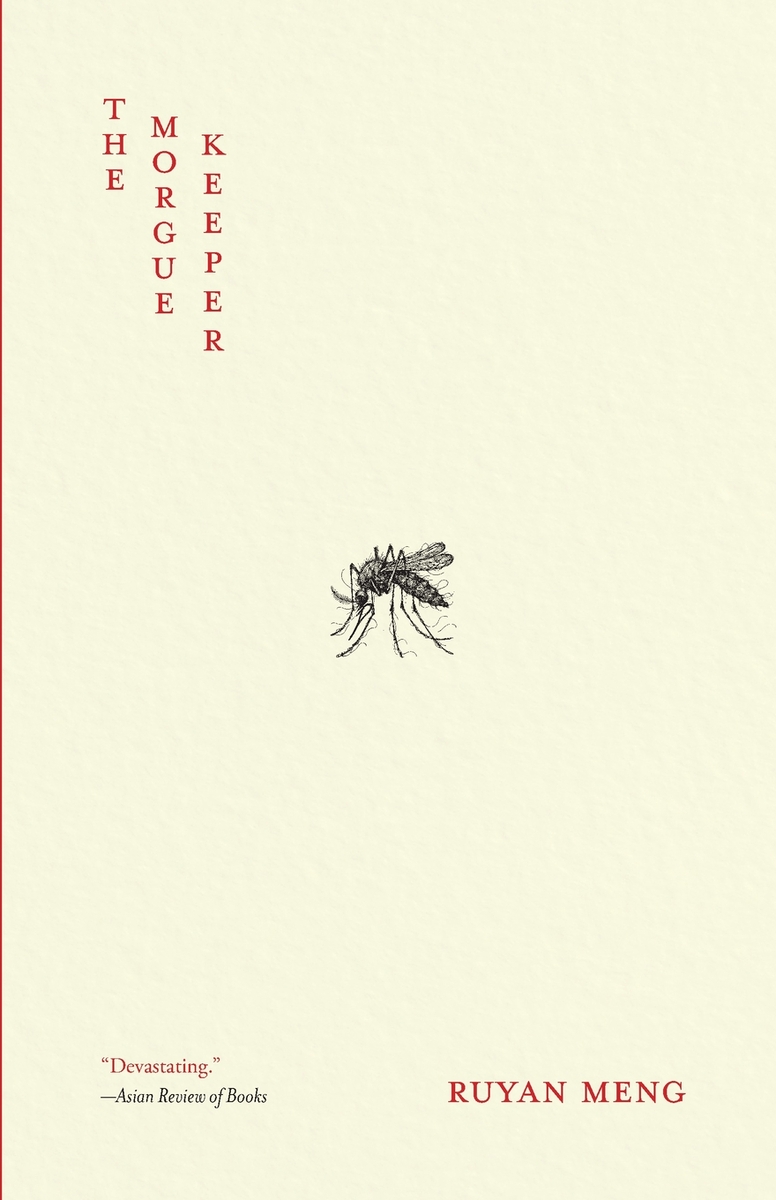
Published by 7.13 Books, the paperback itself is a beautiful object. I had to take a picture of it when it arrived. With a cream cover, the title appears in the upper left in red vertical columns, possibly a nod to the direction of traditional Chinese writing, although read here from left to right. In the middle of the cover, there is a single, but highly detailed, black mosquito. If you stare into it, you can see the various body parts. You see how the bug looks right before it bites. When you first get the book, you don’t know why the mosquito is there. The cover looks so harmless. Peaceful. Beautiful. When you read the book, you come to know about the bug. You know the pain inside. Just like Yuan, you will be challenged to see the lightness of the cover. As the book turned through my hands, it began to change form. I swear the book looks different to me now. The cover doesn’t rest, but insists on an open bend, revealing fifteen to twenty degrees of what’s inside. The cream color seems less confident. It’s harder to stare at the mosquito. Yet somehow, it’s impossible not to face it with the strength of Qing Yuan.
After I read the book, I saw a Goodreads review that compared the book to A Little Life by Hanya Yanagihara. When that book came out in 2016, I heard about its similar level of beautiful intensity, and I passed on reading it. I wasn’t interested in processing pain and suffering over 800 pages. The year 2016 was intense enough, even before knowing what our future had in store. The Morgue Keeper is the perfect length. By keeping it to 200, Meng is able to challenge the us fully. There are almost no breaks. The register is always high intensity. This isn’t to imply there isn’t grace, beauty, or a light within the darkness. It’s more to suggest get ready.
For me, fairer comparisons of the book would be The Joke by Milan Kundera, The Fixer by Bernard Malamud, The Road by Cormac McCarthy, and The Stranger by Albert Camus. The Morgue Keeper, like some of these wonderful predecessors, is about the physical and mental limits required to survive the absurdity of totalitarianism.
Here, Qing Yuan is directly drawn as a descendent to Camus’ favored allegory of the absurd, the Myth of Sisyphus:
How he had been driven by anguish and despair and often too much rage as he scoured the city in search of even the meanest scrap of information, anything at all about a missing woman, a murdered woman. How he had been driven through the fog of death that tainted the whole of life itself, that smothered every motion and breath beneath the summer’s unforgiving sun. How he had been driven by guilt and shame, alone in the morgue in the belly of night, to clean a never-ending procession of corpses. He had been driven and driven without even knowing how. He was still being driven. He would be, he felt, driven for what remained of his days.
All of these books ask how we suffer existence. How do we do it? How do we get by? In a world that can be this dark, how do we see light? These great literary works could all have the same epigraph from Dante: Abandon all hope, ye who enter here. They could stop there, but they all pull off the same magic trick in the end by finding hope hidden in the beauty of our existence via the beauty of art.
It’s also easy to see the Book of Job in The Morgue Keeper. It’s fair to say Qing Yuan and his fellow characters are tested by limits that match what Job faced. In this case, man is tested by the State rather than God. It also could be said that it’s the Author who truly tests a main character. Remember that in the Book of Job, his travails essentially come from a “bet” between God and Satan, a holy “hold my beer” to observe the limits of man’s God fearing and evil-shunning ways. As bad as it gets for both Job and Qing Yuan, I would argue that Meng does it with more care for her subjects by way of what’s at stake in the ultimate test. This book does not ask if we should still love God even though she has us suffer. The question here is if we should still love ourselves. If we should still love existence. By staying closer to the heart, far from the heavens, Meng manages to ask even deeper questions.
The Morgue Keeper, by Ruyan Meng. Brooklyn Heights, New York: 7.13 Books, October 2025. 200 pages. $21.99, paper.
Al Kratz writes from Indianola, Iowa, which is a quiet hilly place south of Des Moines. His current obsession is blending rock history and journalism into his fiction. More about his work can be found at alkratz.com.
Check out HFR’s book catalog, publicity list, submission manager, and buy merch from our Spring store. Follow us on Instagram and YouTube. Disclosure: HFR is an affiliate of Bookshop.org and we will earn a commission if you click through and make a purchase. Sales from Bookshop.org help support independent bookstores and small presses.
 Heavy Feather Review