

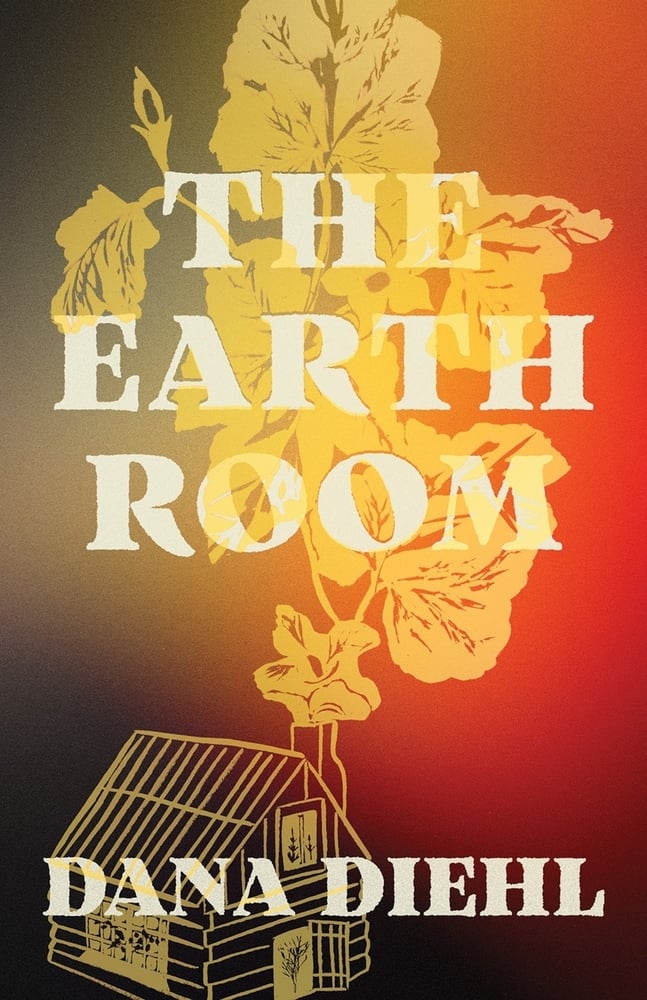
Dana Diehl takes us on a journey very few undertake in life in her short story collection, The Earth Room. It’s one of feminist self-discovery, of magical realism, the inherent organic bond between mankind and nature regardless of age, and the human psyche. This journey challenges not only the characters populating the stories themselves, but it also requires us to stand on the precipice of our very identities and come face-to-face with what it means to be alive, human, and to live beyond the technological networks and social constructs of society.
From the urban and rural areas of America to the cities of Scottland and the glaciers of Iceland, the often nameless protagonists within these stories navigate the unknown and frequently unexplainable phenomena. The story “Daughter” has the nameless protagonist give birth unexpectedly to a ghost baby while her husband is away for work. She naturally worries as any mother would, about how to care for her daughter when medical advancement falls short. As she ventures into this new realm of motherhood, the protagonist considers how much control she previously had over her life, how much society and technology molded her past, present, and how it might shape her future as she navigates what quite possibly might be postpartum depression. Only through her maternal bond with her ghost daughter is the protagonist able to find a new lease on life.
Diehl displays excellent craftsmanship in the portrayal of the natural and supernatural worlds that intertwine within this collection of stories; each word used to describe the surreal and magical aspects of the stories is nuanced. Her work holds a delicate charm balanced by eloquent prose and raw emotions, such as in the soulful lines when the protagonist from “Daughter” feels she has invaded her daughter’s personal space:
She’s staring at me like she knows me. Not just me as her mother, the person who carried her for eight months. She sees me. My secrets. My vices … My failures. Memories I thought weren’t memories anymore, long forgotten.
Unflinching and uncanny at times, Diehl’s prose dredges up the stuff of surrealistic fantasies and phantasmagorias as she ferries us to fifteen different locations ranging from urban to rural to naturalistic settings and beyond:
It’s facing me now, and I can’t understand what I’m looking at. The figure is as tall as I am. It doesn’t have a long, white beard. It doesn’t have a gnarled, wrinkly face.
It has my face.
We are presented with questions of identity in a town where the people shed their skin “like reptiles” and where children begin vanishing after befriending their own skins. Likewise, we are tasked with deciding the value of life and how it should be spent when we get a glimpse of an amalgamated secondary world, in which elderly women replace those of similar age here on Earth. Perhaps two of the most awe-striking stories within this collection are “At the End of the Tunnel,” and “The Earth Room.” The first follows a character as she spends her free time exploring an abandoned mine, that she begins to suspect that she herself originated from. Meanwhile, the latter story features a woman weighed down by the demands of city life and past relationships, who discovers holistic healing though her interactions with a peculiar man that filled his apartment with potting soil.
We can recognize within Diehl’s work all the mysteries and wonders of the world, its hidden magic and its alluring bonds. Diehl places special emphasis on the parent/child relationship as well as the idea that some things in life simply are what they are and must be accepted. Each story is meticulously structured to keep us guessing, and while some of these tales lack tidy conclusions, their endings speak to the profound uncertainties of life and the human experience. “Hex” is a prime example of this, as its male protagonist enters the swamp to confront his witchy ex-wife about the alleged curses she’s placed on individuals in the countryside; just as he confronts her, the tale ends and we are left with questions about the ex-wife, her possible motives, and the possible biased characters of those suffering misfortune.
The Earth Room is a collection that’s comfortable in its own skin and likely to be enjoyed by all seeking to immerse themselves within the magical realm of endless possibilities, the unexplainable, and those who want a moment’s reprieve from society’s sense of normalcy. It is a subtle feast of the most natural epicurean ingredients one can gather.
The Earth Room, by Dana Diehl. Mount Vernon, New York: Black Lawrence Press, January 2026. 144 pages. $17.95, paper.
Kymberli Roberson has published speculative flash fiction pieces in Nailpolish Stories and
Theme of Absence. She holds a BA in Cinema and Photography and currently resides in Illinois,
where she’s working on a dark fantasy novella.
Check out HFR’s book catalog, publicity list, submission manager, and buy merch from our Spring store. Follow us on Instagram and YouTube. Disclosure: HFR is an affiliate of Bookshop.org and we will earn a commission if you click through and make a purchase. Sales from Bookshop.org help support independent bookstores and small presses.
 Heavy Feather Review