
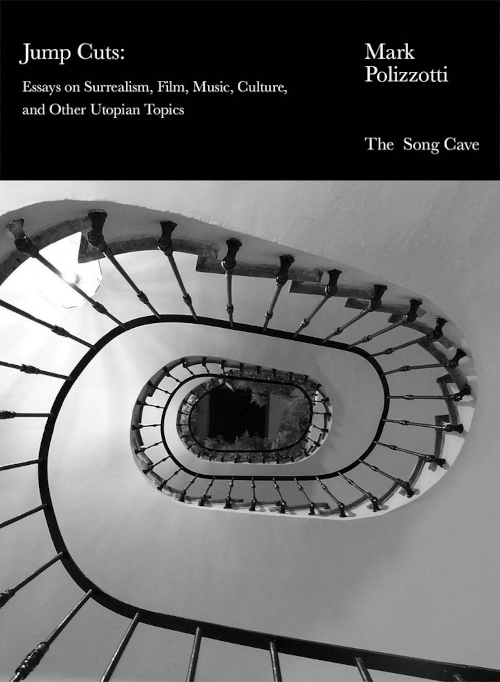
Jump Cuts: Essays on Surrealism, Film, Music, Culture, and Other Utopian Topics, an elegant and thought-provoking new collection of pieces by Mark Polizzotti, opens with an item about poet Paul Eluard’s curiously abrupt disappearance from Paris in March of 1924. Eluard’s months-long abscondment took him to Saigon, with a number of stops at exotic ports along the way. Similarly, the thirteen essays in Jump Cuts, all but one of which have previously appeared in various places between 1996 and 2022, take Polizzotti along an elaborate itinerary that covers such diverse subjects as Alfred Jarry, Robert Johnson, Gustave Flaubert, Raymond Roussel, Colette Peignot (“Laure”), the films of Jean Cocteau and Alain Resnais, Francis Picabia, Bob Dylan’s purported plagiarisms, and more. But as even this cursory list suggests, Polizzotti’s particular point of reference is the French avant-gardes of the late 19th and early 20th centuries. He is justly celebrated as the translator of Surrealist works as well as the author of the definitive biography of Surrealist founder and theoretician André Breton, so it’s no surprise to see Surrealism–its ideas, internal politics, and personalities—serving as a touchstone.
We find this right away with the first and longest piece, “Profound Occultation,” whose title comes from Breton’s famous call, in the Second Manifesto of Surrealism, for the “profound occultation of Surrealism.” Polizzotti shows that what Eluard was running away from was a difficult domestic arrangement of his own devising—a menage a trois of himself, his wife Gala (eventually to be Salvador Dali’s wife), and artist Max Ernst. But Polizzotti sees Eluard’s predicament not just as a personal matter, but as symptomatic of some of the major themes and internal contradictions of Surrealism, the movement Eluard would join when Breton founded it later in 1924. As Polizzotti emphasizes, these contradictions, between choice and design, erotic expression and a somewhat surprising puritanism, and art and politics, showed Surrealism to have been more than the visual art movement it’s often taken to be, at least in North America; rather, it was an essentially critical philosophical and psychological adventure whose methods combined the analytical, the autobiographical, the freely associative, and the affective. As an ideal, it went far beyond art and oriented itself toward the existential; it provided what in effect was a model for a way of being-in-the-world. As Polizzotti summarizes it, Surrealism “above all aimed … to liberate and build upon the potential for marvels in everyday life.” This makes it still relevant today, even if, as Polizzotti concedes, some of its original vocabulary and assumptions seem irrelevant—or worse—to contemporary sensibilities.
Polizzotti addresses this last matter in “Surrealism’s Children.” He readily acknowledges the tendency of the movement to fall short of its stated ideals, as well as its likelihood, given its position within its own historical moment, to be out of joint with our own expectations of what its aspirations—freedom, liberation, the acceptance of desire—should mean in theory and should entail in practice. Polizzotti confronts these difficult matters as they relate not just to Surrealism, but to any art, philosophy, or literature of any period, which in these unsettled times would be prone to provoke “resistance, even a fear—all along the political spectrum—toward engaging with viewpoints that we find alien and distressing.” Yet engage with them we must, he argues, or else “we leave a free entrance to noxious blowhards whose only qualification is to shout louder than anyone else in the room.”
Bob Dylan was one of Surrealism’s children, at least in one of his many incarnations. How Dylan related to his progenitors and influences is the topic of “‘Love and Theft’: Dylan’s Appropriations,” in which Polizzotti evaluates the accusations of plagiarism that have followed the songwriter and Nobel Prize winner throughout his career. As Polizzotti notes, Dylan has always been a maker of collages in a field which, as he nicely phrases it, “is less about expressing a yearning than about preserving a diversified portfolio of loans from the cultural patrimony.” But whereas in the past this was generally understood and accepted if largely unreflected on, in more recent times these loans are being called, and called out as plagiarism, with their detection having been made into something of a cottage industry thanks to the ease of web searching. (I wonder, too, how much of this new attitude has to do with an economy increasingly based more on intellectual property than on physical property.) Polizzotti sees a larger issue here in the contradiction between the pragmatic reality of a performer who, like so many performers before him, is a series of changeable self-inventions, and the lingering Romantic myth of the artist as an authentic, “singular genius.” It’s a myth that’s hard to let go of. But as Polizzotti suggests in his qualified defense of Dylan’s much maligned Self Portrait album, it may be possible to see the authentic in the inventions—to grasp the heterogeneous personae as the “true” person, and to give up the search for a “coherent performing (or writing) entity.”
Like Dylan, bluesman Robert Johnson became a legend made up of truths, half-truths, and listeners’ fantasies. Polizzotti doesn’t debunk the legend so much as put it, and Johnson with it, in the context of Johnson’s time and chosen field. Johnson, again like Dylan, emerges as a popular entertainer whose own music reflected his keen interest in, and understanding of, the music around him. He was a craftsman as well as an artist, a professional among professionals. Here again, Polizzotti suggests that the need to believe in the Romantic ideal of the preternaturally inspired genius—in Johnson’s case, one who sold his soul to the Devil in order to get there!–inclines us to believe the legend rather than the more mundane truth that Johnson was a working musician making a living with his guitar. (But didn’t Surrealism show that the marvelous is immanent in the mundane?)
In the Dylan and Johnson essays as in a number of others in the book, Polizzotti’s gifts as a biographer come through. He is able to locate the salient features of his subjects, distilling them into well-chosen images in economical prose. His “Art of the Inane,” a previously unpublished piece on Flaubert’s last novel, the darkly comic, unfinished Bouvard and Pécuchet, arguably contains as much insight into Flaubert’s character as does Sartre’s sprawlingly prolix, highly speculative multi-volume Family Idiot.
If a major motif emerges from this collection, it’s that of identification. We discover or become ourselves through the works and lives of others. Like Dylan, like Johnson, and like Rimbaud, who memorably expressed it, our “I” is, to a great and often unconscious extent, an other or even several others. Through the process of living, those others eventually are assimilated and transformed—sometimes unrecognizably–into “I.” Polizzotti quotes Rimbaud’s formula in connection with Dylan—an extreme example, to be sure—but it holds for many of the other figures he writes about. And as he cheerfully acknowledges, for himself as a biographer as well. As he argues in “Lives Behind the Lives: Biography as Autobiography,” the identification of the biographer with their subject isn’t a simple or straightforward matter but rather involves a complex form of vicarious intimacy made up of attraction and repulsion, which Polizzotti provocatively compares to the stalker’s identification with the stalked. There is the “same hunger for information and recognition, the same dark wish to enter into and subsume the other’s existence and accomplishments, the other’s notoriety.” And yet despite, or because of, these psychologically overdetermined forces, something of value and insight may result. That’s certainly true of Polizzotti’s biography of Breton, as it is of this fine book as well.
Jump Cuts: Essays on Surrealism, Film, Music, Culture, and Other Utopian Topics, by Mark Polizzotti. Brooklyn, New York: The Song Cave, September 2025. 200 pages. $20.00, paper.
Daniel Barbiero is a double bassist, composer, and writer in the Washington, DC area. He writes on the art, music, and literature of the classic avant-gardes of the 20th century, and on contemporary work, and is the author of the essay collection As Within, So Without (Arteidolia Press, 2021). Website: danielbarbiero.wordpress.com.
Check out HFR’s book catalog, publicity list, submission manager, and buy merch from our Spring store. Follow us on Instagram and YouTube. Disclosure: HFR is an affiliate of Bookshop.org and we will earn a commission if you click through and make a purchase. Sales from Bookshop.org help support independent bookstores and small presses.
 Heavy Feather Review