
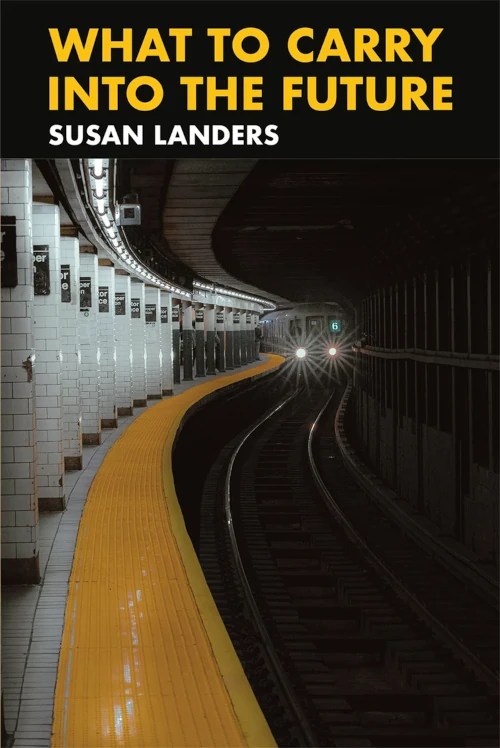
People sometimes ask poets: “Is your writing true, or did you just make it all up?” The truth (so far as poetry is concerned, anyway) is usually a combination of both, as in the latest collection from Brooklyn-based poet Susan Landers: What to Carry into the Future. The book deftly hybridizes a certain accessible kind of diaristic poetics within a more essay-like form as well. Internal revery and imaginative leaps of metaphor mingle with the matter-of-fact, almost journalism-adjacent poetry of familiar place names and proven scientific facts. Notes written on-the-fly begin to coalesce as socio-political/cultural critique: “A few representing the many / tried to take our health care away.” The writing then changes throughout each of the three long sections from verse to prose and back again, containing along the way a myriad of information on local flora and fauna, weather, architecture, media, contemporary political events, history both natural and urban … and trains. Landers writes, “The book came out of a quest to ride every New York City subway from end to end,” and as the process of making the book got going: “[it] transformed into a meditation on joy amidst emergencies.” We are reminded as readers that one does not get to choose what era they live in, or what will happen always around them, but as Landers attests throughout her poetry, “What if we can / —what if we choose to— // go / toward beauty, / […] to have it guide us.”
The idea of a sincere public intellectual, underground but mainstream at the same time, living the life of the mind and being generous about it, sharing thoughts with any/all curious passersby … maybe that is the “What” of the book’s title that Landers seeks to impart? The poet as a kind of volunteer civil servant amongst everyday people, a chronicler of oft forgotten details: “… dungarees and smokestacks / nail salon and scaffold” or “This poem is a time plaza— / a cathedral of vaulted grime— / for anyone who has / ever found, / borrowed, / stolen, / or made the time / to take the long way round.” The first long poem in the book unfurls as all-of-a-piece: “My Quotidian Icon,” an attenuated scroll-like ongoing stanza, like a ledger of the variety of sensory experiences the author notes along their way to wherever they’re going. Without swerving into diatribe or overtly specific namedropping/dogwhistle terms, Landers shows there is a certain new kind of political confusion and trauma, simultaneous with the more playful and free-spirited observations of the spaces around her: “[…] people in power / are not just not making sense / but striking sense with all / of their might.” reads one line, before another: “… New Lots / full of sunflowers / absorbing the heavy / metals from this earth— / hyperaccumulaters / —holding on.” The poem performs a kind of cinematic jump-cutting montage and juxtaposition, an everything-but-the-kitchen-sink style that flows outward to encompass both the present, the past, the author’s inner life, and/or the makings of that life.
Turning her lens alternatively towards the natural world, in the second and third sections of the book, “Sidewalk Naturalist” and “Water Finds a Way,” Landers shows how it would seem that the plants and animals we share this planet with are having to bear the brunt of the damage caused by our profligate consumerist lifestyle:
A creek off the bay.
A salt marsh.
There had been oysters.
The water brackish.
Named after some say a Canarsie leader.
Then grids atop coal ash and trash.
The carving of channels for industry heavy.
A century of discharge.
Today’s black mayonnaise.
The blunt cadence of the incomplete sentences helps to gird a sense of critical inquiry into man’s damaging effect on nature … this stanza, despite its formal justification—its marshaling of detail and facts—is still positively haunted by the rhythms of everyday casual speech, and even a certain streetwise sense of humor: mayonnaise as simile for horrid industrial sludge; the household names endure. Landers’ book walks a fine line between being too aesthete or obtuse, while also avoiding the sort of schmaltzy “bless this mess” motivational-style poetry, which we already know is in the subway everywhere, sentimental placebos essentially akin to the advertising billboards that riders are equally bombarded with all the time.
Landers’ diamond-in-the-rough bits of verse are also reinforced by prose sections that delve into the history of urban development in areas such as the Gowanus Canal in Brooklyn. Short paragraphs, as if ripped straight from a newspaper or photo essay, appear verso to the poem’s recto in the book’s final broadening section: “Water Finds a Way.” Poetry, as the ultimate legacy media, serves to bear witness, a vigil; it may also be a tool to re-rearrange, to digest vital data into an antidote for common apathy or carelessness. We see Landers not only as the walking and commuting poet, but also as the quotidian workaday personality who felt themselves in a rut, which it took a long time to get out of, the office worker: “After years / of working / at a screen / at a desk / for hours / every day / as the sirens / rang in the background …” This voice relatably just yearns for something more vivifying and real than the newsfeed, the desk cubicle. If What to Carry into the Future could be said to have a plot, it would be that of someone hitting the proverbial road, but without having to leave their home per se; rather, they find a way to observe their nearer surroundings more meaningfully, and to find the universal in the local, the political in the personal. It is not a wistful contentment with the way things are, but a discovery of the way things really are, and an inquiry into how they might be changed for the better. Landers describes a day in the office where she simply ran out of the energy/desire to be sheerly productive, so she set out to begin this writing, to see things anew, “Line by line / to build such / tender thoughts. // To know that I’m home. / Like, / really, / even in the gravity of it all.” To ride a subway train is to place oneself in the center of a rawness of humanity, a hopefully egalitarian and level playing field of interaction, a jumbling of different goals, motivations, distractions, or even emergencies. What to Carry into the Future performs a new cognitive mapping of this realm.
The train may be a useful metaphor or microcosm as well for a phenomenon in our time that Slavoj Žižek calls the “Rise of Obscene Masters.” In the mid-to-late twentieth century of popular memory, he has claimed, “Obscenity worked as a subversive undermining of traditional domination, depriving the Master of his false dignity … protesting students used obscene words or made obscene gestures to embarrass figures of power and, so they claimed, denounce their hypocrisy. However, what we are getting today, with the exploding public obscenity, is not the disappearance of authority, of Master figures, but its forceful reappearance—we are getting something unimaginable decades ago, obscene Masters.” People on the train Landers sees wearing provocative T-shirts, “Near me, a man’s shirt / 100% American. / No potential in him” would seem almost partisans of this latter ethos, and Landers doesn’t want to be an unruly passenger herself. So instead, a different idea is proposed. Perhaps, as both a commuter and an inevitable—albeit sometimes reluctant—participant in the chaotic attention economy of today, simply being a decent person and upholding some kind of shared social contract of common sense may actually be the most radical thing one can do for the future.
What to Carry into the Future, by Susan Landers. New York, New York: Roof Books, March 2025. 104 pages. $20.00, paper.
Ben Tripp is a writer and performer from Vermont based in Queens, NYC. His writing can be found via Brooklyn Rail, BOMB, Hyperallergic, Guernica, Full-Stop Quarterly, and Gauss PDF. He was a finalist for the National Poetry Series in 2021 and received a City Artists’ Corps grant that same year. He blogs and archives work at benjamintripp.wordpress.com.
Check out HFR’s book catalog, publicity list, submission manager, and buy merch from our Spring store. Follow us on Instagram and YouTube. Disclosure: HFR is an affiliate of Bookshop.org and we will earn a commission if you click through and make a purchase. Sales from Bookshop.org help support independent bookstores and small presses.
 Heavy Feather Review