
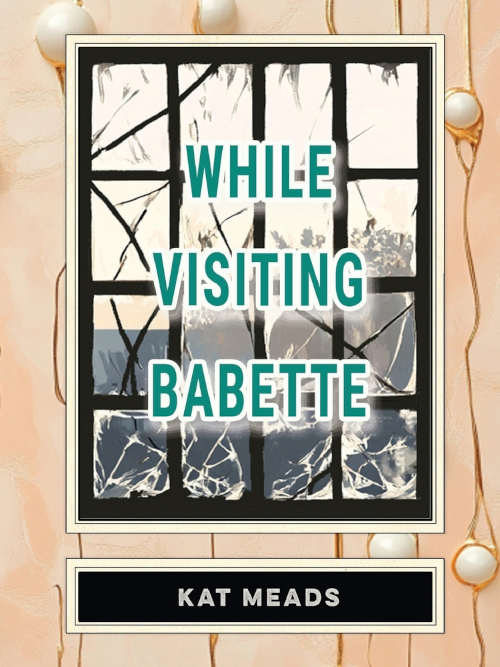
In the last few years, the novella has undergone a resurgence. Some observers attribute its newfound popularity to a readership that has neither the time nor the patience for a novel but is looking for something weightier than a mere short story. And while there are now a growing number of novellas being published and a fair number of contests encouraging people to write them, a good novella is a rarity. At its best, it is simultaneously concise and complex. Its narrative is lean, but its characters are fully realized. It is built on memorable images and precise language. These traits are present in the novel and the short story as well, but in a well-written novella—Claire Keegan’s Small Things Like These or Denis Johnson’s Train Dreams—they are somehow different, unique.
Kat Meads’ While Visiting Babette can be counted among those rare, good novellas. Neither an extended short story nor the skeleton of a novel, While Visiting Babette is the tale of two cousins, Ina and Babette, orphans raised by their aptly named Aunt Careen. As an adult, Babette has regularly been housed in “a variety of structures,” including the most recent, “a sleek fabrication of severe right angles, very modern but somehow very hot.” It is in this last institution where Ina, a frequent visitor to her cousin’s habitations, is trapped during a chaotic lockdown and becomes a resident herself.
Rather than raise a ruckus and demand to be released, Ina seems resigned to her fate. The room she is assigned is stunningly clean, despite “a strand of brown hair curled like a snail in the corner,” and she is the company of her cousin, whose serenity is a foil for her own insecurities, creating an off-kilter symbiosis that stretches back to childhood. The two revert to old habits from their time with Aunt Careen, including round robin callouts and telling lies in unison. Their dreamy world is interrupted and occasionally complicated by other patients, including Clara, who reads the stories she writes to anyone who will listen; a pair of maybe-twins who stage plays of their own devising, and black-haired Isabella, who claims to live in the rafters and may be the one who started a fire in the building.
Meads has structured While Visiting Babette as a series of numbered vignettes, sequential and often consequential, each standing on its own as a snapshot of life for Ina and Babette. Their shared existence is made up mainly of small acts—moving a bed, watching ducks on a pond, being given a sort of personality test (LEAST FAVORITE NUMBER, SONG YOU NEVER WANT TO HEAR AGAIN, FAVORITE OBSCENITY) by a staff member—but, occasionally something extraordinary would happen—the aforementioned fire, the dunking of a resident and subsequent draining of the pond—and this is where Babette’s knowledge of the place gave her an advantage: “Babette could always gauge. Ina was the one who misinterpreted.”
Eventually, Babette decides they “no longer need to be here.” She tells her cousin, “We can do this, Ina … You can do it. I’ll be with you. We’ll be doing this together.”
But Ina, the unintentional inmate, is not so sure:
She had not yet learned to like mashed potatoes.
She had not yet learned to accept a story that was a play or a play that was a story.
She had taken tests but had neglected to answer all the questions.
Her file did not yet contain the term “progress.”
While Visiting Babette is a pleasure to read, certainly for the peculiarities of the characters and the clever unspooling of their stories but especially because of Meads’ delightful writing. Sentences surprise; images shine; observations ring with odd truth. For example, when Babette misreads Ina’s thoughts, Meads writes: “Babette not being able to read her thoughts made Ina feel lonelier than a willow seed.” In another instance, “Ina gazes upon the hedge of azaleas with blossoms pink as gums.” And a query elicits this response from Ina: “Babette’s question did not sound altogether like an unencumbered question. It sounded like a question that already towed an answer.”
Ultimately, While Visiting Babette is Ina’s story. It is her slow acclimation to the institution that provides the tale its purpose and Ina self-discovery. When she reflects upon her accidental incarceration, she has to admit that maybe she belongs there: “Perhaps what they had said since she had come to visit and stayed was truer than at first she believed; that she could not completely rely on what she thought or felt at any given time or place, that her brain had to be retrained.”
Kat Meads’ While Visiting Babette is a masterful piece of writing. It would be easy to quote more passages—even whole pages—that prove the point, but here’s one that captures the novella’s understated charm in appropriately brief and clear fashion. After Clara reads a story to Babette and Ina, Babette tells her cousin that Clara reads to “any two sitting on a bench.” Ina has been under the impression that the sisters in the story were meant to be her and Babette:
Ina had doubted the story was about her and Babette but then she had accepted the idea, trusted it, and now felt bereft.
She and Babette had not had a story written about them after all.
They just lived.
While Visiting Babette, by Kat Meads. Montclair, New Jersey: Sagging Meniscus Press, February 2025. 114 pages. $18.00, paper.
Patrick Parks is author of a novel, Tucumcari, and has had fiction, poetry, reviews, and interviews appear or forthcoming in a number of places, including The Millions, Exacting Clam, Heavy Feather Review, The Writing Disorder, TYPO, Change Seven, Ocotillo Review, Bridge Eight, Another Chicago Magazine, and Full Stop. More at patrick-parks.com.
Check out HFR’s book catalog, publicity list, submission manager, and buy merch from our Spring store. Follow us on Instagram and YouTube. Disclosure: HFR is an affiliate of Bookshop.org and we will earn a commission if you click through and make a purchase. Sales from Bookshop.org help support independent bookstores and small presses.
 Heavy Feather Review