
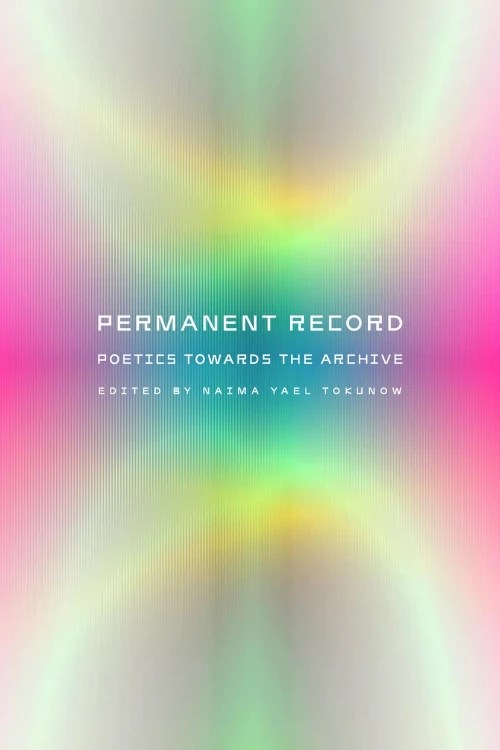
In Permanent Record: Poetics Towards the Archive, editor Naima Yael Tokunow queries convention and prompts ongoing conversation in and of the archival record as conventionally styled and fashioned. In the work’s Introduction, Tokunow asks, in part: “How do we reject, interpolate, and (re)create the archive and record? How do we feed our fragmented recordings to health? … What do we gain from our flawed systems of remembrance?” The sentiments stitched into these and other questions, as both presented and prompted through poetic form, capture the complexity of truths and trauma, the endurance of erasure, and the layered harms of silence in archival maps and historical records.
In an effort to redress and refashion the limitations and often-ill-fitting fabrics of archives as we presently know them, Tokunow seeks, in Permanent Record, “to reimagine who is included in the archive and which recordings are considered worthy of preservation, making room for the ways many of us have had to invent forms of knowing in and from delegitimized spaces and records” These goals are far-surpassed in a work that is as formally ambitious and provocative as it is historically alert and reflective. Of a richly detailed threadwork, the anthology is “itself a record,” and one worth repeating, rereading, and replicating as a contextually unique and historically rich statement of truth.
If in silence, there is history, and in archives, there is inconsistency, in poetry, there is possibility. Tokunow captures that possibility to masterfully reimagine and reinforce the need for critical inquiry when undertaking an analysis of any archive as presently and predominantly presented. The anthology speaks in voices stitched of resolute determination and of a tone that will resonate with those of varied backgrounds. The collection’s authors, many emerging writers at early stages of their publication journey, offer both fuel and hope. The pieces thread previously discarded experiences into a quilt layered of myriad fabrics, perspectives, and lived experiences. In four parts (“Mothertongued,” “File Not Found,” “The Map as Misdirection,” and “Future Continuous”), Tokunow simultaneously deconstructs traditional records and inspires new ways of thinking about what the archive can and should be.
Across the collection, poems of the past explore truths rarely documented in traditional archives. The work’s brilliance becomes fodder for fill-in-the-blank, participatory conversation and a movement towards a more authentic record in both noun and verb form. It’s a remarkable work comprised of neither solitary writing nor scripted conversation. Rather, Permanent Record is a living reminder of poetry’s capacity to query power and rewrite history through intentionality and attention to truths long erased from consumption and exposure.
Permanent Record empowers as it inspires. We are moved to reimagine the weight of silence and gifted the opportunity to fill in blank spaces—not without acknowledging the grief and the hurt, but by finding strength in both and in the power of the written word. Poetry is demonstrated at its finest as both purveyor of truths and a pointed acknowledgment of the inability of any one word, piece, or voice to capture the harms of intentional erasure. The collection is itself an archive in reimagined and authentic forms. Tokunow’s influences find voice in the pages of this collection and will surely inspire more critical inquiry into the archive as both proper noun and action verb, and of a first, second, and third (always more) person perspective. The work inspires intentionality in action as much as it offers space for quiet reflection and contemplation.
Permanent Record is a collection like none other. It’s an example of identity in full dress and fashioned to fit the truths of history through the lenses of a fuller, more authentic experience. It’s everything an archive should be—a uniquely indescribable home, a source of healing and of freedom, an action verb. It models what it means to tell, experience, share, and embody history. This collection is a reminder that there is always another verse and version to be told. We will grow to question records as unfinished, perhaps poetic, verse. Beyond providing fuller voices to otherwise silent archives, the collection creates an original archive of its own. Together, the contributors represent the future of poetry and archival form.
Dear reader, sit “with all the pasts of all the worlds of the poems of this book” and read attentively. Soak in the powerful poetics and healing potential of future archives’ possibility in reframed, refashioned, and reimagined style. Of seams and threads, of “prefiguring the archives of the future” to “prevent further erasure,” and of the fabric and fibers of voices regularly silenced in seams reinforced over generations, Permanent Record offers both a pattern and a prompt for forward movement. It’s a must-read work, of work, that of the politics of memory and the habits of documenting history, always in progress.
Permanent Record: Poetics Towards the Archive, edited by Naima Yael Tokunow. Brooklyn, New York: Nightboat Books, February 2025. 224 pages. $19.95, paper.
Jen Schneider is a community college educator who lives, works, and writes in small spaces in and around Philadelphia.
Check out HFR’s book catalog, publicity list, submission manager, and buy merch from our Spring store. Follow us on Instagram and YouTube. Disclosure: HFR is an affiliate of Bookshop.org and we will earn a commission if you click through and make a purchase. Sales from Bookshop.org help support independent bookstores and small presses.
 Heavy Feather Review