
At the dawn of the 21st century, language is no longer a purely semantic enterprise, that is, an assemblage of words, phrases, and sentences that convey ideas, concepts, and emotions. Granted, language may at times be polysemic, ironic, or ambiguous, which are qualities that have often been exploited in traditional forms of poetry. Today, language displayed in radical new forms of avant-garde poetry transcends semantics; a full understanding of its comprehensive capabilities now requires an awareness of visual semiotics typically associated with the graphic arts. Rather than focusing on what words mean, how meanings are combined, or how context shapes meaning, radical avant-garde poetry experiments instead with colours, shapes, textures, composition, imagery, and motif. Each of these semiotic elements functions like a “word” in a visual sentence. Visual signifiers appear to carry denotative and connotative meanings, but the latter is not always evident at first sight. Visual art has traditionally been understood as a unique language of its own but its recent introduction into the realm of avant-garde poetry has resulted in an intimate and influential exchange between these two modes of communication. What makes visual semantics unique is that they do not rely exclusively on grammar or vocabulary. It seeks to construct meaning through signs, just like spoken or written language. The viewer becomes a reader/interpreter who decodes layers of linguistic and visual signifiers based on their own experiences, much like we interpret traditional poems.
But the semiotic reading of an avant-garde poem today rests on the possibility that the Saussurean tradition may not be fixed or singular. Language is capable of handling the poet’s expressive freedom without at the same time losing its ability to remain linguistically coherent (i.e., legible). Sometimes the visual text succeeds in uttering the unutterable, to break through with an original language (“Ursprache”) never heard or seen before. This is the unsettling “remainder” of language that Jean-Jacques Lecercle discusses in his book, The Violence of Language. Language no longer functions as a simple instrument of meaning, “it seems to have acquired a life of its own.” For Lecercle, language speaks of itself, for itself, to itself, it follows its own inner rhythm and cadence; it seems to flourish most completely in violent chaos and disorder.
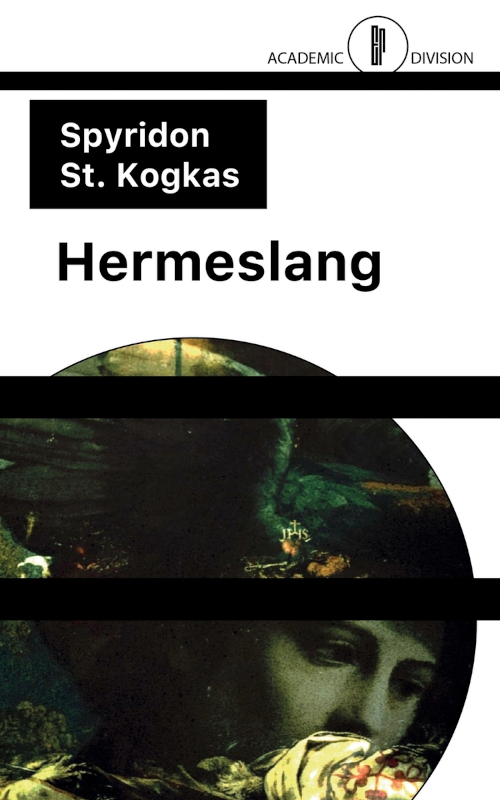
To open ourselves fully to the multiplicity of meanings, intentions, and ideas that await their discovery in avant-garde poetry, we must acknowledge that our semiotic reading must be arbitrary, fluid, and context dependent. If we rely on semiotics as an interpretative tool (“What was the poet’s intention?”), we must be ready to embrace a multiplicity of meanings rather than trying to pin it down to a one-to-one relationship. What makes Hermeslang by Spyridon St. Kogkas so fascinating is that traditional literary and visual semiotics fail to grasp the rich synthesis of theology, poetry, philosophy, and personal visions that is maintained in an unresolvable tension of multiple foreign languages and perspectives. Kogkas calls his glitch poetics a “cryptographic liturgy.” The prefix “crypto-” comes from the Ancient Greek word kryptós, meaning “hidden” or “secret.” Although the graphical content of Kogkas’ poetry is clearly evident on the page, or what Freud calls the “manifest content” of a dream, it is the “latent content” that is occulted from view when we encounter the text for the first time. The latent content of Kogkas’ cryptographic art has a special allure that defies easy description or interpretation. It may be discreet but nonetheless elicits an intellectual curiosity based on our primordial desire to share stories. This desire is both incredibly powerful and intuitive, but it also compels us to engage more deeply with a written or spoken text. We profoundly wish to decipher it, which is why the latent content of a poem (or a dream) may be ambiguous but is never absurd. To declare that avant-garde poetry is absurd is to deny that it can ever create meaning. An avant-garde poem is ambiguous because its meaning can never be fixed; it must be constantly won.
What stands in the way of forms of communication typically established between sender and receiver is “noise,” here manifested in Kogkas’ work by smudges across the text, an abundance of typographic, orthographic, or non-lexical symbols, the use of Leetspeak (or alphanumerical substitutions) and creative codes (“14N6U4635” as “languages”), pseudo-terms that run vertically or diagonally across the page, and non-figurative shapes that appear to undermine the linearity of sentences. Yet, the end-result is not a breakdown of cultural competency but rather a deeper engagement with the texts. It is the poetic equivalent of hearing snippets of overheard conversations spoken in a multitude of languages. We enter fully into the texts’ serious, mysterious, and curious spirit. The messages may be peripheral, but they are meaningful. For example, on page 35, partially obscured by diagonal lines that intersect each letter, is a philosophical maxim written in Latin: “Credere nihil tibi impossibile, te immortaleme accapacem ad omnia intelligenda, omnes artes, omnes scientias, naturam omnis vitae.” (“Believe that nothing is impossible for you, that you are immortally capable of understanding everything, all arts, all sciences, the nature of all life.”). Kogkas’ visual language works in reverse to archaeological pigments, carvings, and organic residue that degrade rapidly once exposed to modern conditions. While archaeologists believe that light and air can be destructive to cave paintings and engravings, the same dangers do not apply to Kogkas’ cryptic messages. Meaning here is generated archaeologically, as we slowly uncover layers and layers of alluring “noise” only to discover in the end that “Culture is public because meaning is.”1 Kogkas’ work “means something” because it has been created using the same communicative tools that we all share. While the form may be radically new, the content is timeless and universal.
A brief word regarding the title and associated terms that inform Kogkas’ collection of poems. According to the Erratum website, “hermeslang” is not a standard term in the Germanic language, nor is it part of German slang. It is a neologism devised for a very specific and poetic context. The title combines Hermes (the Greek god of communication and margins) with the German suffix for language, “-lang.” Hence, “hermeslang” refers to a marginalized but nonetheless communicative language. According to Kogkas, the term is a “metalinguistic invention,” meant to evoke a mystical or esoteric mode of communication. The term further signifies a “semiotic interface,” or a contact point where two communicative systems, subjects, or organizations interact with one another and produce a secondary or tertiary meaning. Kogkas stresses that this kind of symbolic system (perhaps a new form of alienography?) may oppose a traditional linear interpretation but it does promise us a transformative reading experience.
Hermeslang, by Spyridon St. Kogkas. Sheffield, South Yorkshire, England: Erratum Press, August 2025. 178 pages. $17.98, paper.
Edward J. Matthews teaches philosophy, writing, and communications in the School for Language and Liberal Studies at Fanshawe College in London, Ontario, Canada. He is also a part-time lecturer and instructor at the Centre for the Study of Theory and Criticism at Western University. His most recent publications include Arts & Politics of the Situationist International 1957-1972: Situating the Situationists (Lexington Books, 2021) and Guy Debord’s Politics of Communication: Liberating Language from Power (Lexington Books, 2023). He has also published articles in the Interdisciplinary Journal of Student Success and book reviews in Extrapolation and Heavy Feather Review. His new book, Heretical Materialism: An Archaeological Inquiry, is due out in 2026 on the Lexington imprint.
Check out HFR’s book catalog, publicity list, submission manager, and buy merch from our Spring store. Follow us on Instagram and YouTube. Disclosure: HFR is an affiliate of Bookshop.org and we will earn a commission if you click through and make a purchase. Sales from Bookshop.org help support independent bookstores and small presses.
Footnotes
- Clifford Geertz, The Interpretation of Cultures: Selected Essays (New York: Basic Books, 1973), 12 ↩︎
 Heavy Feather Review