
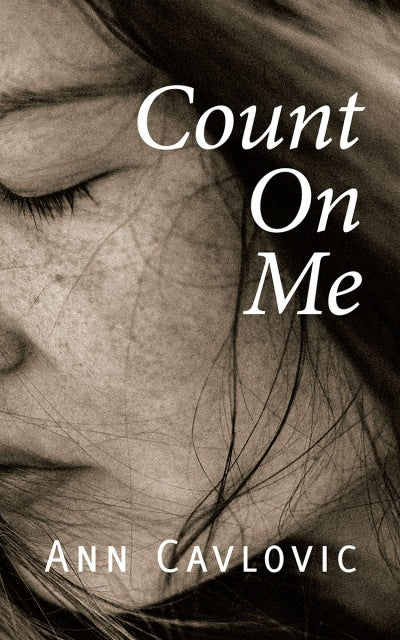
On the topic of workplace harassment, one of my former colleagues once made the remark, “You should be able to advocate for yourself, since you’re mature.” For him, the capacity to believe that one’s version of reality is legitimate and ought to be fought for is a necessary condition of maturity. He implied that there was something deeply unfinished in people who could not speak up for themselves. As he later confirmed, he spoke as someone who was always able to get his way in his family. Ann Cavlovic’s Count on Me, which unfolds the fraught nature of caregiver relationships, is a novel that complicates any assumptions we might have about maturity. Rather, the novel demonstrates just how many adults have a fragile sense of their own reality when confronted with the opinions of others.
Tia, the protagonist, is a single mother who becomes increasingly concerned about her brother’s mistreatment of their parents. Between caring for her infant and becoming disenchanted with her accounting job, she recovers flashes of the past that reveal how her mother has failed to be a safe object of attachment: “I once fell off a jungle gym in grade school and hurt my neck. The teacher called an ambulance. When my mom showed up at the hospital, the first thing she said to me while lying in a stretcher was: ‘How could you do this to me?’” Rather than demonstrating concern for her daughter’s health and performing the emotional mirroring that would enable her daughter to recognize her own pain as legitimate, Tia’s mother trains her daughter to perceive her pain as an inconvenience to others.
Through anecdotes from Tia’s childhood, Cavlovic demonstrates the recursive nature of selfhood, in which the past continues to shape Tia’s present. Afflicted with chronic colds, Tia is overburdened with personal and professional responsibilities, all the while doubting her sense of reality. Cavlovic provides multiple variations on a common theme: through various analogies and metaphors, she tests out ways of expressing the almost inexpressible experience of how one’s neural pathways may become accustomed to denying one’s own experience of reality. One of her most successful analogies occurs near the end of the book, in which she compares the experience of mistrusting one’s own truth to an intentional distortion of space in a science museum: “The floor was slanted twelve degrees, but since the lines of the walls, doorway, wallpaper and curtains were perfectly square, it sent mixed messages to our brains. […] My felt sense, not my visual sense, was the objective truth.”
There are moments where I felt the novel could provide a fresher take on familiar analogies, particularly with its use of Harlow’s rhesus monkeys and Hitler’s childhood, though the narrative momentum is quick to move us onto another dilemma in Tia’s life. One of the novel’s strengths lies in its capacity to weave connections between familial conflicts and environmental concerns. While Tia’s days are filled with attempts to advocate for her parents and care for her infant, she also becomes increasingly disenchanted with her accounting job, in which she is required to perform audits on environmental charities due to the dubious contentions of fossil fuels advocacy groups. Novels regarding intergenerational trauma may run into the pitfall of remaining myopic to the concerns of the family in particular, but Cavlovic’s novel encourages us to form connections between the well-being of children and the well-being of the Earth, arguing that we ought to be caretakers of both.
For Cavlovic, the answer for ending cycles of intergenerational trauma seems to be the capacity to inherit a different way of living in the world. When Tia pivots to an accounting position that prioritizes the inclusion of environmental policy, she celebrates with a group of friends with a new sense of self: “I stood in the middle of the room as everyone raised a water bottle or coffee cup, feeling the radiance of my own smile with freshness, not because I rarely smiled but because I was smiling like Jasmine. My therapist’s particular way of doing it: toothy and confident, with a little wrinkle.” By the end of the novel, Tia can graft the affect of a different embodied history onto her body. She can move beyond the calculus of desperate survival, which has been modeled by her eastern European parents, and contain the capacity to express joy in community.
Rather than ending with clichés regarding reconciliation or “found family,” the novel shapes an affective space that holds both Tia’s responsibility towards her biological family and the necessity for her to discover more nourishing forms of community. Cavlovic’s debut novel provides a thoughtful perspective on the possibilities for overburdened mothers to shape a better world, placing attention on the urgent question of “how to raise children so that fascism could never again take hold.”
Count on Me, by Ann Cavlovic. Montreal, Quebec, Canada: Guernica Editions, October 2025. 200 pages. $18.95, paper.
Isabelle Zhu writes poetry and short fiction in Toronto, Canada. She is currently pursuing her PhD in English literature at the University of Toronto.
Check out HFR’s book catalog, publicity list, submission manager, and buy merch from our Spring store. Follow us on Instagram and YouTube. Disclosure: HFR is an affiliate of Bookshop.org and we will earn a commission if you click through and make a purchase. Sales from Bookshop.org help support independent bookstores and small presses.
 Heavy Feather Review