
I remember reading Martin Heidegger’s What Is Called Thinking? in grad school, with his near-constant refrain: “The most thought-provoking thing in our thought-provoking time is that we are still not thinking.” He saw a world in which human industry was advancing even as the ability or willingness to ask the big questions about life was rapidly diminishing. (And to think this was before the internet, smartphones, AI.) Heidegger’s second refrain is not his own, but a quote from Friedrich Nietzsche: “The wasteland grows.” The so-called wasteland for both men was in reference to ignorance or the decline in meaning, but I can’t help but read it literally, too, in the midst of the climate crisis, where decreased precipitation, to say nothing of shrinking plant and animal populations, not to mention diminished biodiversity, means, in many places, the wasteland truly is growing, spurred on by human ignorance and weakness. Thus, the wasteland grows, both literally and figuratively.
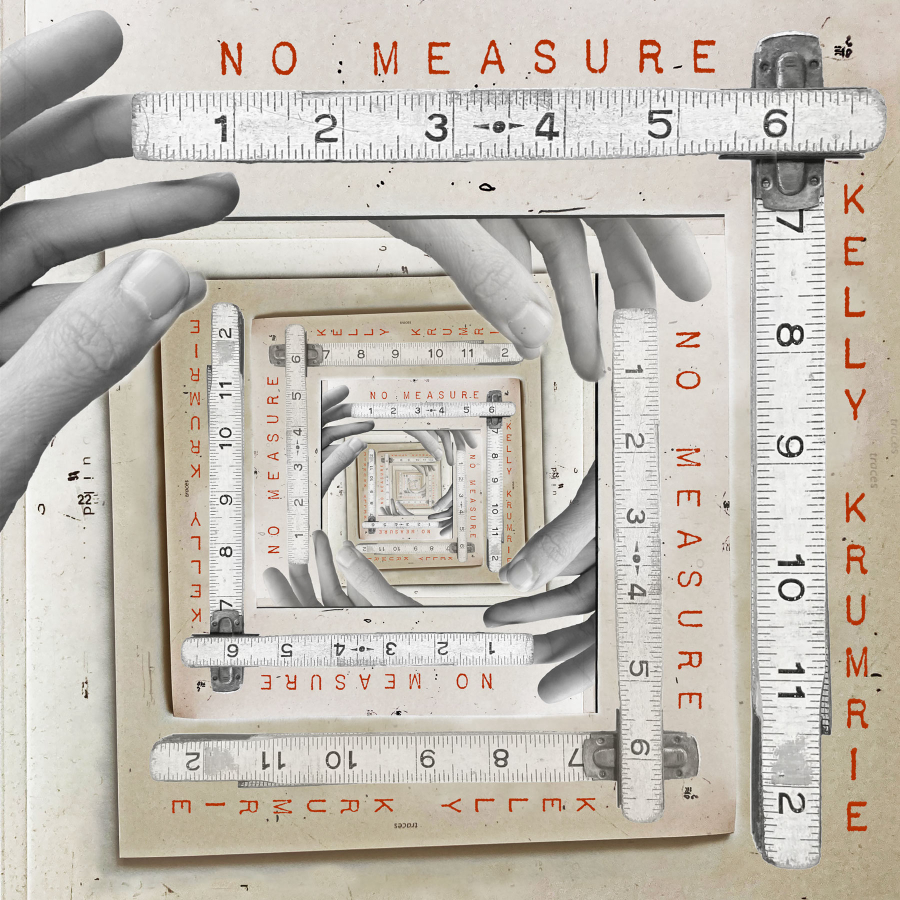
Which brings me to Kelly Krumrie’s brilliant, genre-defying book, No Measure. Each page of this slim, uniquely square-shaped volume features anywhere from a sentence to, at most, three short paragraphs of linked prose poems following a speaker, who, along with their fellow researcher, is working to measure and document a desert landscape while also trying to remediate desertification through planting and maintaining hardy grasses that can potentially battle back the slow-motion catastrophe. The two share looks, touches, as they study the landscape, the language, and emotions as sparse as the surrounding desert.
I was immediately drawn into the world of Krumrie’s book, two characters tasked with the important-yet-ludicrously impossible job of mapping the ever-moving desert. Sometimes the speaker draws circles in the sand, studying individual sand pieces like the equally overwhelming circle studies in Farley Mowatt’s Never Cry Wolf. They, at other moments, take core samples. But most often there are the grids, straight lines laid out on the shifting desert sand, implying knowing and specificity, accurate measurements of a given landscape. The speaker describes the successive lines of wires and rods in a desert where the sand piles up over portions, sinks down beneath others, with wind and rain making small, ever-shifting patterns:
An instrument is scored for my measure. That is, it tells me what to look for. Its notches name a distance, its units and account. I have an array of these: wooden and metal rulers, a wound tape, a clicking wheel, a hanging scale, and string, and pencils. I hold a tool up to something still. To measure is to align, to measure against. The string is slack against the grass. The string does nothing. I do.
And all the while, sand is being blown into the nearby city as the wasteland grows.
But sand is useful, too, we’re reminded, transformed into glass, like the glasses worn by the narrator or the window used by the speaker’s colleague, who sits in the so-called control room, watching and directing the measuring work from above. The term, “control room,” for a building overlooking the desert, is laughable, as if implying control of the natural elements. Or of another person. Yet the room, with its made-from-sand window, is also what divides: “You go up to the control room. The sun refracts off glass, is in my eyes.” While the speaker walks the desert landscape, holding up individual pieces of sand or laying in the grass, their fellow researcher sits above, watching, seeing through a veil of transformed sand.
When they work together, there are always the moments of contact, a brushing off of one another, a helpful hand—the speaker’s “lines” are too sharp, their colleagues’ hands dry as the desert sand. It’s a sparse romance, form and content blended together as both the language and the landscape are full of emptiness, with beauty being there for those willing to look. I’m reminded of Jen Bervin’s Silk Poems, a collection reflecting on the structure and history of silk, along with its medical potentials, demonstrated in both the language and structure of the poems and book; or Inger Christensen’s Alphabet, which mirrors the Fibonacci sequence in its structure while attempting to encyclopedically list the things that make life in the Anthropocene both beautiful and horrifying. Both books blend the objective scientific world with the corporeal realities of being human, providing the kind of deep understanding and knowledge that poetry, when done well, provides. Krumrie does the same, is also part of this important club.
What does it mean, after all, to know about our world? To know another human being? We look for patterns, knowing, as the speaker puts it, that “Regularity is not to be confused with accuracy.” In other words, patterns give us an approximate understanding, but to really know is far more:
I’ve been trying to tell you.
This is about abstraction and reproducibility, repeatability and what it means to measure. The desire to know and to mediate knowing, what landscape desire makes.
Desire is where the other kind of knowing comes in, where the narrator has an ear to the ground to hear sand grains clicking together, where they stand in a valley between dunes and feel the earth move. It, too, is the rhizomic connections between the blades of grass, the unspoken link between the book’s unnamed two characters, those things that go beyond basic measuring tools and push language and understanding further. As the protagonist says: “What traces tell us something? What arithmetic? . . . I time my walk to your stairwell.” The book can be read as a rejection of old ways of knowing, patriarchal, power-obsessed knowing being replaced by something more intimate and generous.
“What exactly do I not know?” asks the narrator of No Measure undermining the typical understanding of knowing, with its history of egoism, cultural hegemony, and human-centered, capitalistic arrogance—it’s a worthwhile question. Krumrie, in this slim volume, provides a spare story of loving and longing, reflections on climate change and its solutions, as well as meditations on existential and epistemological questions well worth pondering, all told through gorgeous, allusive prose that rewards reading and re-reading, not to mention providing more hope about the growing, ever-threatening wasteland than Nietzsche and Heidegger ever did.
No Measure, by Kelly Krumrie. Calamari Archive, October 2024. 114 pages. $16.00, paper.
Matt Martinson teaches honors courses at Central Washington University, and occasionally reviews books for Heavy Feather. Recent fiction and nonfiction appear in Lake Effect, 1 Hand Clapping, and Coffin Bell; his piece, “Trout and Trout Remain,” received a Notable mention in Best American Essays 2024.
Check out HFR’s book catalog, publicity list, submission manager, and buy merch from our Spring store. Follow us on Instagram and YouTube. Disclosure: HFR is an affiliate of Bookshop.org and we will earn a commission if you click through and make a purchase. Sales from Bookshop.org help support independent bookstores and small presses.
 Heavy Feather Review