
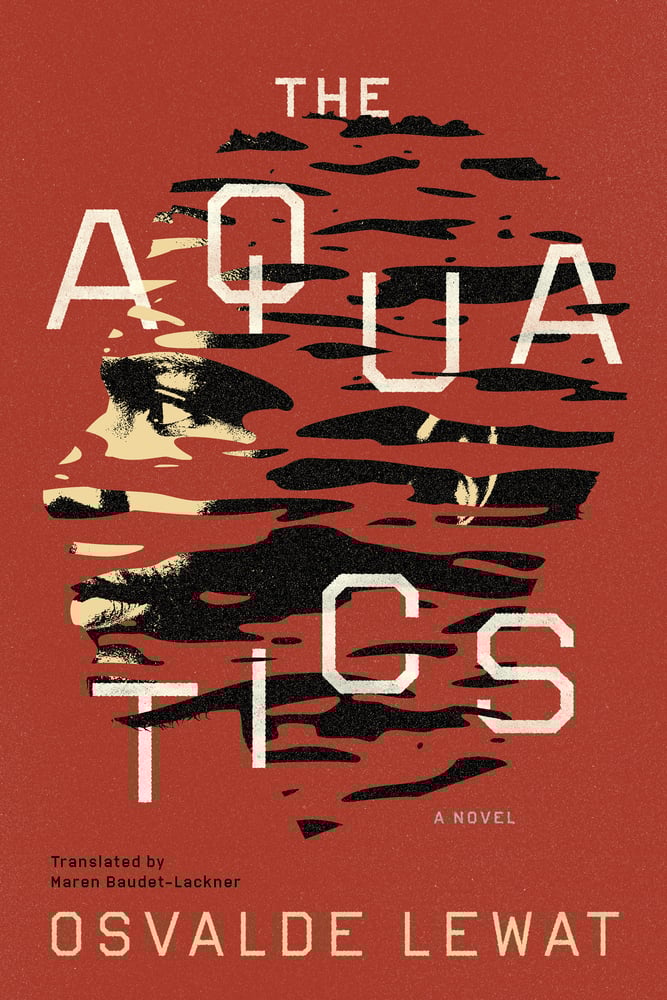
Osvalde Lewat’s debut novel examines the laws and social structure of Zambuena, the fictional African country within which The Aquatics takes place. Zambuena appears to be a thinly-veiled Cameroon, Lewat’s home nation; the fictional country and the real country have numerous similarities: a French colonial history, a Christian majority, ethnic diversity, and social restrictions, notably the criminalization of homosexuality.
Lewat has worked as a photographer, a journalist, and a documentarian; in addition to being her first novel, The Aquatics is her first work of fiction across all mediums. Her switch to fiction, to the form of a novel, allows Lewat to construct the life of Katmé Abbia and present Katmé’s position of privilege as a fictional, almost storybook situation, so separated from the reality of the people of her city.
Katmé Abbia is the wife of Tashun Abbia, the prefect of Zambuena’s capital, a rising star in national politics. The Abbias have far more wealth than they can manage, even with only Tashun working; Katmé quit her teaching job the moment she got married, and now runs the Abbia estate, providing for her family and financing her best friend, Samy, and his art studio.
Even with her two daughters and her numerous maids and servants, Katmé seems uncomfortable acting as “Madame Prefect,” as Tashun’s wife. She’s more at home with Samy, who has been practically her brother since high school. Samy is set to open his first solo exhibition, and his mixed media art includes headless sculptures of the president, experimental film with children greedily eating banknotes, and photographs of brutal life in the Aquatics neighborhood. All of Samy’s work is political, shocking, and funded by Katmé, the wife of a prominent politician.
Tashun is up for a difficult election, and begins his campaign around the time Samy’s exhibition starts. As Samy’s art attracts greater and greater numbers of collectors, his fame grows, and he catches the eye of Tashun’s political opponents, who see him as an easy pawn to use against Tashun, to indirectly discredit Tashun’s campaign. Tashun’s opposition pays for an article to be published labeling Samy as gay.
In Zambuena (as in Cameroon), the simple accusation of homosexuality can condemn one to prison, which is exactly what happens to Samy—he’s quickly jailed, and moved from jail to the lawless central prison, where he quickly wastes away. Tashun, in the middle of election season, forbids Katmé from visiting Samy; the accusation of homosexuality is contagious, and might stick to Tashun too, he thinks.
In prison, Samy is tortured brutally, both by guards and his fellow prisoners. The moment he’s released, he’s murdered; his murder is a public affair, the children of his neighborhood skip school to brutalize the local homosexual, and Samy’s death is a local event, narrated by schoolchildren:
The woman’s voice shouted, what’s going on here, what’s going on, what are you doing at my son’s studio? She cut through the crowd, pushing everyone out of the way, she reached the center, next to us, his mama, she fell to her knees next to him, his head still under the septic tank cover, we couldn’t see his face, how did she know it was her son? It’s okay to kill a girly boy, right? A girly boy who talks to flowers like a crazy person isn’t really a person, right?
As Samy endured prison and everything that came afterward, his best friend Katmé was settling into the life of a politician’s wife, chasing after her own fleeting desire. Samy’s death, a shock to Katmé, punctures the idyll of Katmé’s life, forcing her to reevaluate her impulse to toe the line and the life she had planned out for herself as Tashun’s wife.
The form of The Aquatics allows Lewat to contrast Katmé’s ideal life with the reality of Zambuena. The Aquatics consists of four sections: a short prologue followed by three parts, each of which contain stylistic differences. The prologue is told in first person, using “we” pronouns; the speaker is established to be someone other than Katmé and positions Katmé as outside of reality, as separate from the death of her mother and death in general, immune to the going ons of her mother’s funeral.
The first part of The Aquatics, after the prologue, is also written in first person, from Katmé’s perspective, and her life is close to perfect. Samy’s art is progressing well, she has reunited with her estranged father, and her husband’s career is going well. Sure, her husband cheats on her sometimes, but she has far too much money and can spend it on anything, plus she’s allowed to exercise her moral compass as much as she pleases, by performatively taking part in protests, without skin in the game. Part One of The Aquatics is Katmé’s untouchable, near-perfect, interior life—anything or anyone that doesn’t fit into this life disappears; her sister is barely mentioned and even her twin daughters are accessories, without personalities.
Part Two of The Aquatics is a sudden shift to third person; suddenly we view Katmé outside of herself, and events in her life randomly arise and shift, and the personalities of people she knows change. Fortès, in Part One, is presented as Katmé’s enemy, so it’s incomprehensible to see them suddenly become friends; the friendship is explained away in a later chapter with a paragraph beginning with “one afternoon, Samy and Katmé had run into Fortès at the bottom of the hill, and he’d invited them over for a drink.” Fortès’ change of heart comes out of nowhere, and the collapse of his relationship with Katmé in Part Three also comes out of nowhere. No matter what happens externally, in the reality of Zambuena, none of it can penetrate the haze of Katmé’s life. She and Tashun and his fellow politicians are all bubbled off. Part Three is still in third person, with the sudden death of Samy appearing randomly, like Fortès’ change in personality. This event, finally, is able to pierce through Katmé’s life; nothing else, only the death of a close personal friend, which occurred because of the law espoused by politicians like her husband.
The Aquatics is constructed deliberately; Katmé’s daughters, husband, house, and money all have the quality of a mirage, thanks to Lewat’s precision. Through this mirage, nothing is shocking—not the children on the street, nor the sudden personality changes of Katmé’s friends and family. The first shocking moment in The Aquatics is the death of Samy; all of a sudden the gruesome events ignored by Katmé are rendered in explicit detail, through Lewat’s exact prose. Both as a debut and as a work of literature, The Aquatics is a fantastic, striking work.
The Aquatics, by Osvalde Lewat. Translated by Maren Baudet-Lackner. Minneapolis, Minnesota: Coffee House Press, December 2025. 240 pages. $18.00, paper.
Ria Dhull is an artist and critic living in NYC. You can find her weekly film reviews at Spectrum Culture and her other writing spread across the web. Her animated short film Seraglio Row is forthcoming.
Check out HFR’s book catalog, publicity list, submission manager, and buy merch from our Spring store. Follow us on Instagram and YouTube. Disclosure: HFR is an affiliate of Bookshop.org and we will earn a commission if you click through and make a purchase. Sales from Bookshop.org help support independent bookstores and small presses.
 Heavy Feather Review