
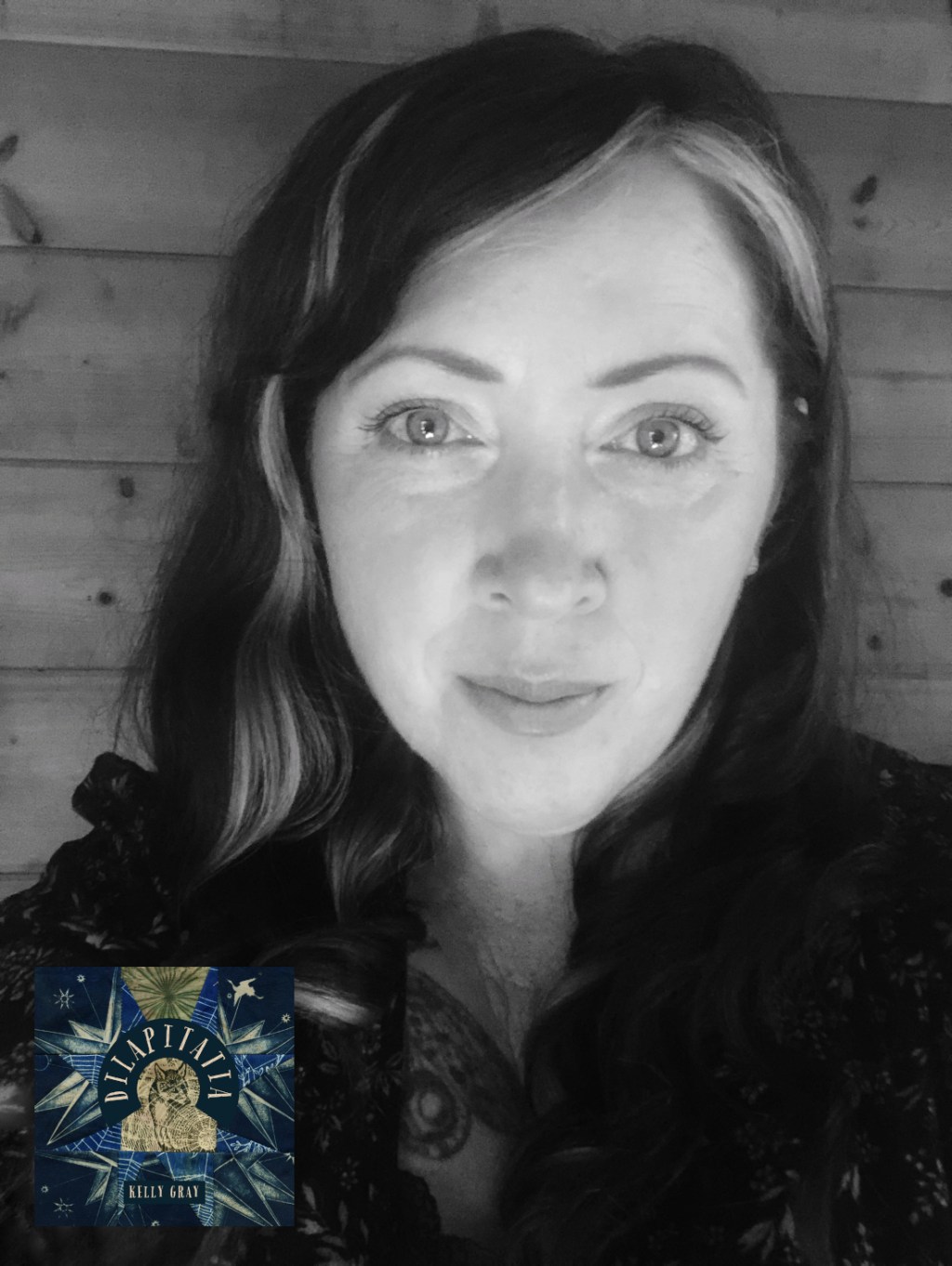

Kelly Gray’s Dilapitatia is, in many ways, a book about haunting—how lineage keeps shaping the present, how the dead remain with us, how our minds and bodies keep returning to the mysteries that possess us. I recently talked with Gray about her collection.
Gray is the author of Instructions for an Animal Body (Moon Tide Press, 2021), The Mating Calls // of a // Specter (Tusculum Review Chapbook Prize, 2023), Our Sodden Bond (MAYDAY Poetry Prize, 2025), and Dilapitatia (Moon Tide Press, 2025), and is the recipient of the Neutrino Prize from Passages North and the ArtSurround Cohort Grant. Her work can be found in Witness, Cream City Review, ANMLY, Rust & Moth, Cherry Tree, Southern Humanities Review, and elsewhere. She lives with her family in a cabin in the woods, nine miles and seven fence posts away from the ocean, and, in addition to her four other jobs, teaches poetry in rural public schools.
Abbie Kiefer: You open your book in an interesting way: with a definition of dilapitatia, an imagined disorder that presents as a preoccupation with neglected or abandoned structures. The list of symptoms is specific and strange, from keeping jars of Xanthoria and Laccaria amethystina to speaking “with or through apparitions of wild beasts.” It’s both clinical and mystical and beautifully jarring because of that. Tell me a little about how you came up with it.
Kelly Gray: Thank you, Abbie, I love that it evoked both the clinical and mystical for you. Initially, I thought Dilapitatia was a collection about anxiety, both in parenting a teen and seeking out an intimate, romantic relationship in the middle of one’s life. I wanted to examine what often feels like different worlds—the care taking versus the middle of the night desires—in one collection.
When you’re taking care of someone and trying to love them in the fullest ways possible, like you do when you are a parent, sometimes it raises awareness around how you were not taken care of or loved. In my case, this prompted a ghost to arrive in my poems. Or maybe she was writing the poems with me? Either way, this ghost was my teenage self and though she had been un-homed for decades, she was still searching in all the places she had been neglected or abandoned for a sense of home. She was asking me to visit these places, too.
While I was shaping the book, a strange thing happened. My grandmother, whom I’d been estranged from for decades, and before that very close with, began her dying process. Despite my family insisting that I avoid visiting her, I felt a distinct calling from her to be by her side while she transitioned. No one had told me where she had been for the last year, I only knew she was in a dementia facility. When I arrived, I realized that the facility was the same building that once housed the juvenile psychiatric hospital that I had been committed to as a teenager. Stranger still, my grandmother was in the same room I had been in. I ended up sitting with her in that room for hours while she became less and less of this world. Though I wasn’t with her when she died, something passed between us in that room. Due to the circumstances, it was both clinical and mystical, and I realized that my grandmother had been sent away in a very similar way to how I had been sent away when I was a teen. So now I had two ghosts on my hands and a lot of rooms and desires for home. It worked its way into the book and I had to name it.
Dilapitatia is the desire to return to abandoned spaces because we believe the feeling of home exists there, in the ruins. It’s why places get haunted. It’s memory layered into land, into body. It’s different from nostalgia or saudade in that dilapitaia hinges on the compulsion to be in physical spaces with the expectation of finding home. “Dilapitatia” the poem is very much a thesis for the book: a human attempting to return to a feeling of home by relentlessly returning to buildings and landscapes layered with memories.
AK: Your keen regard for physical spaces helps define this collection. In one of my favorite poems, “Memory Abdomen,” the speaker tells their daughter, “Sweetie, we are all being pulled down. / This farm we paid three dollars to walk through cannot hold us.” The speaker and daughter have spent a day squelching in good-smelling mud, their arms full of gourds, but the farm can’t be their permanent refuge. And yet the farm and spaces like it—landscapes layered with memories, as you put it—do hold them in the sense that the speaker is compelled to seek them out. There’s a real tension in that: that the places you feel you belong to may never offer you belonging. Do you think the speaker, through the course of the book, makes peace with that tension?
KG: That question feels like an arrow. I do carry a concern that my readers will be disappointed if I don’t offer them a neat ending that includes the speaker finding something akin to belonging. I want to say yes, we all belong, healing is possible! The way I ordered and re-ordered the poems was constantly under that thumb. I kept looking for a sense of repair to emerge. But that’s my conditioning. It’s rooted in how I’ve learned storytelling and absorbed craft. Even more formatively, it’s my family narrative, which said I can only belong if I operate within specific criteria. I just looked up the etymology of belonging: “be-” (an intensive prefix) and “longen,” meaning “to be fitting or suitable.”
This all feels very of the zeitgeist, right? Comfort is king, discomfort has been villainized so that ease can be commodified, including in poetry. I don’t want comfort for my speaker or my readers. Instead, I want to carve out a wider spectrum of experiences.
The book ends with the speaker hoping that their daughter can one day experience joyous thrashing. Meaning that thrashing—the movement we make in response to too much tension but also what we might do during sex and maybe dying—can be exquisite. That’s why I make poems, because I love the tension and the thrashing, line to line, stanza to stanza, poem to poem. I think that’s where the speaker’s belonging exists as well, within the tension.
AK: I want to ask you more about that poem. It’s called “A Note on Sex and Death on the Beach,” and it explores what the speaker wishes for their daughter, one of these things being “a joyous life of thrashing,” as you mention. Reading that phrase sent me back to one of the earliest poems in the book, “In These Pipes, In This House, In This Field,” which is written in sections. The fourth one consists of these five lines:
I promised I would wait for my father’s death
before writing this, but the waters have been rising
for three weeks. I have forgotten how to swim
to him after he threw me in the pool.
My arms and legs learned what could not be taught with kindness.
I’m picturing the speaker thrown in the deep end. There must have been thrashing, though panicked instead of joyous—this kid learning through trial what they couldn’t have through kind instruction. Then I compare that scene to the one in “A Note …,” with the speaker and daughter observing a dead porpoise. “I have so much to tell you,” the speaker says, and yet the poem seems to unspool only in their mind. The parent, I think, is choosing not to impart lessons, not even gentle spoken ones. Two approaches to parenting, two parents doing what they’re able to prepare their kids to be in the world. Did you feel a connection between these poems when you were writing them?
KG: Imparting lessons, especially the lesson that life is painful, and that one day you (as a parent) will be dead and unable to help your child navigate that pain, feels especially tender to me. Instead of talking it out with a young child, I attempted to destigmatize death. The idea that death can serve you, that death is not unlucky or something to be ashamed of, (which feels uniquely American), is best learned through observation, like when you are looking at the insides of a porpoise, on your knees, together. That observation and tenderness will become a foundational memory to pull upon when the time comes. Or at least, I hope so. And not only do I hope so, but I try to ensure so by the writing of the poem, which I hope will outlast me and be of service.
My family is terrible with illness and death or anything uncomfortable. I didn’t get lessons about how to process loss or disappointment. When writing those poems, I wasn’t thinking of them as a pair, but my lineage is always informing my work. I feel lucky that you made the connection and shared it with me (the adage about poems teaching us what we need to know as we write them is so true). When I look at those poems now, I see that the ability to walk into the discomfort is my version of healing, and to that end, the poems are doing that.
AK: That willingness to walk into discomfort is one of the facets of this speaker that I find most admirable. And enviable, as I recognize my own tendencies—as a reader and a human—to seek orderliness and consolation. Books like Dilapitatia ask me to stretch past that. Here’s another way your book stretches me: it doesn’t mind being mysterious. Like these opening lines from “Birdhouse”:
Before he came the creek was littered
with dead birds&
all I could do was weave broom
after broom.
I am not who they think I am,
I am good & I am sad.
Birds & reeds, the hollow boned. I hope this is enough.
Why so many dead birds? Why so many brooms? Who are they and who do they think the speaker is? I don’t know and I don’t need to know because these lines create a mood so effectively and offer that image of hollow-boned birds and reeds. Gorgeous.
I think you as the poet use mysteriousness to put us in the mind of the speaker, who is a little bit adrift, and so we as readers must drift a bit as well. But this is also someone who recognizes the beauty and perhaps necessity of mystery within a life. “I find the scientists who want to decode whale song suspect,” you write in “Whale Mouth.” At the risk of conflating poet and speaker, I imagine you are similarly suspicious of these cetologists. That you welcome some unknowing. How, then, do you decide how much secrecy a poem can hold? How do you differentiate between mystery and obfuscation?
KG: Well, not to bust up the mystery, but at times I’m writing about literal events and people think I am operating in the world of metaphor. I find a lot of dead birds, I always have. I went through a broom weaving stage. So, on one hand, I live in a world where I encounter a lot of animals in all stages of body, and I talk to them and I think they talk back to me. On the other hand, I’m aware that when I’m writing about dead birds and brooms I’m also writing about beautiful things around me that have been lost and my desire to craft tools for cleaning, because if I don’t clean it up, how will I find belonging?
My memories are based more within images than feelings. So I write to that, not as a choice on the page but because that is how I experience the world. In my mind, I’m being open, even vulnerable. During revision, I try to stay with the image, because the image feels most truthful to me. I would never try to make something more mysterious, I feel desperate to get to the core of how I feel and communicate that in the most honest way possible. It’s just that I find figurative language a more accurate representation of the human experience.
I also hope to pull towards an audience that understands we don’t need to know everything, including in poetry. We can let the sounds carry us, the images carry us. When I’m teaching my middle school students, they come to me thinking that poems are riddles. I tell them that I will never ask them what a poem means, I will only ask them how they feel while reading the poem and what questions the poem brings to the table. If I were invited onto a boat full of cetologists (which I would like very much) I would want to know more about how they feel when they are observing the whales, as opposed to trying to insert myself into the whale’s private song. It feels invasive. I feel the same way about space, leave the moon and the stars alone, isn’t it enough that we can see them? I understand that wanting to “know” everything about something as special as a whale (or another human or time period or root system) is a love language (and that science can fuel great things), but sometimes, the way we cycle that knowledge back as expertise means we miss the opportunity to be within wonder.
Abbie Kiefer is the author of Certain Shelter (June Road Press, 2024), named a 2025 Julia Ward Howe Award Notable Book. Her work is forthcoming or has appeared in The Atlantic, Copper Nickel, Image, Ploughshares, The Southern Review, and other places. Find her online at abbiekieferpoet.com.
Check out HFR’s book catalog, publicity list, submission manager, and buy merch from our Spring store. Follow us on Instagram and YouTube. Disclosure: HFR is an affiliate of Bookshop.org and we will earn a commission if you click through and make a purchase. Sales from Bookshop.org help support independent bookstores and small presses.
 Heavy Feather Review