
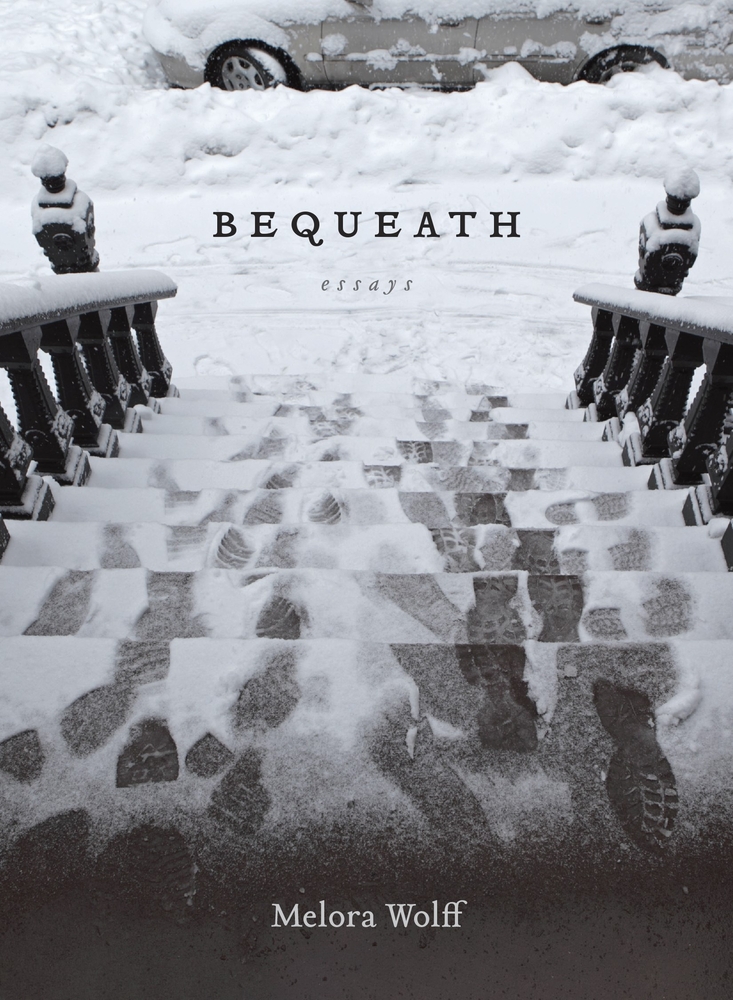
“Before she opened the book, and before I entered this picture, I did not know that love is a deed …” So culminates the themes of Melora Wolff’s latest essay collection, Bequeath, published by the Louisiana State University Press. Part ode to a father figure who is a loving, enigmatic storehouse of imagination, part unflinching retrospection of dark—even sinister—occurrences in Wolff’s childhood but also girlhood in general, her essays strip away the halcyon settings of prestigious girls’ schools, sleepy summer breaks, drizzly New York nights, to uncover the interiority of people in would-be happy situations who are not happy. A coming-of-age departure from childhood hallmarks of Twizzlers and backyard theaters, Wolff’s maturing narrator discovers, as a doctor in her essay “Joy” puts perfunctorily, “‘Very common. … Not a bad thing. Unless the hole gets bigger. … just a funny heart. Like so many. And as she gets older, of course, pain.” It is the lifeblood of experience, hitting the midlife wall at which point the introspective gaze pivots forward and backward simultaneously. Like the trajectory of memory, Wolff operates outside linear sequencing: the final essay is titled “Beginning” and inserted midway through the collection is the “End.” Her songs of innocence and experience coexist, as the girl-woman narrator examines each critical moment through the lenses of the child at play and the woman the same age now as her parents then, assessing the scene for what it really was.
Wolff’s parents are recalled in the final page or paragraph of many essays, in present tense, as if she cannot allow them to remain archived in the past. The bedrock of girlish fascination and nostalgic imagination, her father, a prominent jazz musician, is first introduced in a patriarchal hall of fame in “Masters in This Hall.” The fathers, though their celebrated careers are announced, are collectively anonymous, mythic figures that the parochial students of an all-girls’ school find alluring, unfathomable, and even desirable. In subsequent essays Wolff’s father takes center stage, while her mother looms in the backdrop. We learn she reads unnamed novels, but we have an eponymous essay devoted to her father’s favorite TV show. We see her mother’s tension in arguing with her, foiling an Asian mother-daughter duo in a class-based clash as each girl takes an opposite stance against her mother on what constitutes freedom. We see the father through a cheerier lens, with circus peanuts and music lessons. Wolff apprehends her mother’s depression, subtly manifested amidst a distracted summer of mosquitoes and languished play. Like the fictitious Mrs. Robinson, this housewife self-channels frustration for her stunted joy and lost dreams despite domestic comfort. Wolff’s essays about her mother flow inward, an exploration of herself in the context of her maternal parent, whereas her writing about her father exhibits the memoirist’s ideas of identity that orbit both hers and his. In some ways, Bequeath belongs as much to the father as to the daughter.
The act of memoir-writing is called into question as Wolff implicates her trustworthiness. “Mystery Girls,” a childhood essay on predatory violence, is also a reinvention of a memory, reminiscent of Ian McEwan’s Atonement, in that the most vulnerable player in the piece exploits the most agency, a subversion of the age-old power dynamic of men against girls. In a way, the child’s alteration of the story indicts the memoirist Wolff, who has shown her hand and suggests to us similar negotiations of storytelling, the tyrannical demands of relaying the past. How much do we owe to accuracy? Where do we allow for editing in the documentation of what actually happened? With New Historicist circumspection, she invites us constantly to question her:
Maybe we had known we would always be alone with our torn knees and brimming tears until the fathers swept us up in their arms … Or maybe we remembered none of this at all. Maybe we wondered instead why we had never felt our fathers hugging us, why they always slipped away whenever we came near them …
In a later essay, the memoirist confesses:
I’ve wanted to write what I remember. But it’s possible that the beautiful Drake, demolished years ago, may not have been the hotel that I recall. We may have been in some other hotel lobby. Or maybe the weather wasn’t all that bad, I’m not sure. I can’t tell which of his words and mine are both a truth and a lie. I’ll never know why our paths crossed that night.
It is a grueling test of honesty to which Wolff subjects herself: “Maybe, after all, Lost in Space just meant a lot to me, and nothing to my father. That is possible, I suppose … but I will never know for sure.” She beats the refrain “I did not know,” while attending to memories of happiness—exploring an ancient mansion or producing plays—that eclipsed the struggles of a father and mother she did not fully comprehend. Bequeath, especially in its more metaphysical essays, is an exercise of history as the writer of the memoir must decipher where she has rewritten reality. At the essential midlife hinge of the timeline, Wolff juxtaposes sweet scenes of fathers indefatigably spinning daughters like ballerinas against sighing work-exhausted men draped “across the furniture, like wide unfolded flags,” of Norman Rockwell images of TV nights swathed in her father’s arms versus the more sinister possibility that those nights were gifts to a peripheral mother who may have needed “one hour alone … to weep a little in the kitchen.”
Bequeath does not shy away from its metaphysical search for something admittedly impossible. Wolff includes words like “ideal” and “perfect” when describing televised houses, a letter from a beautiful actor, an inherited car stashed with artifacts of a full, but completed life. The anthem of her essays signals a return: “Home. Now.” In the pursuit of home, she discovers the futility of return, the memory being savagely questioned again and again as it rewrites reality—inherited, sometimes self-inflicted pain—for romance. She recalls in the penultimate titular essay a memory of pure joy, plunking piano keys in a beginner songbook. How quickly the simplicity of that joy transpires to something grander, more complex, until the pianist in a moment of realized loneliness and resistance smashes her hand deliberately in the piano bench.
The act of retelling is an act of restoration for Melora Wolff—not only of memories but of self. Her essays come to grips with lifting the painted veil, beyond the overt celebration of a romantic father who instills idyllic lessons of music and heroism in his daughters and sends them on scavenger hunts through art museums, but upon his death bequeaths cryptic inheritances that become more burdens than blessings. Wolff’s final essay is a gift to her mother, ever the quencher of romance in her other essays; in “Beginning,” it is she who introduces fantasy to the daughter, who makes a writer of her. Wolff abandons the motif of uncertainty and declares, “I remember very well, turning to a particular page that became the first page of my life,” a storybook memory with her mother who’s “reading aloud, but there’s a thrumming all around me … This is a picture of love.” Fear, which permeates through the presence of predators, through the departure from childhood into loneliness, vanishes in the safety net of her mother’s arms and a storybook open wide. She considers the love of Peter Pan’s fairy, but the question resonates with a love sacrificially and self-effacingly bequeathed to a daughter. Like Pan in the famous fairy death scene, Wolff similarly alights on a truth universal: “Isn’t all love—apparent? … This picture of love makes no sense, and perfect sense: she has spent herself entirely on loving him, and now he knows the truth.”
Bequeath, by Melora Wolff. Baton Rouge, Louisiana: LSU Press, September 2024. 180 pages. $24.95, paper.
Shannon Nakai’s work is featured or forthcoming in American Poetry Journal, The Cincinnati Review, Atlanta Review, Tupelo Quarterly, Los Angeles Review, Cream City, Los Angeles Review of Books, Colorado Review, Pleiades, The Cortland Review, and elsewhere. A Fulbright Scholar, Pushcart Prize nominee, and finalist for the AWP Intro Poetry Prize, she is a legal representative for refugees and asylees with the International Rescue Committee.
Check out HFR’s book catalog, publicity list, submission manager, and buy merch from our Spring store. Follow us on Instagram and YouTube. Disclosure: HFR is an affiliate of Bookshop.org and we will earn a commission if you click through and make a purchase. Sales from Bookshop.org help support independent bookstores and small presses.
 Heavy Feather Review