
“Of course, the Veldt Institute is not commonly known—likely no one outside the Veldt Institute is aware of its existence—but it is clear that those who arrive do so at the exact time that is best for them.”
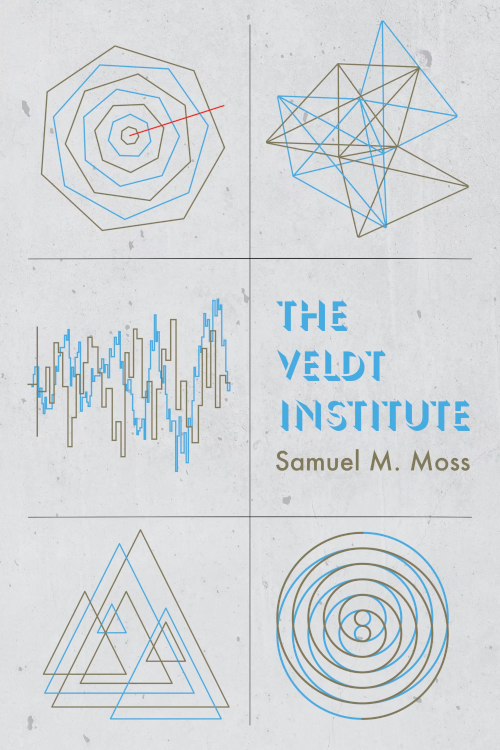
This is not a review, per se. It is more a series of impressions and associations meant to entice you into reading this curious, beautifully designed debut novel, one of the first few titles published by the promising new press Double Negative. As the book opens, its narrator begins to describe the titular Institute in meticulous detail, laying out its structure, purpose, staff, and treatment modules. As the pages turn, these descriptions interleave with the narrator’s own progress reports. The patients at the Veldt Institute are each on an individual treatment track, and yet they live lives of striking uniformity, as in a Zen monastery, the military, or a psychiatric facility. This latter, of course, seems the most obvious analogy, as the patients follow “treatment” and see “doctors,” but the freedom they enjoy is not found in a typical psychiatric hospital. I thought of the Jungian psychiatrist John Weir Perry’s residential center Diabasis, established to allow so-called schizophrenic persons to work out their pathways through “ego-death” on their own in a safe, supportive environment. It was the very antithesis of standard psychiatric “care.”
Importantly, as it was at Diabasis, there is no medication distributed at the Veldt Institute. Instead, residents take a series of behavioral “cures”, including a “rest cure”—a kind of sanctioned idleness that would be stigmatized on the “outside” as avoidance of responsibility. It is not all rest, though, for there is also work detail, such as cleaning the courtyard, similar to the “work practice” or “active zazen” one experiences during a Zen Buddhism retreat. Other cures include meditation on healing sculptures, walking the paths around the Institute’s grounds and beyond into the veldt itself, basking in the medicinal rays of the golden veldtlicht, and reading from the many “books of ideas” found on the Institute’s bookshelves:
The search for meaning is a constant struggle, and freeing one’s self from this struggle is one of the unintuitive tasks undertaken at the Veldt Institute. I imagine many of these texts are, through their very form, designed to push one further away from the truth as we commonly perceive it. That there are myriad other forms of meaning is clear, but calling these structures of importance meaning can occur only through allegory.
And could this novel be read as allegory? Certainly there is the temptation with airy, spacious texts such as this to probe at that interpretation. Rene Daumal’s novel Mount Analogue came to mind as an example sharing common ground with The Veldt Institute. As in Daumal’s book, the narrator’s progress reflects what could be construed as a symbolic confrontation of life’s challenges in the quest to find meaning—a hero’s inner journey. Experiences accrue over time and we mature (in theory), gaining knowledge and wisdom, as our aperture on the world widens and we shed our youthful naivete. Of course, each individual’s path through life is unique, just as the treatment plans for the patients at the Institute. As the narrator states, “One must learn how to construct his or her own myths, for this is the only way to take agency over one’s existence.”
This statement hints at a utopian quality to the Institute, a kind of New Age sensibility associated with the counterculture of the late 1960s and early 1970s. A subset of this culture sought alternative living and working arrangements through communal effort and in communion with the Earth. One of these communities, still active today, is called Arcosanti, located in central Arizona. The community is based on the principles of arcology (a fusion of the terms architecture and ecology), which is an approach to urbanism that emphasizes sustainability. The architecture of Arcosanti’s buildings is breathtaking in its utilitarian beauty, much like how the Veldt Institute is described. Moss pays particular attention to this description, indicating the relevance of the residents’ surroundings to the success of their treatment.
With the exception of the doctors, the characters in the book remain unnamed. However, there is one recurring character known as the Holy Fool. This person serves as the voice of doubt and challenge to authority, similar to the trickster characters found in folklore and myth. He is a disrupter to the status quo and vexes the doctors to no end with his antics. Is he mad? Perhaps, or maybe he has merely completed the treatment and is determined to show it’s a sham. It is hard to say when each person is on a separate path. Early in the novel, when under the care of Dr. Otto—the first-phase doctor—the narrator experiences a “Moment,” a psychedelic-like experience of being on the cusp of viewing everything from above—of truly perceiving reality as it is, once the veil of subjectivity has dissolved. It is this view the narrator wishes to reclaim, one that the Holy Fool may indeed have already absorbed.
About a quarter of the way into the book, there is a chapter that contains a single sentence: “At the Veldt Institute everyone is sick so no one is sick.” As I read this, I was reminded of the Indian spiritual writer and speaker Jiddu Krishnamurti’s famous quote: “It is no measure of health to be well adjusted to a profoundly sick society.” Are the residents of the Veldt Institute well-adjusted and, if so, does that adjustment only apply within the confines of the Institute, when the world outside is said to have collapsed? Who is making the judgment that “no one is sick” or that “everyone is sick”? Does “everyone” include the doctors? They do appear increasingly buried in their own esoteric concerns as the novel progresses. Is the Institute even a real place? Could it be simultaneously real and unreal? Paradoxes such as these underpin its structure, which shapeshifts over time as the Holy Fool’s cackles echo in its rafters.
As our narrator passes beyond the final treatment phase and the book draws to a close, history itself can be understood to reset—a sense arises that the Institute’s function is recursive in nature, suggesting a transformation akin to the life cycle of the mythical phoenix. This iteration has turned to ash, and a new history pulsates in its embryonic stage. Yet, a question persists: how many narrators have come before, and are there more yet to emerge?
I remember reading Gerald Murnane’s The Plains—another open-ended, grassland-adjacent novel—and pondering the emptiness haunting its core. Did it mean anything? Was it meant to mean anything? And perhaps most pressingly of all, did I want it to mean anything? In general, I don’t look for meaning in literature. I look for it to ask questions, either ones I’ve never thought of or ones that I find myself obsessing over. I don’t mind if it toys around with possible answers in a vague, tangential way, but I prefer nothing definitive to emerge. The lines of inquiry in The Veldt Institute converge and diverge before ultimately dissipating in the veldtlicht, which some readers may find maddening. For me, it felt comforting, like peering into mirrored fragments of life in all its absurdity and contradiction, punctuated with sudden moments of clarity and transcendence.
The Veldt Institute, by Samuel M. Moss. Berkeley, Tucson: Double Negative, September 2025. 254 pages. $22.00, paper.
S. D. Stewart lives in Baltimore, Maryland. He is the author of the novel A Set of Lines and a member of the collaborative publishing project Ghost Paper Archives.
Check out HFR’s book catalog, publicity list, submission manager, and buy merch from our Spring store. Follow us on Instagram, Bluesky, and YouTube. Disclosure: HFR is an affiliate of Bookshop.org and we will earn a commission if you click through and make a purchase. Sales from Bookshop.org help support independent bookstores and small presses.

