
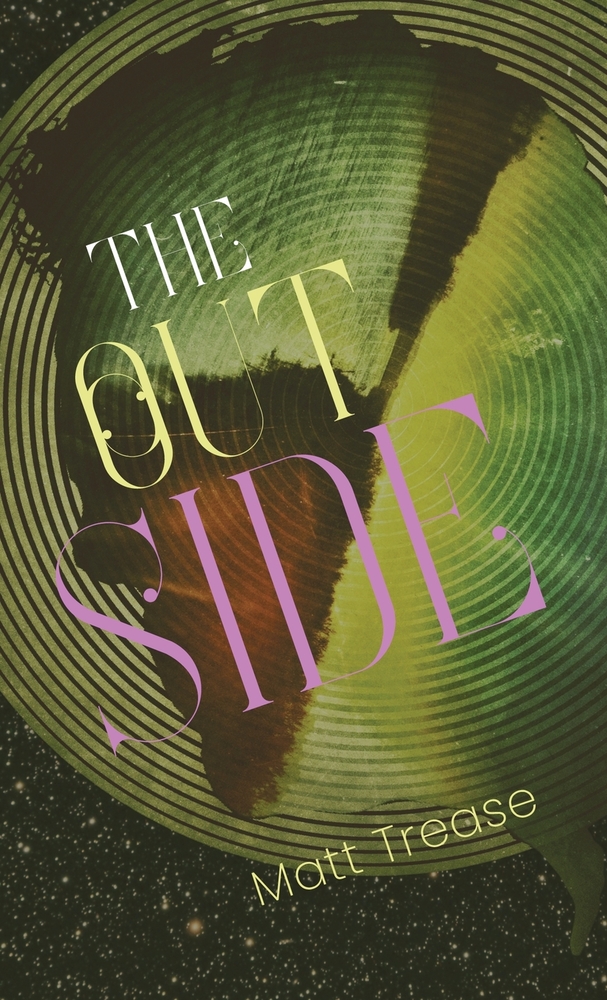
When I think about what it truly means to be an engaged writer, I think about writers who confront the world from some set of principles: Muslim, Christian, Buddhist, Hindu, Jewish, communist, or socialist, through an indigenous belief system or some other source of precepts and strictures. Matt Trease is just such an engaged writer, and his first full-length collection, The Outside, doesn’t just lay out his principles, his grounds for engaging with the world, but enacts them on the page. It also shakes up my mind; Trease’s vision is informed by the sorts of ideas and practices that, through ingrained prejudice, I had come to see as ungrounded, lacking in engagement with the so-called real world. His writing, offhandedly erudite then quotidian then back again, is informed by mantic practices and pagan traditions that I have tended to dismiss as “woo-woo,” new agey, or any other epithet that allows me to ignore them. But, in fact, no writer could be more committed to reality than this one. Through the journey it enacts, The Outside shows how an investment in writing practices can break down dichotomies of self/other, human/nature, body and soul until one sees reality more clearly and more clearly sees what is wrong with it.
If we look at the book as a whole, The Outside reveals a classic structure consistent with Trease’s precepts and familiar to any reader of modernist long poems. The book begins in the dayworld with “In the Belly: an Imbolc Daysong,” moves gradually into the long, visionary nightworld descent of Trease’s brilliant “River of the Inside,” and gains at least a temporary union of the two worlds in the final “Epithalamion.” What unites all the poems is the natural world in which Trease writes, the Duwamish river watershed south of Seattle, Washington that is the touchstone for this collection. In essence The Outside is a 21st century “Wasteland,” but it isn’t cultural collapse that Trease is invoking and critiquing, like Eliot, but the much less classist, much more immediate collapse of the environment that sustains our lives. Both Trease’s book and Eliot’s end in notes—they are both tissues made partly of echoes and allusions—but at least for our time what Trease hears is much more important to listen to.
The first long poem in The Outside, “In the Belly; an Imbolc Daysong” is Trease’s effort, following Bernadette Meyer’s Midwinter Day, to write continuously in the course of one meaningful day, getting past any impediments of rationalization or exhaustion through punning, allusion, bibliomancy (opening books from around his own library, turning to pages at random, scanning what’s there for the missing oracle) along with bits and pieces of researched or remembered lore taken from wherever his mind lands: from Duwamish traditions, from scholars like Geoffrey Bateson, from old songs, from Hollywood movies like Caddyshack and Groundhog Day. I would also call it a didactic poem, a laying out of what Trease understands about the unity of self and world, how that unity can be discovered through poetic imagination, and in what ways our 21st Century American lives keep us blind to it:
In this standard rhythm, today is On a typically rainy Puget Sound day, he proclaims this “turning,” this “fleshing out” of time even in his daily shower: As above, so below; as inside When the moving of his mind alongside the phases of the day goes out of sync, he turns like Meyer to memory, wordplay and association: Lost the music again Ultimately, at the end of this day-long prayer to the union of mind, sense and breath, to “solid-air-ity,” Trease asserts his great aim, against “our stockpiled store- / rooms, our Frankenstein-ed food / supply our Industrial distrust / of difference our dopamine- / dispensaries,” to “i- / magi-ne like ol’ Blake”: and for a brief moment Anyone who can bring together Blake and Bill Murray impresses me. In any case, this poem makes a necessary and exhilarating start to the project of the book. The longest poem in the collection, “River of the Inside,” builds on the practices first found in the daysong and fashions a 46-page dive into what it means to live near, even ON, the Duwamish River, a partly buried, long-polluted waterway that backbones the ancestral homeland of the original “People of the Inside,” the Duwamish. About this poem, Trease informs us: The poem was composed in two parts: the first part commenced in August/September of 2022 and the second part during March of 2024. Both were composed ritually using bibliomancy, overheard audio, and tarot.
That description may tell us a bit about how the poet managed the feat of concentration that this work records, but it doesn’t begin to capture Trease’s prismatically angry, swiftly cogent movement of language and meaning, a movement that mimics the current of a river moving not just through space but back and forth through time. Trease explores the loss of relation to both present and past that our modern obliviousness to the river has created: “What does it mean to be without / a history murmuring Sound / some thing faintly like water” and through concentrated language to reach toward some other way we and it could be: T H E U N K N O W N! even disarray needs practice
puts us on a path In all honesty, however, this poem only transcends our damage to the Duwamish and ourselves in passing fancy; it is largely a whirlwind, a jagged meditation bringing together the modern history of the Duwamish and its watershed. Its waves of fragments comprise myriad details about the Duwamish as it has now been captured and tainted; a critique of contemporary, limited ideas about environmental restoration; Trease’s own analysis of the monotheistic dualism that structures our culture’s ways of looking at the river and our relation to it; alongside very brief flashes, beyond “cause and effect” in which the “misfortunate joy of language” revels in water and stars. “An Epithalamium,” a poem on the occasion of the marriage of Trease’s longtime comrade-in-literary-arms Paul Nelson to Bhakti Watts, is the final poem and in many ways the sweetest. It gives further evidence of just how Trease’s way of thinking and writing informs everything he does. There is the intentionality of erudition—typing out the site of their wedding as “Big Lake” in Lushootseed, the Duwamish language, which certainly conveys more about the occasion than “Lake Washington.” There is the technique of punning not just on words but on syllables, alongside pop cultural allusion, as here, where Trease calls out the changes the lovers must adopt: Sing, Hymnaios! Ch-ch-chchanges
The final lines of the poem deftly capture the sense of possibility that marriage entails, if lived out deeply and passionately: In here, trails Here “trails” suggest a way of marrying the earth that sustains us, but only for the moment of the ceremony. Trease blesses the marriage of close friends, a winning sentiment, but this is simply a final grace note in a dark, impassioned book, a melodic moment in a larger, bracingly dynamic but necessarily dissonant composition. The Outside, by Matt Trease. Seattle, Washington: January 2025. 164 pages. $18.00, paper. Dave Karp is associated with Margin Shift, a Seattle, Washington, reading series dedicated to supporting writers outside the mainstream. His articles and reviews have appeared in Golden Handcuffs and Heavy Feather Review. He has taught high school English in Seattle for 26 years. Check out HFR’s book catalog, publicity list, submission manager, and buy merch from our Spring store. Follow us on Instagram and YouTube. Disclosure: HFR is an affiliate of Bookshop.org and we will earn a commission if you click through and make a purchase. Sales from Bookshop.org help support independent bookstores and small presses.
a quantified halfway point
between the winter solstice
and the spring equinox
I am trying to tie together
those turnings
of the wheel
of the year
to flesh
out time
from death
to rebirth
so outside. Our bodies are composed
of up to 60% water, and now the river water
is returning to river composed
of parts of me I’m letting go
in this contained rain.
[…]
I looked back
Euridice was
Gone
go on
Gawain
time to listen-
In again
will BEleave
it might teach us
how not to
BE
scared of our own
shadow
processes catching tiny crumbs
in the heart you thought
a small bird, a roach, a flower
made thy music so other
things I make easier
every time
emotion
may grow
more rooms
than I had fortunes for
time, ancient history
your lucky charm
The not-listening
to weak, self-
pityinglofty
pre-tenses, ambitions
the primitive can sense
and accept
do not become
labyrinths
but remain
openings
 Heavy Feather Review