
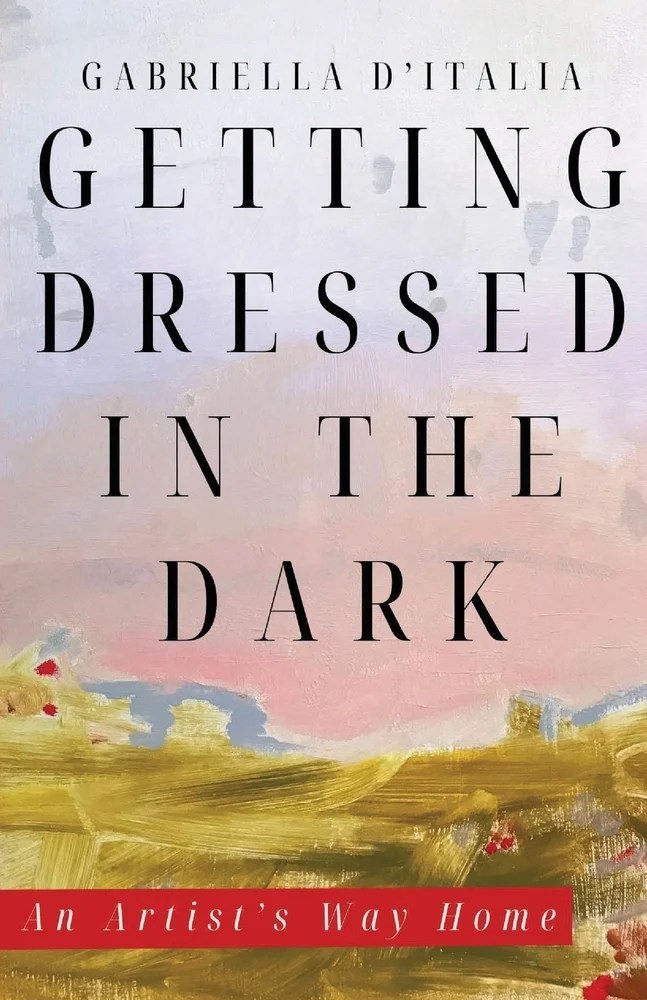
The crisis that catalyzes Gabriella D’Italia’s debut memoir, Getting Dressed in the Dark: An Artist’s Way Home, is a gruesome separation and divorce, when D’Italia learns that her partner of twenty-two years has been cheating on her with her much-younger coworker and friend. However, Getting Dressed in the Dark is much more than a divorce memoir. Overlapping vignettes, relational recollections, and micro-essays on art and craft, mind and body, are stitched together to create a contemplative journey toward self-integration.
The book starts in the bathtub. D’Italia provides minimal context for her soak, inviting us to assemble meaning and implication from the scant, sensory details she furnishes: “pinkish brown tiles that covered the walls and ceiling,” a matching tub, “episodes of Bored to Death [streaming] from a Kindle.” D’Italia is seeking refuge at her parents’ house after leaving Maine—a metonymic signifier for her marriage and her exquisitely constructed home, the Bell School, which doubled as her creative space—”in a blur of violence just a handful of fleeting and interminable months earlier.” We do not have full access to the circumstances of D’Italia’s flight until much later in the book, but D’Italia recreates the emotional import of this unanticipated ejection from her life in vivid language throughout.
While the book hinges on D’Italia’s divorce—brought about by a situation so stereotypical and banal as to be doubly repugnant to D’Italia, who views normativity of any kind as a mortal enemy—the substance of her marriage remains almost ancillary to the text. In the chapter titled “Divorce,” D’Italia takes a much more metaphysical approach. She writes not about the civil or religious union of separate persons but the nature of how one apprehends knowledge. “Logic was never meant to lead,” she asserts. “The mind has no joy.” D’Italia’s writing style is meandering, associative, and confidently quiet in the way of those who trust their work will find the people for whom it is meant.
For D’Italia, the most significant separation in all of our lives is the divorce between intellect and material, knowing and being. D’Italia has spent her life trying to seam this split, primarily through her art practice, as well as mysticism. “In art-making,” she writes, “I found something to surrender to: the place where my ideas met the world. I surrendered to style.” Style is a key concept for D’Italia, and she defines it as “presence at the union of body and spirit.” Style is not a concession to trends or self-constuming according to external expectations. Rather, style is an organic expression of one’s inner meaning. Her work is a call to wholeness.
After D’Italia finds herself disenchanted with corporate America by the age of twenty-three, she and her husband Rob elect for a less conventional life. Their move to Maine marks D’Italia’s entry into the world of textiles, first via costuming, and then with quilting. “I’d arrived in a kind of work that inspired me, kept me desiring, kept me living,” D’Italia recalls. “It was analytical and planful, while at the same time being intuitive. It needed the body and the mind. When it was finished, it was both useful and beautiful, intimate in everyday life.” D’Italia’s explorations of her artwork—fiber-based, sculptural, domestic, alchemical—are among the most potent passages of the book. Her reflections are dense with experiential wisdom, and they extend an invitation for us to engage in an equally tangible pursuit. My experience of Getting Dressed in the Dark was highly sensory: I read her opening bathtub passages while stretched on a floating mat in a cool lake, occasionally warping the pages with lakewater. Later, I creased the book’s red spine against a table and read the propped-open text while my fingers flitted around a crochet hook, creating cloth through a series of interlocking knots. This kinetic processing allowed me to enter deeper into the text. D’Italia is a narrator exquisitely attuned to multiple ways of knowing, to femininity, mysticism, and counterculture, to curiosity and queerness.
D’Italia’s meditations about art-making, materialism, and style are placed around the more emotionally hot passages detailing her husband’s infidelity, his betrayal of shared narrative, and her departure from Maine. First and foremost a quilter who understands the way meaning arises from the interplay of materials, D’Italia has meticulously patterned the book. Its flow is both intuitive and intentional, if understated. She writes about her preoccupation with work that occupies background, and similarly, the meaning of Getting Dressed in the Dark must be apprehended intuitively, a kind of osmosis rather than forceful internalization.
This book is a strange gem that will resonate deeply with select countercultural artists. It is for those whose material work foregrounds the body while inviting collaboration with the mind. It is for those who recognize the work of living as a spiral journey, ever revisiting similar questions, ever discovering new intersections within the self.
Getting Dressed in the Dark: An Artist’s Way Home, by Gabriella D’Italia. Portland, Oregon: Unsolicited Press, October 2025. 304 pages. $22.95, paper.
McKenzie Watson-Fore is a writer, artist, and critic currently based in her hometown of Boulder, Colorado. She serves as the executive editor of sneaker wave magazine and the inaugural critic-in-residence of Mayday. Her work has been published or is forthcoming in Christian Century, Full Stop, Master’s Review, and elsewhere. She can be found at MWatsonFore.com or drinking tea on her back porch.
Check out HFR’s book catalog, publicity list, submission manager, and buy merch from our Spring store. Follow us on Instagram and YouTube. Disclosure: HFR is an affiliate of Bookshop.org and we will earn a commission if you click through and make a purchase. Sales from Bookshop.org help support independent bookstores and small presses.
 Heavy Feather Review