
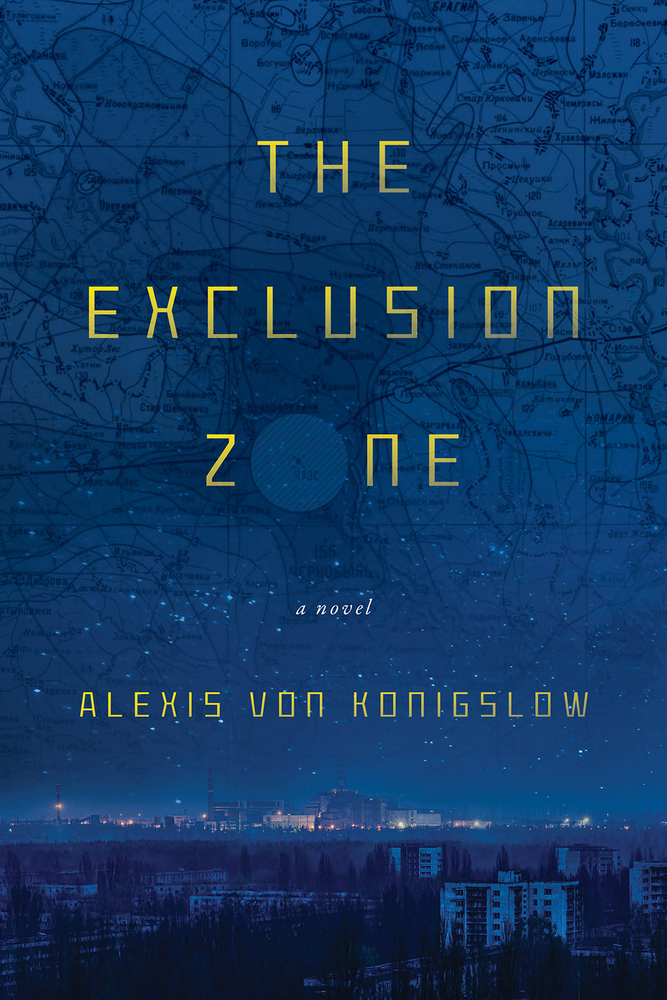
Chernobyl. The name itself conjures a range of emotions and images, and my own intrigue in this infamous disaster was more than sufficient to pique my interest in giving this particular title a read. There’s a fantastic German word for the overwhelming sense of unease that’s palpable throughout—unheimlich—literally, “unhomely,” or the exact opposite feeling of the warm, contentedness of home (physical, emotional, or otherwise). Of course for some, Chernobyl is home. And in this gripping read from Alexis von Konigslow, Chernobyl and the eponymous Exclusion Zone provide a haunting backdrop for the pursuit of that ultimate human desire—the truth.
Set in the eerie stillness of the Exclusion Zone—the 30-kilometer radius around the site of the accident with the highest levels of radiation—our protagonist Renya has been unexpectedly and mysteriously awarded a research grant to complete a computer program capable of detecting fear. Arriving in the area in close proximity to the site of the Chernobyl nuclear disaster, she’s both intrigued and frightened of the woods that surround the makeshift research headquarters—despite the very real danger of contamination, intrigue wins out.
As she settles in, Renya, a university physicist, begins to learn more about the history of the accident, from both video archives and accounts from the locals—namely, an enigmatic man named Yuri. Despite the dangers of radiation contamination, at her request to see more of the area, he takes Renya deeper and deeper into the Exclusion Zone, bringing her closer and closer to the answers she seeks—and danger. She also learns that the other researchers are dealing with mysteries of their own, their findings in areas from animal behavior to botany surprising for all the wrong reasons, and point to a terrible truth the world isn’t ready to accept.
Working to complete her fear-detection program, Renya becomes close with fellow researchers Claire and Shantoo—two of the only other women in the group. They share their findings, and fears, appreciating a rare sense of safety and comfort in an otherwise uncomfortably gender-disproportionate setting.
The narrative of The Exclusion Zone is undoubtedly gripping and well-paced. The setting is, suitably, unsettling, and keeps us just a little on edge as a sense of danger grows quietly but steadily in the background. But ultimately for me what really made this both a compelling read and something I kept thinking about long after finishing was its central conflict of truth vs. belief. The themes of this novel—sexism in the sciences and the way women are treated in traditionally male-dominated spheres; climate change and humanity’s seeming indifference in the face of its terrible consequences; the role that authority plays in the dissemination of information—all come down to truth, and what we choose to believe to be true. This conflict comes out in how Renya interacts with other people, like Nick and Yuri, as well as with herself—what she tells herself about the dangers of the Exclusion Zone and why she’s there in the first place.
Renya’s relationships are a prime example of how our own “truths” can be flawed and based more on what we want to believe as opposed to the actual reality (if that even exists). For example, although she maintains her commitment to finding truth throughout the novel, Renya often betrays her own hypocrisy when interacting with her estranged husband, Nick. Their conflict revolves around his supposed affair after recovering from a heart attack, despite his repeated denials that anything happened. Despite his repeated defenses, Renya is unwilling to accept a reality besides her own:
“Whatever I did,” she said. “Whatever I did or didn’t do. Whatever I did wrong, it didn’t mean that you should fuck another woman.
“I didn’t!”
“You did something”
“I acted like a child.”
“You went to play pool with some woman, and you kissed her, and who knows if—”
We get bits and pieces through their interactions over video chat—Nick’s concern for Renya is readily apparent, especially as her actions become more reckless.
This conflict between truth/fact and faith/belief isn’t limited to how Renya relates to her husband and others. Her increasingly reckless ventures into the Exclusion Zone—again, ostensibly seeking the “truth” of what happened and the remaining consequences—contradict her training as a scientist who ultimately knows the risk of her actions but nevertheless chooses to ignore them. Emotions, as we see numerous times, overwhelm reason:
“I thought it was fairly safe,” Renya whispered, “for short stays at least. That’s what they told us.”
“And you believe your government?”
Renya said nothing.
“You really trust everything they say to you?” Yuri pressed.
She didn’t know if she trusted the government. She didn’t know if she’d believed what her administration had said. She didn’t know if she believed it now. But Yuri was right. She had been exposed. And she was here.
I began this review by saying that The Exclusion Zone is about the truth, or rather our pursuit of it. But really that’s only partially accurate. It also addresses faith, belief, and guilt—or rather, everything that influences how we respond to truth and how we decide what truths to believe. In other words, our entire concept of reality. Belief, after all, comes down to choice—one that informs everything about how we see the world.
Reading The Exclusion Zone is like walking through the dark, silent forest itself—the deeper you go, the closer you get to the truth. And what truth is that? I encourage you to pick up this title to see for yourself. There’s a good chance you’ll arrive at an entirely different truth altogether.
The Exclusion Zone, by Alexis Von Konigslow. Hamilton, Ontraio, Canada: Buckrider Books, May 2025. 224 pages. $21.00, paper.
Kevin McMahon is a writer from Illinois. He received his B.A. in International Business from North Central College, where he also studied German and contributed to the International Brecht Society’s Communications. A native of New Hampshire, he lives in Chicago’s southwest suburbs with his wife and two cats.
Check out HFR’s book catalog, publicity list, submission manager, and buy merch from our Spring store. Follow us on Instagram and YouTube. Disclosure: HFR is an affiliate of Bookshop.org and we will earn a commission if you click through and make a purchase. Sales from Bookshop.org help support independent bookstores and small presses.
 Heavy Feather Review