
Roast Duck with Plum Sauce
At two in the morning my mother phones, waking me. Insomnia, fear, and the need to talk have overwhelmed her once again. There’s pain between us—some open wounds, some badly healed ones, some jagged scars—but we both know we have only a few months left.
“I’m hungry,” she says.
“Make a sandwich. I’ll stay on the phone with you.” I push the pillow up against the wall and settle in.
“I don’t want a sandwich. You know I don’t eat bread.” My mother is obsessively thin, at times anorexic in the days when that was something to be proud of. She is delighted that chemo has given her a serious thigh gap. I am not thin.
“You like peanut butter. One peanut butter sandwich won’t hurt you.”
“I want roast duck. I want your roast duck.” My mother always sneered at my cooking. Chemo has knocked out not only her ability to sleep through the night, but also her need to inform me I don’t measure up.
“The problem is, you have no style.”
“Better than the alternative. What good is a great meal if you’re completely distracted by the presentation?”
“Why bother with a great meal if you’re just going to slap it on a paper plate and sling it on a dirty tablecloth?”
“Make a sandwich, Mom. I’ll come home tomorrow and roast a duck.”
“Well, okay.” She submits with poor grace.
As my mother clinks the plate and knife, rustles the bag of frozen bread she keeps for guests, we talk about what a wonderful cook she is. She’s not, but that’s her image of herself. We talk about her favorite deli in New York, the one she went to with her grandmother before I was born. “The iced tea came in tall glasses with carved silver holders and monogrammed silver spoons for the sugar. So very high-class Russian.” She sighs, nostalgic. “Do you still have that gold rimmed serving platter from my grandmother?”
“Of course.”
“Good. That would be perfectly lovely for duck.”
As she eats her sandwich, my mother retells the story of the restaurant in Boston she and my father went to when she was pregnant with me. Baked garlic bulbs in miniature ceramic cups, woven baskets of sourdough bread, and fresh seafood caught right off the pier and carried through the dining room to the kitchen. Theater. “The morning sickness was so bad, I still get nauseous thinking about fish with garlic. But was worth it.” Despite our baggage, I know she means the morning sickness, not the restaurant.
I reach for the pencil and pad I keep next to the bed. With the phone on speaker, I jot down what I’ll need for tomorrow’s dinner. Duck. Broth. Oranges and plums. Rice. Maybe snow peas. Carrots. Butter. I don’t want to put Great-grandmother’s gold-rimmed platter on the list, but I do. I want my unadorned offering to stand on its own, but tomorrow it will disappear into the theater of bright vegetables, slices of fresh fruit, drizzles of sauce, and gold rimmed presentation. That’s just the way it is.
A Slice or Two of Carrot Cake
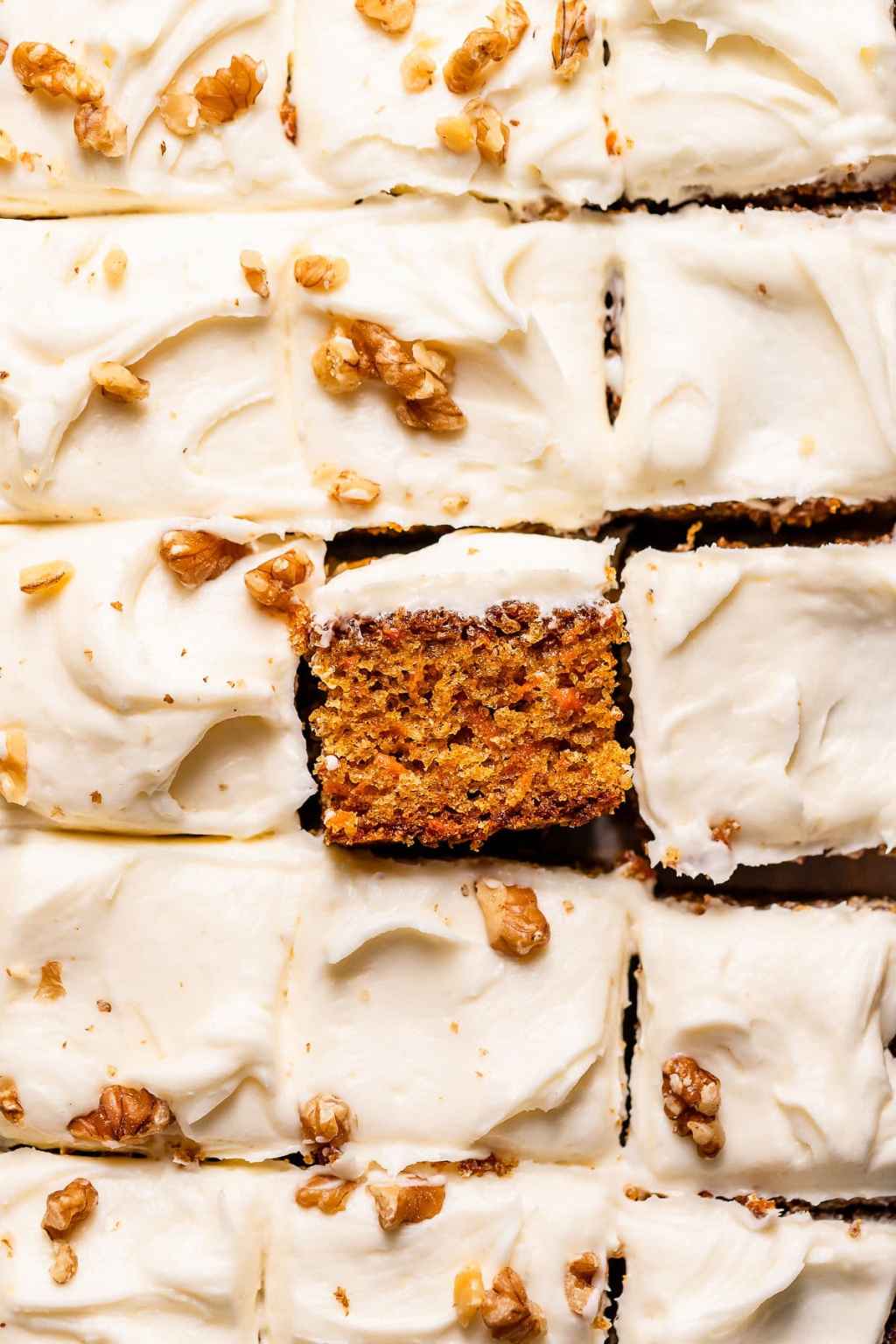
In the bakery today I bought a slice of carrot cake, with lemon cream cheese frosting and a cream cheese frosting carrot on the top. It was nestled on a bed of paper lace inside a plastic shell and I bought the biggest slice. When I got home and raised the lid, that single large slice fell apart; it had, in fact, been two slices side by side; the cream cheese frosting carrot decorated only one. Had they originally been a single slice, or were they from two completely different cakes?
- If I had filed for divorce last month, this split would be a sharp-edged metaphor indeed. I’d stuff the second slice into the trash and slam the lid and laugh or weep or maybe just a bit of both.
- If I were married just a year, this flaw would ring with dark foreboding. I would press the slices back together, shift the carrot to the middle, repair the icing with the back of a spoon, and hope that no one saw the seam.
- If I were single I might reminisce about the last time love had conquered me, and how that meant-to-be-forever oneness simply one day dropped away.
- If I were an only child, I might long for a sister or even a brother to laugh with at this cake transformed. Then we’d split it into perfect, equal shares.
- If I had three brothers and two sisters, I’d learn the futility of attempting to create anything resembling an equal share, and that all the shouting about the size of the slice is not about the cake.
- If I’d been happily married for thirty-four years, I would recognize that two entities never form a single whole. In fact, we are best when we remain unique but aligned so closely that we look like one from outside the box, and we no longer know whose idea the carrot was.
- If I were recently widowed I’d lament that such a crucial part of existence can fall away and yet still be there, the same as ever, so close you think you can touch it, and I’d put the cake away to eat later, sometime later, with just the lightest caress of the carrot on the top.
As for me, I have been all these things and more as my thread of years unspooled. I bought the biggest slice because this cake brings back the taste of spring and lemon cream cheese frosting makes me smile. I ate the double slice myself, with the carrot on the top. It was delicious.
Yes, Bananas Are Yellow
The old aunties tell Cara there are five kinds of fruit you should never put in your underpants: plums, apples, cantaloupes, watermelons, and bananas. Plums are too soft, apples too hard, cantaloupe too big, watermelons way too big, and bananas too obvious. The old aunties snigger when they say this. Cara is embarrassed because she is pretty sure they are laughing at her.
Cara is the kind of little girl who likes to double-check everything. Efficient living relies on accuracy of data, and efficient living is the key to a long and satisfying life. The aunties have told her this. For fifty-six days she tracks the good and bad events of her day. This way, if she finds a four-leaf clover, she will be able to measure the precise amount of good luck it brings. Adding carraway seeds to the chicken feed is supposed to keep the chickens from wandering off, but when put to the test, the chickens ignore the plan, and Cara has to search the woods to find them. When Mother learns that Cara not only deliberately left the gate open, but wasted expensive carraway seeds, she is utterly furious. Cara likes the word “utterly” because it is decisive.
Her brother tells her that when she loses something she needs to carry a stick between her teeth and woof like a dog while hunting for whatever she’s lost. When he tells her she will live to be one hundred and one if she takes off her clothes and sleeps in the snow on the first full moon of the first blizzard, she’s pretty sure that’s just a joke. Thinking about it, she also stops carrying the stick and woofing.
The old aunties dream up more facts for her to test.
The lesson about the five fruits, for example, obviously needs to be validated. The first four meet expectations. The plum squished when she walked, the apple caused a bruise between her thighs, the cantaloupe fell out and smashed on the ground, the watermelon wouldn’t even go in. But there are no bananas in her remote village, thus she is one fruit short. This is worrisome, as incomplete knowledge can be a handicap to planning her life.
Several years pass, and one evening, in the hayloft, Samuel shyly presents her with a banana—the old uncles had explained where to find one. Samuel is two years older than Cara and they have been best friends since they were children, even though Samuel’s slapdash approach to living one day at a time makes Cara crazy sometimes. Cara puts Samuel’s banana in her underpants, but she still doesn’t know what’s obvious about it. She is a little puzzled that it stays attached to him, but she’s a bit distracted to think about that for long.
Several more years pass, as years tend to do. Cara continues her quest for accurate data and a well-ordered life. She is proud of her efforts; she’s progressing reasonably well. She peels an apple and throws the skin over her left shoulder to reveal the first letter of her true love’s name. She enters her newlywed home with a new broom and a loaf of warm bread. She hangs a horseshoe with the open side up over the front door to catch the luck. When she’s pregnant, she peels an apple and throws the skin over her right shoulder to reveal the luckiest first letter to name each of her children. Her four children grow strong and loud and messy and happy.
One bright morning, a ringing of bells and rumbling of wagons bursts across the fields. A traveling circus arrives in the tiny village, jolting the spring day awake with an explosion of red and blue striped tents, gold flags waving and snapping in the breeze. Men with strange accents shout out to beckon the villagers, who rush to leave their ordinary lives behind for a day, to wager on the games of chance, to enter the mysterious tents and see the wonders of the world. Acrobats! Fortune tellers! Dancers! Breathtaking tales of fire-breathing dragons and the lost treasures of Atlantis! Spices and sweet frying oils bite the air. Exotic foods from the mountains of Kathmandu, the shores of Arabia, the jungles of Peru, display their colors like overflowing baskets of precious jewels.
Wait a minute. Bananas are yellow?
Samuel turns pink and scuffs the ground with his foot.
Their laughing children—Sonya, Samuel Jr, Zuzanna, and baby Soxie—tumble about, as muddy and rambunctious as puppies.
Samuel buys a yellow banana and shyly presents it to her.
The old aunties snigger. Cara is embarrassed because she knows for certain they are laughing at her.
Yes, it turns out to be quite obvious why you should not put bananas in your underpants if what you’re after is efficiency and order, but a satisfying life is rarely well-ordered or efficient. Chaos swirls around Cara, with its noise and confusion and dust and complete lack of adherence to any discernable plan. Sighing, she takes the banana from Samuel but keeps his hand in hers. Together they buy utterly delicious frozen custard creams, a different flavor for each child, then hug them and send them back out to play in the mud. They are children, after all. Cara decides she can forgive herself for being young and gullible and ignorant, once upon a time.
She points a finger at the old aunties, no longer embarrassed. “You just hush!” she says.
And they do.
Elissa Matthews was born and raised in New Jersey, but eventually launched on a journey of discovery, working many jobs, including bartender, cook on a prawn trawler, and cold-water SCUBA diver. She once again lives in New Jersey, twelve miles down the road from where she grew up. She has one published one novel, Where the River Bends, and a collection of short stories, Bittersweet and Magic. Her short stories and poetry have appeared in several journals and anthologies.
Image: wellseasonedstudio.com
Check out HFR’s book catalog, publicity list, submission manager, and buy merch from our Spring store. Follow us on Instagram and YouTube. Disclosure: HFR is an affiliate of Bookshop.org and we will earn a commission if you click through and make a purchase. Sales from Bookshop.org help support independent bookstores and small presses.
 Heavy Feather Review