
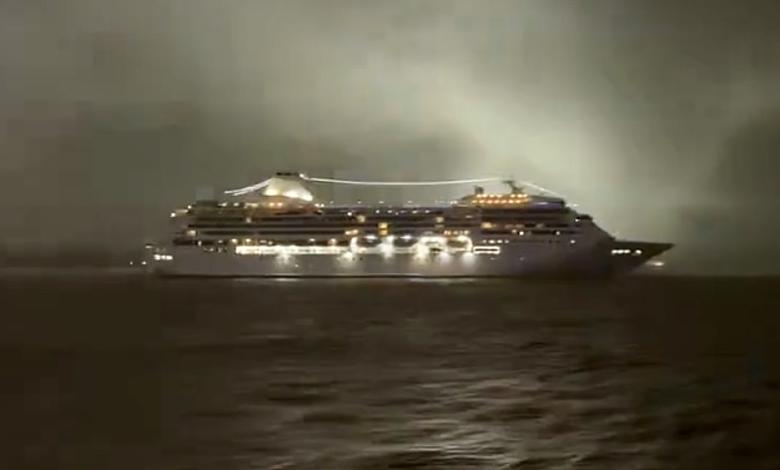
I stood on the ship’s balcony, my head hanging over the railing, thick clusters of orange vomit merging with the darkening sea like Postmodern art. Agreeing to this was like stepping into a floating dream that mixed toxic positivity with aggressive self improvement through gurus and pickleball, astrology, and Pilates. I could hear the judgement oozing from the women’s glowing skin, tight, rubbery abs and slick hair that remained in place even after they’d sweated through a workout. It was obvious that I didn’t belong here.
My wealthy in-laws, Bettina and Roy, swore by Paradise Recovery Cruises and bought me a ticket for a Mediterranean jaunt two weeks after the doctors let me leave the hospital. Bettina and her housekeeper April moved in with Josh and the baby to help them out. It was strange to get their updates, to see pictures of my and my daughter’s lives going on without me.
The waves tossed underneath me and my stomach roiled. I’d thanked my in-laws profusely, although I immediately regretted saying yes. When I gave birth to Alma four months earlier, I was elated. I didn’t know it was possible to have my body torn apart, my baby ripped from my arms and taken to the NICU moments after she was born and still feel an exhilarated sense of being able to achieve anything, still feel love emanating from every part of me.
I went into labor at thirty-five weeks, my water breaking without my even knowing what happened, my sheets slick with streaks of pink like a summer sunset against white clouds. I couldn’t get out of bed, Josh had to lift me, and he recognized the blood, my body’s willingness to do something my mind was not yet ready to conceive of. One of my friends, who was an installation artist, had recommended watching birth videos and I watched an elephant give birth, while standing up, after carrying her baby for two years. I had vivid dreams of prickly, olive colored lizards and long black and yellow striped snakes in my suddenly murky drinking water. I also dreamed I was swimming in what I thought was a pool, surrounded by green plants, and I swam towards a giant orange plastic castle, my growing stomach grazing piles of small neon pink and orange rocks. I was sure almost right away that we were having a daughter. She’d have dark wavy hair like me, and calm, dark lake blue eyes like Josh.
I listened to classical recordings everyday. I played my violin for her everyday, everything from lullabies to the pieces I was working on. We talked a lot about names. My real name, Tatiana, meant fairy princess, which always seemed bizarre when I thought of the no nonsense way I was raised. My mother thought this was hilarious. “What do you mean it’s ridiculous, it’s a classic name. Who cares what it means?” My family and close friends called me Tanya, which meant honorable in Russian. When my family become religious when I was older, I learned that it also meant it was taught in Hebrew.
I knew Josh would be indifferent to a name that reflected anything Jewish. No naming after dead grandparents, dead rabbis, or anything like that. Josh was nominally Jewish, but aside from a guilt laden drive once a year to a synagogue on Yom Kippur, where he didn’t eat but chewed gum and drank a minimal amount of water, there was not much Jewish about his lifestyle.
I was born in Russia, moved to a small town in Israel with my family for two years and then we moved to Toronto. We were excited to replace sweltering heat with fresh air and snow, to see my parents work as engineers again. We lived in an apartment building on Antibes Drive, in the heart of Toronto’s Russian Jewish community. Most people around us spoke Russian or Hebrew.
I was halfway into my master’s program in Composition and Performance at the University of Toronto when I met Josh. He came to one of our concerts. We were playing Dvorak, and he said my playing moved him. He was in his last year of law school, and he said it was one of the few times he’d let himself get mentally absorbed in something else.
We got pregnant not too long after getting married, and almost right away, I started looking up names of famous Jewish musicians. He shot a few of them down until we landed on Alma. I didn’t really know who Alma Rose was, just another Jewish musician who’d died tragically in the Holocaust, but the name meant nourishing and supportive in Latin, knowledgeable in Arabic, and a leap in Greek. I thought about my brother Alex’s bar mitzvah speech. My parents had just gotten involved with the Russian Chabad synagogue, and he talked about names, the one our parents give us, the one our friends give us and the ones we give ourselves. The one we give ourselves is the most important, he said, and from then on, I started going by Tanya. I also decided if I had kids one day, I’d give a lot of thought to what I named them.
Alma was perfect. Even Josh agreed.
What was even worse than Alma’s birth was her time in the NICU.
They led us to her room, through a maze of corridors to a passage full of black and white photos of kids who were born early at miniscule weights who’d developed into adorable older children. They were meant to be reassuring but when the gravity of her situation hit me, I couldn’t stop crying. What if after everything we’d gone though Alma didn’t survive this?
We were given a padded bench that folded out to sleep on. She was in a plastic box, and we watched her breathe, tangled and covered in wires. They gave her oxygen and took her temperature and what felt like hundreds of unnamed tests constantly. The doctors and nurses explained everything badly. My brain couldn’t take in the information. There was a constant whirring of noises, the beeping of machines, the nurses barging in at all hours. I could only hold her when someone was there to supervise me. I had to pump breast milk, and no one warned me how much it hurt. One of the nurses told me it was liquid gold, and the best thing I could possibly do for her. Another told me she wasn’t gaining enough weight, so they would start supplementing with formula. They barged in at all hours. I didn’t sleep much for three weeks.
Josh often stood at a distance, his eyes wet and full of fear until an older nurse assured him that bottle feeding the baby was his job, and he was doing great. I cried because no one had thought to say anything encouraging to me. The lactation consultant told me I had to be careful because my breasts were now so large they could suffocate her if I wasn’t careful. She stuck her hand underneath my breasts and repositioned Alma forcefully.
They were paranoid about germs. They watched us wash our hands and sanitize everyday, even though we were staying there. The skin on my hands felt raw and chapped. Anytime anything fell on the floor, one of the nurses would remind us that the floor was lava, and we had to throw it away. When they finally let us take her home, I wasn’t sure I’d know how to do anything myself. Josh had to go back to work, and I was alone all day with Alma.
I made it my mission to make sure that I had read all the latest parenting articles and blogs and watched the latest videos. I learned how to swaddle her, how to change her diapers in seconds, what the best organic baby bodywash and detergent wash. I washed my own hands all the time, for forty seconds or more. I went through tons of hand sanitizer and made anyone who wanted to see her sanitize or wear a mask, including Josh when he got a cold from work. I got up to nurse her every hour, or every two hours and there was so much to do I could hardly sleep in between.
I didn’t need to. “She energizes me,” I told anyone who’d listen. “She’s healthy, she’s gaining weight. Our pediatrician is really happy with her.” Our condo had never been so clean.
Josh kissed me forehead one night and said “I never knew you were such a talented chef, babe,” when I made spinach ricotta ravioli for him from scratch. He had always been measured with his compliments, his mother being a believer in all flattery being intended to deceive, so I knew he meant it. I challenged myself to make more foods that I knew he loved, authentic paella with shrimp and chorizo, bibimbap with homemade sauce, and homemade tuna handrolls cut from a fifty-dollar piece of sushi grade tuna. He said I was a dream wife, that I ironed and folded his shirts better than a dry cleaner. Of course we didn’t need a maid, he agreed, when I was such a natural at everything. My parents said I was acting jittery when they came by to visit, but I knew they were just worried about me because of what we’d gone through.
I didn’t tell them that my ears were still ringing from the NICU machines, that often when I tried to sleep, I’d hear them beeping, and I’d jump up, full of guilt to check on Alma, to make sure she was breathing and okay, that she was swaddled tightly and safely, that she had everything she could need. I didn’t tell them that all the beeping, phones, alarms, the microwave, the washing machine, made me sweat and feel my heart pounding in my throat. I told them that they didn’t remember what it was like to have a baby. Everyone said how cute she was, how adorable, how sweet. She was more beautiful than I’d imagined. I found myself fantasizing about her future, about all the amazing things she could be as Josh worked later and later, and we saw him less.
I called her Almaschka, the way my Bubbie called me Tanuschka and I hope she felt as loved as I did. The first time something bad happened, I boiled water for tea in the fancy Scandinavian kettle Josh’s parents bought us and forgot it was there. The water kept boiling, the stove kept heating and soon, smoke billowed out of the kitchen like a scene from a movie, and the smoke detectors screamed like little girls having full body tantrums and Alma screamed and I picked her up and ran outside to the neighbors who called 911 and the fire department came and at some point Josh came and explained to everyone I was a new mom and sleep deprived and everyone seemed okay about it.
The next time was much worse. I took Alma for a walk through our neighborhood after a fresh snowfall. The snow sparkled like frosting on a wedding cake. I pictured her being bigger, running around making snowballs and throwing them, wearing a bright blue snowsuit, lying down in the snow making snowballs angels. On my way back I lay down with her in our backyard. She was still strapped to me and I heard her laugh as I lay on my back, my arms moving up and down, my curls getting wet. Then she settled down and I think we both fell asleep. I woke up to Josh standing over me screaming, Alma was underdressed and crying hysterically and how long had we been out here? I didn’t know. Time had no meaning anymore. The world around us looked like a messy watercolor painting, like a gradient scale of whites and grays. My vision was blurry. I wondered if I was wearing my contacts, if I’d remembered to put them on earlier. My breasts was spraying thick drizzles of milk through my jacket.
He rushed us both into the car, “to the hospital,” he said, Alma to pediatrics, to make sure she didn’t have hyperthermia, he said to me angrily. He deposited me in the ER, and eventually, a day and half later, so I’m told, I ended up in the psych ward at the same hospital where I’d given birth to Alma.
When I woke up, a woman was standing in front of me. She had big, dark eyes and chin length, wavy brown hair.
“Hi, Tatiana.”
Was I Tatiana? I felt like I’d been bludgeoned in the head with something sharp, then thrown into a lake where I was just trying to breathe, and paddle and start to get my bearings.
“Hi,” I said, choking out the word.
She held up a glass of water from my bedside table. “You need to drink,” she said, and I nodded.
“This must be so hard for you,” she said. “One of the reasons I never had a baby was that I couldn’t imagine the sacrifice.”
A baby. The thought hit me like a concrete silo. Alma.
I hadn’t thought about her in days, had it been weeks? I’d been dreaming about playing violin, about mastering Bartok’s Sonata for Solo Violin for an enraptured crowd, I was enjoying myself so much and I wanted to cry because even my dreams were selfish, I didn’t know if she was okay, if Josh or his mother or my mother knew how to take care of her. I wanted to cry but my eyes felt painfully dry.
She put a hand on my shoulder.
“It’s not selfish to want to make the most of your talents. Music always got me through my most difficult times in my life. You’ll get through this.”
“How do you know?”
Her smile was mysterious but sweet. She smelled like French violet candy and fresh jasmine. She turned to leave the room.
“I just do. That’s all I can tell you. And I’m touched that you named your daughter after me. It’s nice to be remembered.”
My jaw dropped and I felt the tears coming full force as I heard Josh and a person I assumed was my doctor talking just outside the door.
“Look, she isn’t getting better,” he was saying forcefully. “She’s in there, looking like she’s awake and talking to herself again”.
“Well, it’s likely that we need to increase her medication.”
I could hear Josh sighing deeply.
“Okay,” I heard him say. “Do whatever you need to do to bring her back.”
It took a few weeks, so I’m told, but the medication did eventually work. It made my thoughts more clear, it dulled my anxiety and fears, it made Josh feel safe in bringing Alma to visit me. It felt so good to see her and hold her.
His parents paid for the cruise as a last stop before I started taking care of Alma again. They’d hired a night nurse and a daytime nanny, but if I wanted to step into taking care of her and the house slowly, they wanted to support that. Josh seemed to trust me a little bit more everyday, if tentatively. I’d scramble eggs and make toast for us, and he’d pour the orange juice and watch me eat and swallow my pills in one dry, acidic gulp.
Josh packed my suitcase for the trip. Bettina even bought me some new dresses. I’d lost a lot of weight postpartum, but some of the psychiatric medication caused me to gain a little bit back. She brought me some looser styles, some billowing caftans and tunics in multiple jewel shades, full of silver and gold sparkles. I brushed my hair and got dressed. I dabbed on the new gold eyeshadow she bought me with my fingers.
One my second night of the cruise, I found myself looking up Alma Rose. Her life had been short but fascinating. She was Mahler’s niece, and her father had been the concertmaster of the Vienna Philharmonic. She founded an incredibly popular touring women’s orchestra in the thirties and managed to evade the Nazis until 1942. She led the women’s orchestra in Auschwitz, using music to distract herself and maintain her dignity, saving countless lives by recruiting women to play instruments, even if they weren’t professionals.
I wondered how she maintained her ambition and love of music and still managed to save people when she couldn’t save herself. On the third night, there was an event where we were encouraged to think about our greatest regrets, write them down and burn them in a controlled communal fire. Some people volunteered to read them out loud.
“I’m sorry I cheated on you,” a ridiculously handsome man, with gold-streaked hair and sharp cheekbones read out loud from a letter to his ex.
“I didn’t love her. I was more attracted to her than I was to you. I know you’re not supposed to say that. Love is supposed to be unconditional and eternal, but Lana and I had chemistry, she made me laugh, and she was sexy. I was attracted to all the potential, for an easier life, but I regretted it from the moment I let you go. I’ve missed you and thought about you every day since I confessed and you left me.”
We watched as he dropped it into the fire, as it dissolved into embers.
He sat down, a mix of emotions running across his fine-featured face.
A woman who looked around my age stayed sitting and read hers in a shaky voice.
“I’m sorry I gave up my beloved rescue dogs, Fiona, Simba, and Sophia. I loved them so much. They were each so loving and so loyal and full of trust. They’d look at me with their soft brown eyes like I was their universe. I wanted to take care of them and give them everything. I’m ashamed at how easily I gave them up, because a guy I was dating wanted me to get rid of them. He was an awful guy, but I was insecure, and everyone kept telling me how lucky I was that he wanted to marry me. I miss my dogs and I think about them everyday. I wish I could have loved them until the ends of their lives. They gave me so much.”
Eventually, it was my turn. I picked the container in my purse with my daily pills, which I’d started taking at night because of the time change. I opened the remaining plastic pockets, with the pills for my remaining days and watched them drop one by one into the fire. I watched them fizzle and pop, I watched them disappear completely.
I turned around and headed back to my room.
I tossed and turned but eventually fell asleep. In my dream, I woke up in my bed at home, sweating, and feeling my skin roast. I could see thick flames of orange and red everywhere I looked, I could smell the smoke as it singed my lungs. I panicked when I heard Alma coughing, and I ran to her crib. I wasn’t sure where it was coming from, if it was the same fire I’d made in the kitchen and this was my fault, if the dryer had caught fire in our laundry room, if it had been candles or an appliance but the flames grew higher and thicker, and I just managed to grab Alma and make it outside. Josh had been asleep beside me, and I’d tried to wake him, but he’d gone back to sleep, telling me I was overemotional. “It’ll be fine,” he muttered, “go back to bed.” When I shook his arm before finally leaving, when I told him I was worried about him, and didn’t know why he wasn’t taking I was saying seriously, he asked if my medication was right, if I should see my psychiatrist to increase it.
I woke up shaking. I found the pencil and notepad they’d given me earlier. I wrote my thoughts down as quickly and non judgmentally as I could. Then I walked out onto my balcony and read them out loud.
“I don’t know if I was ever in love with Josh, the way things are supposed to be when you’re crazy about someone, and you’d do anything for them. I married him because it made sense, but when I got pregnant, I realized that maybe it didn’t. I still wanted to be myself. When I was drowning, he expected me to save myself without causing any trouble. If I feel this alone,” I read slowly, the conviction dawning on me again, “I’d rather actually be alone.”
I crumpled the paper and threw it into the thrashing blue black.
I went back to bed and fell into a deep sleep. I dreamed I was doing a concert in a glamourous European music hall, full of chandeliers and beautiful instruments and a large, stylishly dressed audience. My daughter was six, in sitting in the front row, in a blue fancy dress, with my parents and brother watching. We were playing Mahler’s Symphony of a Thousand. When we got to the violin section, I looked up at my conductor. It was Alma Rose, and she gave me the kind of smile that reassured me that she believed that I was capable of anything, even possibly greatness.
I woke up and realized I was smiling. I wondered if my family knew any good lawyers, if they’d help me pay for one. When I got off the boat, I was going to pack up Alma and her piles of clothes, her organic diapers and creams, her knitted elephant lovey and all of her blankets. I’d pack up a few outfits of my own, my violin and composition books, my books on music history techniques, and one day, when I finally had the guts to leave him, we’d be ready.
Danila Botha is the author of the critically acclaimed short story collections, Got No Secrets,
for All the Men (and Some of the Women) I’ve Known, which was a finalist for the Trillium
Book Award, The Vine Awards, and the ReLit Award, and, most recently, Things That Cause
Inappropriate Happiness. The collection won an Indie Reader Discovery Award for Women’s
Issues, Fiction, and was a finalist for the Canadian Book Club Awards, the Next Generation Indie
Book Awards, and the National Indie Excellence Book Awards. She is also the author of the
award-winning novel, Too Much on the Inside, which was optioned for film. Her new novel, A
Place for People Like Us, will be published in Sept 2025. Her first graphic novel will be
published in 2026 by At Bay Press.
Image: 973thedawg.com
Check out HFR’s book catalog, publicity list, submission manager, and buy merch from our Spring store. Follow us on Instagram and YouTube. Disclosure: HFR is an affiliate of Bookshop.org and we will earn a commission if you click through and make a purchase. Sales from Bookshop.org help support independent bookstores and small presses.
 Heavy Feather Review