
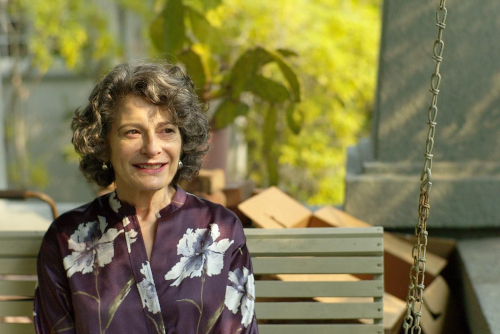
to begin and end in the garden, slapping mosquitoes, reading her book
White lily, red lily, azalea, camellia, wisteria, salvia, grape arbor, rose.
She checks anxiously on each plant, notes who is dead or barely surviving, who
is furiously blossoming and shooting up green for reasons she can’t fathom—
what if garden is a bed in straw, the steaming breath of animals,
a fever dream, a scarlet river restless inside its reflected sky, a
domed or tented place, an unnamed grief
or another negative space that hasn’t arrived yet, is arriving, did
(did not) arrive
what if a garden resists
*
First, these currents of air, this sun, these plants and their roots, the ghosts in
the walls, then if she can hear them, words. The ones she will allow—
She kicks away the fallen leaves as if searching for something lost. And so
losing it more completely?
What would it be like to say irretrievably? Or even, more irretrievably?
if she can bear it
*
She observes the gestures of her own hands, her walk, and breath, listens to
her own pulse and voice, the fascia sliding over her muscles, her tendons and
nerves—
how, without recourse to any sort of iconography,
to form a picture
no, a perfectly formed human body
to hold in mind an owl’s concentration on a mouse, the
green bark of an olive tree, the insects living there
the insects that will bring it down
*
A voice rises, calling over the play of small children. What does the repetition
of the vowel in no, no, no hope for?
leaves scattering
a line’s turbulence
on laid paper
a source of crossing out
and finally,
I twist my heart
round again
the sound of sanding and sawing
orange towels hanging from yellow clothespins
swan-like cyclamen blossoms
*
One of the red cyclamens has spread itself open, stems softened, petals like
watercolors running. A strange corpse—not hard, desiccated, but instead
dismantled by too much water within.
She is preoccupied with touch, and its consequences—for example, the
yellow and purple mottling of a bruise, or the hardness of a dragonfly’s green
iridescent body which keeps her from feeling alone.
*
She doesn’t know the word for this much green. But she reads that Hildegard
von Bingen, in the 12th century, took a word right out of its Latin frame—
viriditas:
greenness
and made it to mean:the soul is a tree unfolding the feminine green is green is green is Green is. And she is scraping it off the garden bricks with her trowel— She notices a small tear at the armpit of her dress where her movements have as if she were an actual green leaf, or a scarab
digging in the garden, and the mosquitoes buzzing
yes, she must give even these their due—
from now on, I would stand outside myself, watch over and to make herself known or unknown *
On the windowsill an old bird’s nest straggling. Long grasses unwoven from the to paint the walls with beautiful pictures
then, as our grandmothers taught us we all make things and what we make places us giving birth, giving death—one and the same time
*
A spider weaves a web of holes, mapping a pattern of air. how very small. how small?
I held out my hand as if to ward off a blow.
there is no way to write about how delicate is our need.
*
There’s an image inside the wrecked cyclamen which she can’t quite She waters the plant, though she knows this instinct is wrong. —As for me, I’ve lost my own image.
*
She stands in the dusk watching the shadow the pink rose casts on the wall and she looks for one more way to repent time— she meant to say represent— meant to say time the body takes up, takes in, when all that is given is She wants to say translucency translates time
and not be told to stop. Note: Lines in italics are quoted from the writings of Anne Frank, Simone de Mini-interview with Barbara Tomash HFR: Can you share a moment that has shaped you as a writer (or continues to)? BT: I didn’t begin writing until my late thirties after working for years as a visual artist. I began writing short stories and entered a graduate program at San Francisco State to study fiction writing. Out of curiosity I took a poetry class with Frances Mayes—it was revelatory. I saw that poets used experimental processes that echoed those used in the visual arts—methods such as collage and assemblage, the play with language as a raw material—breaking lines, using fragments, shifting syntax, arraying words on the page to use white space. And maybe best of all, a poem (unlike a short story) didn’t need to be bounded by narrative, or character, or even a beginning, middle and end. A second revelation came in the classes I took with Myung Mi Kim. The innovative poets we read—Susan Howe, George Oppen, Edmund Jabes, Bernadette Mayer, Leslie Scalapino, Kathleen Fraser, Lorine Niedecker—showed me just how much work I had to do. I began to practice, practice, practice. HFR: What are you reading? BT: Recently I’ve been reading several collaborative works including Rendered Paradise (Apogee Press) by two of my favorite poets, Susanne Dyckman and Elizabeth Robinson. Their collaboration is multi-dimensional in that the poems focus on the works of visual artists—Vivian Maier, Agnes Martin and Kiki Smith—so they are collaborating not only with each other, but also with specific artworks. Over time, I’m reading in the experimental-poetic essay collection One Thing Follows Another (punctum books) by Sarah Rosenthal and Valerie Witte in which, in alternating essays, the two writers explore the work of dancer-choreographers Yvonne Rainer and Simone Forti. Currently, I’m reading a collaborative manuscript in progress by David Makaah Kwon and the poet Heidi Van Horn. This extensive and multi-faceted documentary work cannot be easily described. In part it follows the relationship between Van Horn and Kwon, which began to take shape in the form of letter writing when both were teenagers and Kwon became a ward of the state of Hawaii (he continues to be incarcerated to this day). Finally, I’ll mention a translation as collaboration, the fascinating novel The Painted Room (New Directions) by Inger Christensen, beautifully translated from the Danish by the poet Denise Newman. HFR: Can you tell us what prompted “to begin and end in the garden, slapping mosquitoes, reading her book”? BT: Once I get going, I find it hard to stop experimenting—I’m fascinated by what emerges from reshuffling and reframing language and by all the permutations of meaning new juxtapositions allow. When I completed writing my most recent manuscript, a book-length hybrid poem titled Biography in a Walled Garden, I collaged passages from the book to make two (so far) new, much shorter poems. One of these is the poem featured here, and the other, “Mostly, she is trying to learn Italian,” appears in the latest issue of Conjunctions. Making these poems, treating the long-poem as raw material, reconfirmed my sense that working with language is something like swimming in an endless sea—if completion is the shore, then it’s a shifting mirage. Biography in a Walled Garden itself was shaped by an unusual process for me—working through material I began writing loosely over fifteen years ago while sitting in an overgrown walled garden that recalled the garden depicted in the Annunciation paintings I was visiting almost daily while living in Florence. Saturated by these images of a woman’s ordinary life in one moment transformed, I found myself imagining what it would be like to exist in her reflected light, captured by encounter—held in the tension of engagement and resistance, disruption and arrival. The walled garden—its moving shadows of clouds and birds—the Italian language, the paradoxes and challenges inherent in all language-making, the profound impacts of motherhood, and of foreignness make up the landscape in which this work exists. While I have been writing this book, I have also been reworking paintings and drawings I made as a young artist many years ago. I am drawn these days not so much to self-revision as to visiting and collaborating with my past self. HFR: What’s next? What are you working on? BT: A couple of years ago I was working intently on a poetry manuscript, In the Dark and in the Sea. I was about to embark on a final revision of the book. I decided to take a break from it for a couple of weeks and work on something else, something short. I began writing a piece that I thought might become the start of a chapbook. Instead, it became the book-length poem Biography in a Walled Garden. The weeks I had planned to work on the new piece turned into years! I kept thinking about getting back to In the Dark and in the Sea—it troubled me deeply to leave the book for so long. Now that Biography in a Walled Garden is finished, I’m eager to go back into the abandoned manuscript—but after so much time, will I be able to reenter it the way it deserves? I can’t wait to find out, but I’m stymied by the cognitive and energetic deficits I’m experiencing with Long Covid. I’m crossing my fingers that In the Dark and in the Sea will continue to wait for my undivided attention—it’s next! I’m also continuing my relatively new work as an associate editor of the online journal Posit (Issue 40 was released this week). And I participate in several long-standing writers’ groups—it’s inspiring to be involved over a period of years with the work in progress of writers I admire so much. HFR: Take the floor. Be political. Be fanatical. Be anything. What do you want to share? BT: If I begin to rant, how can I stop? And forgive me—how can I not echo the words of so many others who speak more eloquently and knowledgeably? Every day, almost every hour, there is a new threat to democracy, to the rule of law, to the programs and institutions that promote people’s well-being, health, freedom to think and work independently—and for many citizens and immigrants, even their survival. Racism. Misogyny. Intolerance. Cruelty. The distortion of reality. All to the end of consolidating authoritarian power. We carry on our everyday lives—those of us who can—but real harm is being done with an octopus’s reach. We want (and need) to oppose, to resist; we want to continue to imagine and create, as best we can, a more just society. We are looking for ways to do so, some of us are finding them, some of us are yet stunned, overwhelmed and floundering. I am grateful that so many carry on—even without equilibrium or a clear path, even under threat—those artists, writers, journalists, educators, scientists, legal scholars, all the caring, thoughtful people working with hope, or despite hopelessness, within the eye of the storm. Barbara Tomash is the author of five books of poetry including, most recently, Her Scant State (Apogee), PRE- (Black Radish), and Arboreal (Apogee); and two chapbooks Of Residue (Drop Leaf Press) and A Woman Reflected (palabrosa). This year, Biography in a Walled Garden was named Runner Up for the Dorset Prize and was a finalist for the Test Site Poetry Prize and the Michael Waters Poetry Prize. Her writing has also been a finalist for the Dorset Prize, the Colorado Prize, and the Black Box Poetry Prize. Her debut collection Flying in Water won the Winnow First Book Award. Before her creative interests turned her toward writing she worked extensively as a multimedia artist. Her poems have appeared in Colorado Review, Denver Quarterly, Conjunctions, Web Conjunctions, New American Writing, Verse, VOLT, Tupelo Quarterly, and numerous other journals. Tomash is an editor of Posit, an online literary and art journal. She taught for many years in the Creative Writing Department at San Francisco State University. Check out HFR’s book catalog, publicity list, submission manager, and buy merch from our Spring store. Follow us on Instagram and YouTube. Disclosure: HFR is an affiliate of Bookshop.org and we will earn a commission if you click through and make a purchase. Sales from Bookshop.org help support independent bookstores and small presses.
aspect of God
intricate patterns of mold glowing. Green. Not an image. Not a word.
strained the fabric, an arrow-shape pointing at her
observe myself
to hide the sound of the groaning enormity
ball of nest are evidence of work well done
to spit three times into the palm of our hand
in the light of our mothers
decipher—red petals becoming pale and translucent, melting in the sun,
dripping on the terrazzo.
becoming diffuse and finally erased, a mere chalk mark, the actual, discernable,
physical thing merging with darkness, or with the few remaining, intensifying
streaks of light
a simple absolute. She refuses to say the word.
Beauvoir, and Emma Goldman
 Heavy Feather Review