
The academy has long been suspicious of literary language, considering the very concept of a privileged mode of expression privileged in other ways: elitist, exclusionary. These days fiction writers seem to agree. If they aren’t in fact autofiction, the stories you read in, yes, elite literary publications mostly try to sound as if they’re just someone like you or me talking, with the rhythms and diction of ordinary speech. Of course this is easier said than done, but my point is that stories no longer aspire to sound written, as if doing so would mean trying too hard, which would be uncool.
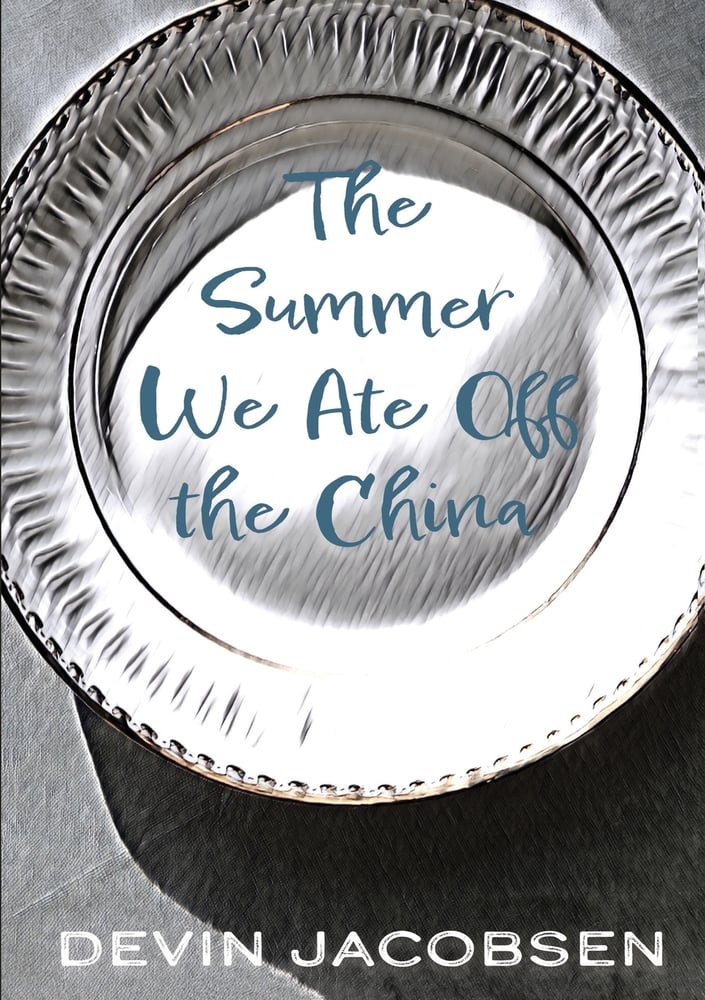
In his beautiful and wide-ranging first collection of stories, The Summer We Ate Off the China, Devin Jacobsen, author of the novel Breath Like the Wind at Dawn, eschews a fashionable cool in favor of big language and deep feeling. Many of these stories wear their literary pedigrees openly, and if you’re steeped in Southern literature, you’ll love the echoes of Eudora Welty in “Possum on the Roof,” the book’s opening story, a hilarious family drama where no one seems to know what’s going on under or on their roof: “The noise goes a-brushing and a-scraping and a-shuffling from one end of the house to the other,” the narrator reports of the mysterious sounds overhead. In the magisterial “The Man in the Sky,” the son of an enslaved woman returns as a great man to the small Southern town he escaped, searching for his mother. Watching him pause in front of Taurino’s Clock & Timepiece, the narrator observes, “I watched him shake his head, as though somehow still amazed by the great changes that time brings about in the affairs and circumstances of life, as though he had still not yet come to realize that to exist is but to hopscotch from one disappointment to the next,” a piece of advice that Quentin Compson Sr. might have given his doomed and time-obsessed namesake in The Sound and the Fury.
Disappointment is characteristic of many of Jacobsen’s protagonists, who imagine or even manage to enact alternatives to the not-great lives they’re living. In “The Elegance of Simplicity,” the narrator is scraping by while caring for his severely mentally disabled son, who may or may not have been kidnapped by his ex-wife. Living abroad as a younger man, the narrator spied his dream woman, then rushed to meet her just as her train doors were closing! When he happened to see her again, after posting three hundred lost-dog kind of flyers all over the station, he let her walk out of his life, and now he realizes what a mistake it was. But even as he thinks this, you know he wouldn’t have done anything differently. Or as in the opening lines of “Let Dogs Delight,” “On looking back, you perceive patterns, a particular trajectory to a life, and doubt it could have been any way other than what it was. But even in the midst of living can it really be any way else?” This is the moral that the narrators of many of these tales seem to draw from their lives. In “St. Petersburg” the narrator’s shrewish and frivolous wife insists they vacation with their baby at some low-tide kind of beach resort. He thinks back on a young secretary of his whose advances he spurned, feeling at the time like a “crazy man” but now thinking, “I believe she got married not long after that, that gal, and I don’t guess I should’ve done different.” In the wistful “The Good Life,” a man, separated from his wife by an ocean, falls in love with a woman who advises him to talk to his wife about their affair. He tells her it’s not so simple. “Once you and Astrid have been together for ten years, you’ll come to accept your fate with a certain amount of … happy resignation.” This from a man whose wife even once suggested they open up their relationship. But at the time, the suggestion simply struck this philanderer as “profoundly sad.” “Well,” he concludes, “I’m one kind of coward or another.”
Are these men cowards? Are they plagued by inertia? It’s true that if you somehow managed to marry your fantasy lover, you wouldn’t be where you are today. But you could find yourself in an equally bad position, or one that’s even worse, so you might as well accept the life you’re leading. This isn’t the most heroic attitude. But as Jacobsen shows in this wise collection, simply living your sort of shitty life requires its own kind of courage.
The Summer We Ate Off the China, by Devin Jacobsen. Montclair, New Jersey: Sagging Meniscus Press, March 2025. 208 pages. $21.95, paper.
Jason K. Friedman is the author of Liberty Street, a book of narrative nonfiction about the rise and fall of a Southern slaveowning Jewish family. His book of stories, Fire Year, won the Mary McCarthy Prize in Short Fiction and the Anne and Robert Cowan Writers Award. His work has also appeared in The New York Times, Literary Hub, Moment, Tablet, The San Francisco Chronicle, The Gettysburg Review, Image, The South Carolina Review, and Cimarron Review, and has been anthologized in Best American Gay Fiction, The Queer South, and the cultural studies reader Goth. His story “The Golem” was Storyville‘s story of the month. His novel The Creek Is Gone was runner-up in the AWP Prize in the Novel, and he’s also published two terrifying children’s books, Phantom Trucker and Haunted Houses.
Check out HFR’s book catalog, publicity list, submission manager, and buy merch from our Spring store. Follow us on Instagram and YouTube. Disclosure: HFR is an affiliate of Bookshop.org and we will earn a commission if you click through and make a purchase. Sales from Bookshop.org help support independent bookstores and small presses.
 Heavy Feather Review