
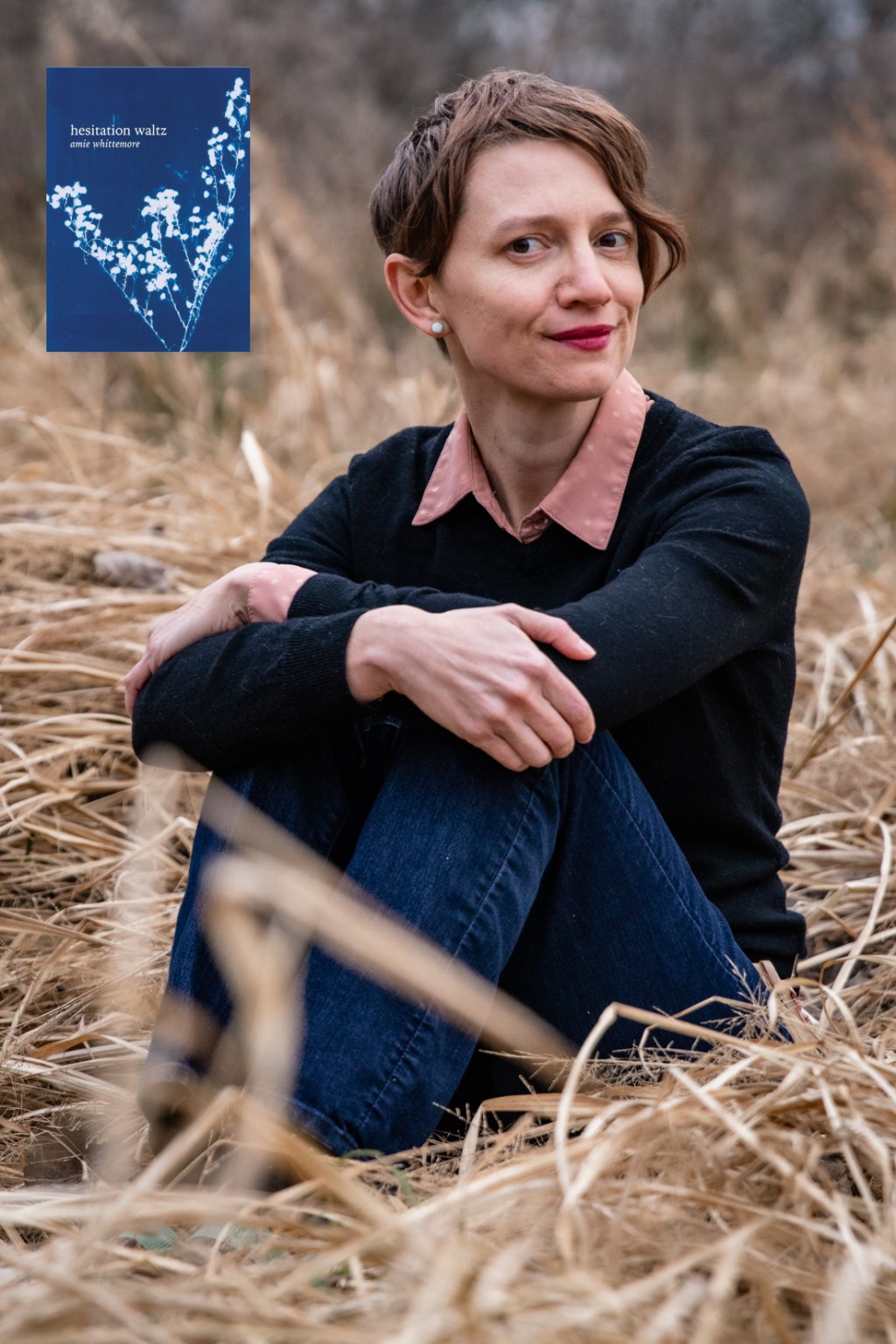
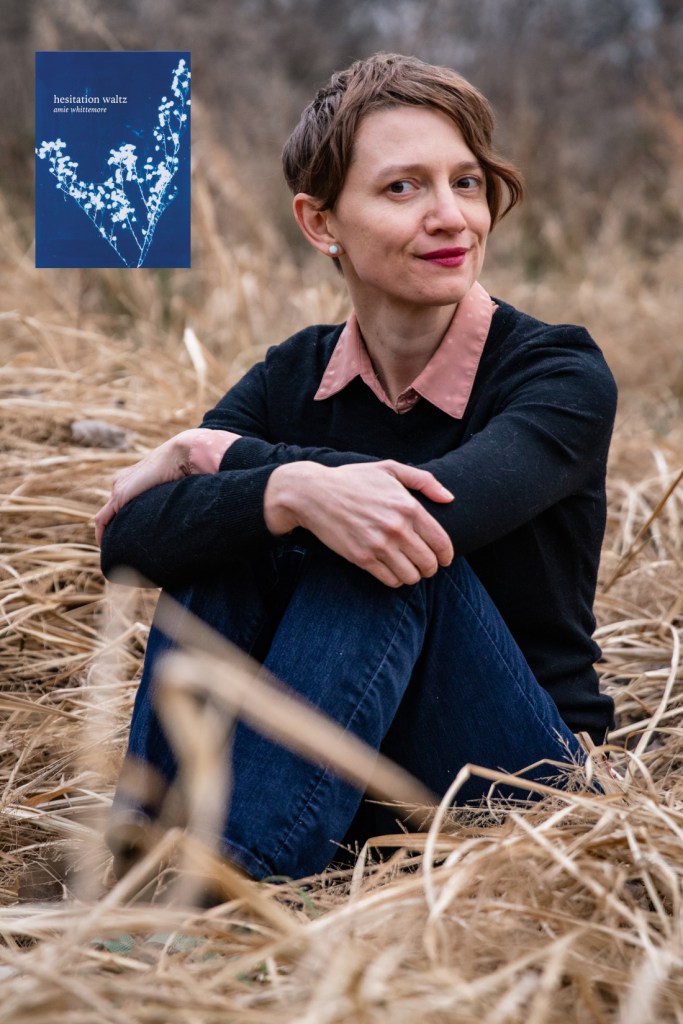
Amie Whittemore (she/her) is the author of three poetry collections, most recently Nest of Matches (Autumn House Press), and the chapbook Hesitation Waltz (Midwest Writing Center). She was the 2020-2021 Poet Laureate of Murfreesboro, Tennessee, and an Academy of American Poets Laureate Fellow. Her poems have won multiple awards, including a Dorothy Sargent Rosenberg Prize, and her writing has appeared in Blackbird, Colorado Review, Terrain.org, Pleiades, and elsewhere. She teaches creative writing at Eastern Illinois University.
It was delightful to speak with Whittemore about her chapbook, Hesitation Waltz, a text that C.T. Salazar describes as “brimming with the world’s many engines. Amie Whittemore’s lyric offers a space of potential where the pastoral meets the social. Even as the questions the speaker asks grow heavier—‘Who’s complicit?’—the poems grow lighter: ‘We’re all the kingdoms we inherit, their riches / as much as their precarity.’ Whittemore’s poems ask the ways the world is both ‘ruined and beautiful’ with us in it, and insists the task of tending to it is luminous in its imperative.”
Our conversation happened in the month of March, the month of false springs and rainstorms. In my case, Tampa was shrouded in golden pollen, which always keeps me hiding inside as the window reveals everything buzzing and starting anew. Hesitation Waltz is a memento of the natural world’s treasures, but also as Salazar notes, its insecurity. Whittemore’s poetry blends science and lyricism, highlighting the importance of imagination and narrative as rhetorical tools in environmental advocacy. In this interview, we discussed essential readings, Rate My Professor reviews, fascinating species, and how poetry can offer a magpie’s message.
Natalie Louise Tombasco: “Ghost Pastoral” situates us within the landscape of the speaker’s adolescence. The refrain, “Where the cows / once gathered for water. / Where maples tossed their samaras / like confetti,” suggests the melancholy cleanup in nature’s afterparty and that the past is not what it seemed. Haunted by the complicity of the family’s farm, there’s sorrow in the lines, “Over what I thought / was natural—our monoculture corn, / drainage ditches, even the poison / my father perfumed through / the barn slats to kill the bees.” There’s recognition that the natural world was always “ruined and beautiful.”
This contrast is evident in the epigraph with Anna Lowenhaupt Tsing’s ideas from The Mushroom at the End of the World about “contamination” and “purity.” Tsing “argues that staying alive—for every species—requires livable collaborations. Collaboration means working across difference, which leads to contamination. Without collaboration, we all die …. The diversity that allows us to enter collaborations emerges from histories of extermination, imperialism, and all the rest.” Can you discuss how Tsing’s writing is important to your environmentalism?
Amie Whittemore: Thank you for this question, Natalie! While I, admittedly, haven’t spent extensive time with Tsing’s work, what initially drew me to her was the stance you capture so well in the quote you selected: that the collaborative work of survival must emerge from/within/through “contamination.” I feel like much of the mainstream discourse around environmentalism has a problematic nostalgia to it—that if we “fix” the problem or “save” the world, we’ll return to some “pure” state that hasn’t ever existed. Tsing’s work, alongside the wonderful Robin Wall Kimmerer’s work, has helped me imagine a way forward, amid the climate crisis, instead of a way “back.” I think often of Kimmerer’s book, Gathering Moss: A Natural and Cultural History of Mosses, and moss’s ability (much like fungi) to transform/heal polluted landscapes. Here, we see that collaborative effort Tsing points to—that if we partner with other than-human species, we might escape the ruinous self-centeredness of Western/imperialist/capitalist culture and develop a more interconnected future. Maybe.
NLT: I haven’t read Kimmerer’s book on moss, but I’ll definitely add it to the must-read list. Building off Tsing’s pollution/pure dichotomy, your poems teeter between praise of the natural world and mourning what’s been lost. It seems equally important that there’s the presence of climate anxiety in poems like “Solastalgia Pastoral” and “Frail Migration,” but also abundant beauty as seen in lines, “Bright blister, bold break / in the brush of alien / honeysuckle, rarest / perfume in a disaster / of farmland.” In this way, the poems seem to be in the Romantic tradition or in conversation with Mary Oliver’s American Primitive as it’s similarly rooted in place and at once elegiac and celebratory. Why is it essential to balance those two modes of perception?
AW: For me, at least, it’s important to balance these two modes of perception because I don’t know another way of being in the world. Not that it isn’t, at times exhausting, the all-at-once-ness. But I think praise/celebration offers a way to buoy ourselves in the face of despair—to fight, in whatever small ways we can, the forces that would bring more ruin, would sacrifice more flora and fauna and fungi. Praise keeps us in alignment with our values. Elegy shows us the limits of our power, attunes us to the relentlessness of change. Even if we were in an alternate timeline in which the agricultural and industrial revolutions never led us down this particular path, there would be grief, loss, various despairs. A therapist once said to me: “the tax we pay for loving is grief,” and that’s just part of the fabric of being alive, even in the face of climate grief, which feels so frustratingly avoidable.
NLT: Since we discussed some of Tsing’s ideas, I’m curious about other texts that may have influenced you—theoretical or otherwise. If you could make a syllabus of essential ecopoetry and ecocriticism that chimes with Hesitation Waltz, what would you include and why? What’s the benefit of this literature to climate activism?
AW: Oh, thank you for this invitation. At the top of the list would be Amitav Ghosh’s The Great Derangement, as reading that book shifted my thinking in how literature can approach the other-than-human world. In it, Ghosh looks at the absence in much of Western literature, particularly fiction, of nonhuman forces and how even the most “daring” literature becomes complicit in the climate crisis because of this lack of engagement. This made me re-see so many of the texts I consume, with their relentless interest in human interactions as if these interactions were separate from the ecosystems in which they happen. It also made me try to de-center my own climate grief in the “Vox Mundi” sequence in Hesitation Waltz; in these poems I personify nonhumans, such as coral and petroleum, in an attempt to look at the climate crisis from outside my own limited perspective.
In addition to Ghosh, Robin Wall Kimmerer’s work is essential. Nature writers such as Jennifer Ackerman, Elizabeth Kolbert, and David George Haskell have also been central to my work. I also adore Soil: The Story of a Black Mother’s Garden by Camille T. Dungy, though I read it after I finished this book. As for eco-poets, here are a few collections I think resonate with Hesitation Waltz (at least I would be honored/thrilled if others recognized a resonance!): Claire Wahmanholm’s Meltwater, Katy Didden’s Ore Choir: The Lava on Iceland, Catherine Pierce’s Danger Days, Vivee Francis’s Forest Primeval, and Ross Gay’s Catalog of Unabashed Gratitude.
NLT: Adding these as we speak! Furthermore, I enjoyed your poem “Ode to My Superpower,” a response to a student’s evaluation that appears to take issue with your preference towards women’s narratives in a science fiction literature course. You write, “If curating a collection / of ‘uncomfortable’ texts / is a superpower, I’ll claim it.” It’s almost as if the male protagonist is the default—especially in the sci-fi genre—and to steer a class toward differing perspectives feels like a bait-and-switch for the aggrieved student. Please excuse my mini tirade, but perhaps, his discomfort stems from seeking a “safe space,” filling his schedule with genres that validate a cis white male identity. Can you talk about that experience and your pedagogical approach to feminist literature with a male audience? Or more broadly, can you speak to the ways sci-fi and gender have historically co-existed? Do folks overlook how subversive this genre has been?
AW: I’m glad you enjoyed this poem—it was satisfying to write. I tend to approach feminist literature with a bit of a trickster approach, not announcing it as such, particularly in a general education course, like the science fiction one I used to teach. I didn’t lead with the word ‘feminist,’ but simply told the students that my goal was to expose them to writers and texts that may not always get mainstream attention, to open them up to new writers. And, through our discussions, issues of feminism and racism and other -isms would organically emerge. One of my favorite moments was when a white cis-male student said Octavia Butler’s Parable of the Sower was the best book he’d ever read. Or when a group of students of all sorts of backgrounds (without my prompting!), rebutted (kindly but firmly) a student who kept saying women were “biologically programmed” not to succeed in business. In sum, I tried to let literature do what it can be so good at doing—changing people’s hearts and minds through masterful storytelling.
Which doesn’t fully answer your question. Sci-fi and gender have had a long, complicated relationship. Arguably Mary Shelley was one of the first SF writers with her Frankenstein. And yet, it’s centuries before we see another female writer rise to such prominence. The story of Alice B. Sheldon, aka James Tiptree, Jr., is a fascinating one; Sheldon wrote under the name Tiptree for many years in the 1960s-70s before being “outed” as a woman. Tiptree often wrote from a masculine, sometimes sexist, point of view, which often led to sharp critiques of gender and gender roles in Tiptree’s work—which I highly recommend! I think the genre is inherently subversive but also wildly marketable, which has led to certain flavors of SF being more readily accessible than others.
All that said, I think there’s so much good, feminist, anti-capitalist SF out there right now. I highly recommend anything by Becky Chambers and Annalee Newitz (particularly The Terraformers) for some hopeful, liberatory SF.
NLT: Oh wow, that’s so interesting about Tiptree—I feel like there’s a poem there. You cite learning about the medical uses of horseshoe crabs in an essay titled “The Blood Harvest” and gynandromorphic cardinals in a National Geographic post. What interested you about these two species and stories? Additionally, can you explain your approach to research, your process, and how you aim to harmonize lyricism with scientific inquiry?
AW: I wish I could say I had a coherent research process. It’s more like a dilettante magpie’s approach to research: I tend to skim and scan and pick up whatever sparkles for me—which is usually, as these examples illustrate, something that shows me the world more richly and weirdly. I had no idea that horseshoe crabs were used in medicine before reading about them; and I just love when nature proves again and again how beautifully queer and trans it is through the invention of gynandromorphic cardinals.
Often, it will take me a long time to figure out how to write about the scientific material I come across. I think by letting these ideas marinate, I can find language that stays true (or I hope it does) to the scientific reality while pointing to the qualities that matter to me—which are usually those qualities that signal the capacious weirdness of life.
NLT: I’m thrilled by your use of poetic forms as you employ the pastoral, elegy, epistle, meditation, personae, and ode. I loved the lines in the voice of petroleum where you sing, “I crave gelatinous sleep, the deep bedroom / inside stone where I was a lake that dreamt / of nothing.” Can you speak a bit on why or how these forms and traditions served as a vehicle for your attention to capitalist ruin of the environment?
AW: I’ve been working on the poems in this collection for a long time—some of them were written a decade ago! And over the years of trying to figure out how the poems work together as a whole, I found these forms useful guides, helping me to see that some poems had more in common with each other than I anticipated and that I could illustrate those connections through titling conventions. For instance, “Kankakee Mallow Pastoral” began as an ode; shifting the title to “pastoral” helped me shift the focus to the landscape in which the mallow persists, de-centering, at least a little bit, my affection for it as the focus of the poem. This allowed me to see it in conversation with the other pastorals I was working on as well.
NLT: Hesitation Waltz is a type of dance, yes? Why did you settle on this title? I like how it chimes with mobility and migrations, while simultaneously engaging with the opposite of that—being caught up in the stillness of meditative response. The “hesitation” seems to be on the cusp of change or progress, or in a Hamlet kind of way, swaying between active and passive modes. The book also focuses on the possibilities of romantic love and a healing earth. As “Patience Meditation” reveals, there is hope and potential in the imaginative act of poetry writing. Like the young girl holding birdseed for bluejays, maybe poems can bring change (or at least that’s what I tell myself). I’m assuming this chapbook is part of a bigger project, and if so, what will it aim to accomplish?
AW: I think you’ve explained my title back to me better than I could have done so myself! Yes, to all you’ve said about the title. And yes, it was an actual dance back in the early 20th century. As you note, the title captures the tensions in the book between action and passivity, between movement and stillness; it speaks to being on the cusp of possibilities, particularly the hesitancy around hoping for a healing earth (and for interpersonal/intimate connections). The only way to move through that hesitancy is to step into the dance—the grief and joy of it all, all at once.
Originally these poems were part of a full-length collection, that I shopped around for many years. It was a finalist and semi-finalist in several contests, but I could not for the life of me figure out what was holding it back from being selected. And I couldn’t afford to keep trying. So, I went through the collection and culled my favorites to make this chapbook—which was picked up by the first place I sent it to. This seemed like a sign from the universe that I had chosen well to dismantle the full-length. Who knows! Maybe I’ll figure out the dance steps to make it work someday; for now, I’m happy this waltz is finally in the world.
Natalie Louise Tombasco is a poet from Staten Island, NY, where she proudly received a public school education and was a First-Gen CUNY student. Tombasco holds an MFA from Butler University and a PhD in creative writing from Florida State University. Currently, she is an Assistant Professor at the University of Tampa. Her debut collection Milk for Gall was the winner of the 2023 Michael Waters Poetry Prize (Southern Indiana Review Press). It is a finalist for the 2024 Big Other Book Award and the 2025 Midwest Book Award. Recent work can be found in Best New Poets, Verse Daily, The Rumpus, Gulf Coast, Black Warrior Review, Diode Poetry Journal, Copper Nickel, and The Cincinnati Review, among others. Find out more at natalielouisetombasco.com.
Photo credit: Emily April Allen
Check out HFR’s book catalog, publicity list, submission manager, and buy merch from our Spring store. Follow us on Instagram and YouTube. Disclosure: HFR is an affiliate of Bookshop.org and we will earn a commission if you click through and make a purchase. Sales from Bookshop.org help support independent bookstores and small presses.
 Heavy Feather Review