
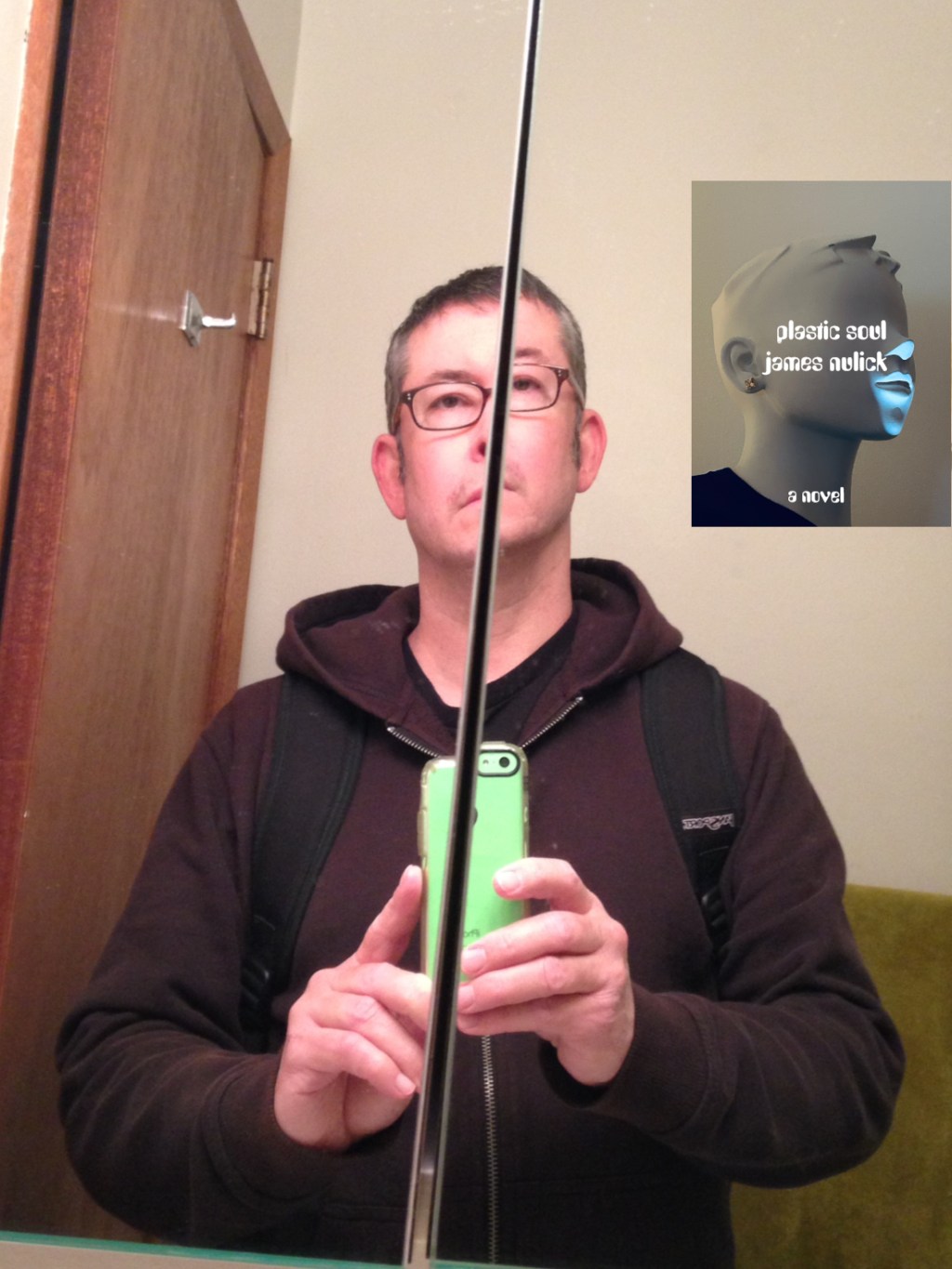
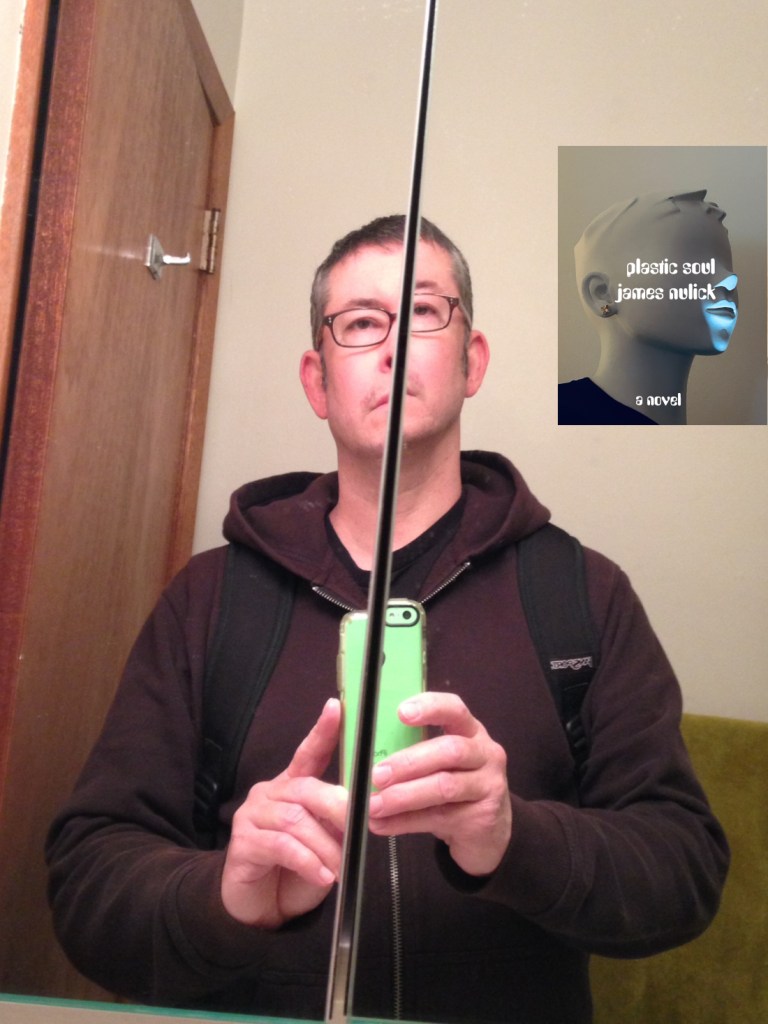
From the venom-tongued Valencia to the hallucinatory The Moon Down to Earth, James Nulick writes novels about outsiders with the precision of a plastic surgeon and the phantasmagorial style of Marcel Proust reanimated in battery acid. His hypnotic and serpentine prose cumulates and reaches new heights in his latest novel Plastic Soul, a work of speculative fiction about a future society where human cloning is possible, managing to meld the visual poetics of Sylvia Plath with a damning reflection of mankind’s worst instincts in four parts; a quartet of loneliness, vanity, and selfishness. I sat down with Nulick to discuss the novel over Zoom and then conducted the interview via email afterwards.
Matthew Kinlin: I read Cormac McCarthy’s Outer Dark recently. I noticed, like McCarthy, you use dialogue without quotation marks, which lends your prose this immersive and dreamlike quality. Can you explain your use of dialogue?
James Nulick: Thank you. Dialogue is entirely artificial. Dialogue in a book, even more so, especially if it involves quotation marks. I loathe quotation marks; quotation marks are for amateurs. Apologies if you use quotation marks, although I know you do, I read your excellent novel So Tender a Killer. It’s OK, I forgive you—you are still young! I stopped using quotation marks after my failed debut novel, Distemper (2005). I was dormant for ten years after Distemper, working, hanging out in bars after work, weekend boozing, sleeping around, learning how to write. When I wrote Valencia, my first real novel (Distemper doesn’t count), I decided to try writing dialogue without quotation marks. It was very freeing! I have a nickname for the technique I use for writing dialogue, which is always embedded within the text block, or paragraph. I call it bounce back, like two girls on a volleyball court, lobbing a ball back and forth. None of this he said, she said, no accounting for interruptions. Just like real life, whatever that is. It sounds pretentious, but it’s very easy to follow. I write dialogue in such a way that it feels totally natural. It took me twenty-five years to learn how to write natural-sounding dialogue.
MK: The key advertising slogan that repeats throughout Plastic Soul is: “How much would you pay to have an honest conversation with yourself?” If you could ask a single question to a clone of James Nulick, what would you ask him?
JN: Hmmm, I wouldn’t ask him anything, I’d advise him if he’s going to have sex, use a condom.
MK: Plastic Soul follows a quadrant of voices: Sylvie Buisom and Joey Osbium, two clients of the Chrysalis Institute; medical director Dr Daria Moore Thompson of the Chrysalis Institute; and finally, her most adored clone, the handsome Iyama Siyos. Anne Sexton writes: “I would like to bury / all the hating eyes / under the sand somewhere off / the North Atlantic and suffocate / them with the awful sand / and put all their colours to sleep / in that soft smother.” How does anger relate to these four different perspectives?
JN: Iyama is very handsome, isn’t he? Anger plays a crucial role for all these individuals except one—Iyama. Iyama is the innocent, the angel in the machine. He is our hope, the reader’s hope, humanity’s hope. The other three are just human. Sylvie and Joey are lost, misguided, selfish. They are very lonely. I don’t judge them at all—who am I to judge? They want someone to love, just like everyone else. And they want to be loved. It’s the most basic of human needs, to be loved. Dr Thompson wants to be loved, as well, but her misanthropy gets in the way. Her anger likely comes from her relation to her body, but I’m not sure. She knows she’s a hollow vessel, but then we all are. Great anger can come from feeling unloved. There is so much anger in the world, and I think it all stems from people who feel unloved. School shootings are a very recent example. If those shooters had someone to tell them, just for once, that they were loved. If that one girl had said Yes, that would’ve made all the difference.
MK: The second section of Plastic Soul, called Bro Bot, explores the unrequited teenage love between Joey Osbium and his straight friend Fernando. Osbium confesses, “I quickly inventory his armpit hair as he’s pulling his shirt over his head.” His painful longing reminded me of Yukio Mishima’s Confessions of a Mask. He later concludes, “I could be in his room with him forever and my life would be complete.” How do you connect with his sadness on a personal level?
JN: How do I connect with Joey’s sadness? Not at all. I have been in a very happy and faithful relationship for the past seventeen years. Although I sometimes wonder, how has he put up with me for seventeen years? Kidding aside, I was basically Joey in high school. I was totally in love with my best friend, who had no idea I was in love with him. He was kinda dumb, ha. But God, was he handsome. He was as straight as they come, the all-American boy next door, pardon the cliché, handsome, popular, nice dresser. And he had no idea. He didn’t have a car, though, so we did everything in my car, go to parties, go to the movies, go to the park to drink illegally, whatever. My car was my only power over him. He learned how to drive in my car. He’s married now, two kids, blah blah blah. The usual. But oh my god, when we were young, he populated my mind 24/7. And then some.
MK: In Molloy, Samuel Beckett writes: “To restore silence is the role of objects.” What is the role of the inanimate in Plastic Soul?
JN: God, what a lovely quote. Thank you for sharing it with me. I love Beckett, I read him so much in my early twenties, it was quite formative. Thank God I read Beckett first, then DFW later. I’m sure I would’ve been a pompous twit if I’d read DFW before Beckett! I love them both. The minimalist and the maximalist. Can’t we have room for both? I tend towards minimalism, same goes with material objects. Well, you know Nico, right? My plastic child, my department store mannequin? He’s kind of a spiritual lighthouse pulsing behind the text of Plastic Soul. It’s his face on the cover of the artist’s edition. Do you know the work of philosopher Timothy Morton? They speak of object-oriented ontology, the philosophy of objects, if you will. I am simplifying it, of course. What gives humans lordship over objects? Who decides their autonomy? Is a stapler a stapler because we say it is, and that is all? The clones in Plastic Soul are treated by Institute physicians as if they are objects, and sexual objects, at that. They know why the clients want them, let’s not pretend. I wanted to give the seemingly inanimate agency. I wanted to be a voice for them. Animals also play an important role in Plastic Soul. Do we have lordship over them just because they can’t speak? Says who? It angers me, adult humans always thinking they come first, before children, before animals. I come from a Catholic background. Being Catholic focuses the way I see things. If we believe humans have a soul, why not objects?
MK: On their 1977 single, Kraftwerk sing: “We are standing here. Exposing ourselves. We are showroom dummies.” Walter Benjamin describes the shopping arcades of Paris as seductive phantasmagoria; a perfect dreamscape of capitalism where, “Combs swim about, frog-green and coral-red, as in an aquarium,” exploring what he terms the sex appeal of the inorganic. At one point, the clone of Joey Osbium is described as “a rare butterfly in a display case, a living mannequin.” Can you speak about the sex appeal of these living mannequins?
JN: I’m not sure that I can. They are human, they just happen to be artificially created. Are you familiar with the CRISPR-Cas9 gene editing technology? It’s used for modifying DNA sequences. Scientists claim it can be used to correct faulty genes, improve crop traits, develop new treatments for disease, but I am sceptical. If there is a door leading to corruption, humans will always pass through that door, and under the most innocuous of pretences. But I don’t trust humans to do the right thing. How long before we create a human being simply because some wealthy couple who can’t create one on their own want it? That’s not a living mannequin; it’s a child who will someday put forth the question who am I? Where did I come from? Why am I here? To paraphrase Paul Gauguin. I wouldn’t want to be an adult on the other end of that question. I am adopted, which creates its own set of issues, so I think I have a pretty solid case against cloning humans.
MK: The fetishism of Plastic Soul extends to fashion: the teenage boys dressed in Dickies, Vans, RVCA Daggers jeans; their BMX bikes; Joey Osbium stealing a pair of Fernando’s boxer briefs to huff. Dr Thompson, amusingly, rather than listening to her tiresome patients, is more concerned with her Ferragamo shoes, which were “itching for my attention yet again, their chunky, gothic beauty.” What is the spell of fashion here?
JN: I think fashion holds a spell over all of us, Matt … we’ve been doomed since that first fig leaf. Fashion, the fabric we drape over our bodies, becomes a second skin, an extension of our body, and therefore, our reality. Is there anything more intimate than clothing? Not even our significant other is attached to our body like our clothing is—it is with us, all day long. And since we are required to wear clothing, I think it should reflect how we feel about our body. We only have one body, which slowly moves from beauty (childhood) to decrepitude (old age). Along the way, we can accentuate the good stuff and hide the bad, if done properly. I’m an old man, so I only wear black. It is the duty of the young, the beautiful, to be billboards. The old, such as I, should quietly disappear behind tasteful blacks and browns, no loud colours whatsoever. And proper shoes are a must.
MK: Dr Thompson is a fun character; her boredom with her vain patients, her consuming sexual infatuation with Iyama. She reminded me of the Juliette Binoche character in Claire Denis’s High Life; Dr Dibs who is tasked with artificial insemination on a spaceship of criminals on their mission to extract energy from a black hole. She has a device called “The Box”; a small chamber where she instructs the crew to masturbate. How do you understand Dr Thompson?
JN: I’ve never seen Claire Denis’s High Life; I must stream it. Dr Thompson is a complicated character. She’s also hilarious. My editor, a woman named Anita Dalton, who is also my friend, thinks Dr Thompson is pure evil. I’m not so sure, myself. We all walk a very thin line of what is considered proper and what is, according to law, unforgivable. But what if no one is looking? Dr Thompson has body issues, as most of us do when we are no longer twenty-four. Men can go around with a gut and uncombed hair, but it’s different for women, because society expects a woman to be perfect. Just look at your average magazine rack. Who can humanly live up to that? I’ll tell you who: teenagers. Iyama Siyos is eighteen. He’s also Dr Thompson’s idea of the perfect male body, the Kouros. She is fifty-seven, her husband even older. Her career as a neurosurgeon has reached its apex, she is wealthy, well-respected, and incredibly bored, and here is this young man, literally under her microscope, whom she falls in love with. I don’t harbour any feelings of ill-will towards her, though what she does to Iyama is indeed horrible. If anything, I feel sad for her, I sense her loneliness. Again, we all want to love and be loved, in return. Iyama wants that, too, just not with her. Her absolute power over him reflects the Institute and society at large: we worship the young long enough to drain the life from them, then we discard their bodies after the appearance of the first worry line. I love Iyama because he refuses her, he refuses to be a chess piece. He is the only true normally functioning human in the novel, to my mind, and he is a clone. Plastic Soul is the first novel I’ve written—I’ve written four novels—with a happy ending. I wanted Iyama to have the power to say no. Nobody says no anymore, we’re all afraid to. It’s very California, the constant yessing to everything. Iyama and Jace from The Moon Down to Earth are two of my favourite people, they just happen to be characters created from the royal jelly in my head. One makes it out alive, one, well …
MK: The violence of the book finds it apex in the ritualistic game at the Chrysalis Institute, known as Razors, which the clones are forced to partake in, selected by a cruel lottery. What does this game offer to the Institute?
JN: Well, the physicians claim it’s for research and development purposes, but we all know better: humans love watching other humans suffer, especially if those who are suffering are beautiful. This kind of bloodsport has been going on since the Spartans of ancient Greece. Look at the horrors going on in the Middle East right now—what has changed?
MK: Sylvia Plath writes: “Perfection is terrible, it cannot have children.” From the opening namesake of Sylvie, Plath haunts the book: the theme of beekeeping, its stark daylit imagery which reads like witnessing a surgical operation at midday. What is the relationship of Plath to the visual language of Plastic Soul?
JN: The mannequins lean tonight, in their isolation chambers. I love Sylvia Plath; she’s always had this dark pull for me. I don’t really like poetry, it’s just not my thing, but the few poets I do love are these really intense, morose women: Sylvia Plath, Anne Sexton, Elizabeth Bishop. I used to be a beekeeper when I was a young man, at one point I had over 30 hives, 30 surgical white boxes filled with anger. Plath’s love of beekeeping, which she osmosed from her father, is the love of the dark, dangerous female, as all worker honeybees are female, the queen is female. Everyone who is productive in the hive is female. The only males in the colony are the useless drones. And of course, all the females in the colony have the dangerous fire in their tails, the painful sting. It’s almost a sexual thing, getting stung, except it’s a woman piercing your flesh, not a man. Plath’s mental imaging of the hive, of its energy, its combustion, informs the visuals in Plastic Soul. That and my own knowledge of the beehive, which is pretty extensive. When we learn something in our youth that we want to learn, that we choose to learn, it can have a powerful lifelong hold over us. I long to take up beekeeping again, but I live in an apartment in the city, so it’s impossible.
MK: Jean Cocteau’s film Orpheus features the line, “You’ve never seen death? Look in the mirror every day and you will see it like bees working in a glass hive.” What is your relationship to aging and the body?
JN: Wow, another great quote. Observation hives are wonderful; I’ve always wanted one. Unfortunately, my relationship to aging is fairly intense: I nearly died last October. I was having trouble breathing, was rushed to the hospital, and was told I had a pulmonary embolism—blood clots in the lungs. I also have blood clots in my right leg, it’s called a DVT, deep vein thrombosis. A pulmonary embolism can be fatal if it isn’t caught in time. Jocelyn Wildenstein, the Catwoman, died from a pulmonary embolism last year. I guess the one positive thing about a PE is that it’s often a sudden death, so there’s that. When I asked the vascular surgeon, who is basically an overpaid idiot, how it happened, he said it was likely from getting COVID multiple times. I’ve contracted COVD three times, the last time was really bad. He’s not an idiot because of the diagnosis; he’s an idiot because of the way he decided to treat it. But that’s something I’d rather not bore you with. I turned fifty-five in January. That’s an age where you think, OK, it could happen any day now. Death, that is. I’m practical, I’m a realist … I’m an old goth, Matt! Darkness is hardwired in me, along with my killer sense of humour. William Shakespeare died at 52, my blood brother Franz Kafka died at 40, what gives me the right to still be here? Although, to mention Beckett yet again, I rather prefer his numbers—he checked out at a grandfatherly 83.
MK: In Plastic Soul, mirrors have been outlawed and replaced with a piece of polished mercury. The scrying glass of John Dee was derived from obsidian used by the Aztecs to deflect bad spirits and associated with the deity Tezcatlipoca, whose name translates as “smoking mirror.” At one point, Dr Thompson, instructing her students, offers the Crowley motto, “Do what thou wilt.” Is there a magic(k)al element to this future world of treacherous glass where even the word mirror is taboo?
JN: Yes, I would say there is a sateen magick overlaying the entire text of Plastic Soul. What the physicians are practicing behind the reflective glass walls of the Institute, for instance, generating new body parts in 60 days or less, constitutes as magick, to my mind. I am reminded of the Arthur C. Clarke quote, “Any sufficiently advanced technology is indistinguishable from magic.” It still holds true, perhaps even more so. Consider the iPhone in your hand.
MK: Plastic Soul feels like a political work in that it reflects a world where certain bodies are seen and used as completely disposable units. The book ends by giving a voice to the clone Iyama Siyos, who in a sense becomes the hope for “a sickly, doomed species, incapable of love, compassion or true progress, destroying our own planet in the name of greed, habitat desecration, and petroleum lust.” Donna Haraway writes, “The cyborg does not dream of community on the model of the organic family, this time without the oedipal project. The cyborg would not recognize the Garden of Eden; it is not made of mud and cannot dream of returning to dust.” The cyborg, according to Haraway, subverts hierarchies based on domination. What do you feel Iyama represents?
JN: Iyama represents hope. When I consider what is going on in the world right now, it’s easy to fall into a state of hopelessness. Things seem so unsure, so unpredictable. The future is really scary. What kind of world are we leaving for our young people, what mess will they inherit? When I think of the terrible things happening in the Middle East right now, the murder of Palestinian women and children, the horrific, senseless destruction, I wonder if readers of Plastic Soul have read it closely enough? Have you paid attention to the names? Other than Dr Thompson, who is intentionally hiding behind her very bland, white-friendly name, all the physicians at the Institute are Arab. That is intentional. Iyama is Arab. His brothers and sisters are Arab. All the beautiful clones in Plastic Soul are Arabs. Is anyone paying attention? I was attempting to illumine for the reader that the Other is us, we all reside on the same planet, we all have blood flowing through our veins. But humans have a terrible habit of dismissing the other, it’s easier to kill people when they’re considered somehow less than human. That is perhaps Dr Thompson’s one redeeming quality. She is married to a black man. She’s in love with an Arab teenager, and, most likely, with his father, as well. She doesn’t think of people as this or that. That kind of fleshblind enlightenment is extremely difficult to attain, if not almost impossible.
MK: If you could clone another person, living or dead, who would it be?
JN: Oh, I don’t want to clone anyone. Because it wouldn’t be them, would it? Even if I loved them, it wouldn’t be them, it would be a simulacrum of someone I used to love at a very specific point in time. NO.
MK: You are working on a new novel Loophole, partially based on the Clarice Lispector novella The Hour of the Star. What can you tell us about it?
JN: Thank you for asking about Loophole. I worked on Plastic Soul for two years, The Moon Down to Earth, my novel before Plastic Soul, for three years. I’m getting faster at writing novels, which is good at my age, because, you know, every day is a gift—or a curse. My plan is for Loophole to be very short, under fifty thousand words, or about two hundred pages, published. Writing long novels takes a lot of energy, and I’m old now. Loophole is a departure for me, but then every book I write has been a departure from the last. I don’t want to write so many books that I start repeating myself, that would be boring for both me and my readers—I think my readers expect something new from me each time. Loophole is a response to Clarice Lispector’s The Hour of the Star. That book floored me. I was both drained and exhilarated after reading it. It’s the first book of hers I’ve read, the book she finished shortly before her death. My partner has read most of her work (in the original Portuguese), The Hour of the Star is the only Lispector book I’ve read, though I own most of them. They sit on my shelf, waiting for me. Like Lispector, I’m an experimentalist, but only because I don’t know any better. Sure, I was trained in a writing workshop environment, a bit like wrangling a room full of Dobermans, but all that training went out the window once I left school. I was already fully developed as a writer by age ten, my voice just had to find its form. But back to Loophole. It’s experimental for me because it’s about a boy and a girl, a young man and a young woman, in love. It’s very romantic. Nicole, the young woman, is loosely based on Macabéa, and Nico, the young man, is loosely based on Olímpico. She’s 23, he’s 19, like Macabéa. They are happy, they are in love. And then a strange old man interrupts their lives, similar to Rodrigo. But it’s not me, I am not the narrator. There’s a scene in the second act of Loophole where the kids get drunk and stoned in a graveyard. Young people have very few options these days, and I wanted them to experience some form of joy as they Memobottle themselves into oblivion on a late Monday afternoon. Wait, maybe I’m the headstone they’re propped against in the graveyard. Yes, that’s it, I’m the headstone. Solid, unmoving, timeless. Good for leaning against whilst intoxicated. Thank you for this, Matt.
Matthew Kinlin lives and writes in Glasgow. His published works include Teenage Hallucination (Orbis Tertius Press, 2021); Curse Red, Curse Blue, Curse Green (Sweat Drenched Press, 2021); The Glass Abattoir (D.F.L. Lit, 2023); Songs of Xanthina (Broken Sleep Books, 2023); Psycho Viridian (Broken Sleep Books, 2024) and So Tender a Killer (Filthy Loot, 2025). Instagram: @obscene_mirror.
Check out HFR’s book catalog, publicity list, submission manager, and buy merch from our Spring store. Follow us on Instagram and YouTube. Disclosure: HFR is an affiliate of Bookshop.org and we will earn a commission if you click through and make a purchase. Sales from Bookshop.org help support independent bookstores and small presses.
 Heavy Feather Review