
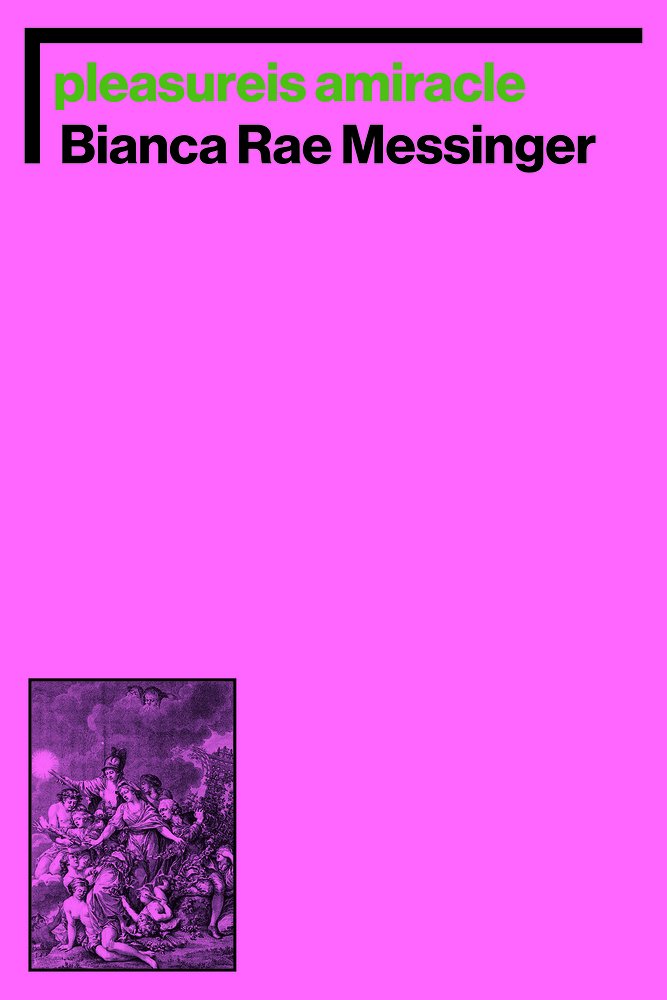
Bianca Rae Messinger’s first full-length collection, pleasureis amiracle, explores the timelessness of memory and desire. While reading Messinger’s lyrical prose, I oftentimes found myself reading the poems aloud, nearly singing them. The musical quality of the poetry in pleasureis amiracle begs you and I to question the importance of sound in our lives. What does it mean to live in a world with sound, but to not fully hear it? Both an experiment in form and syntax, Messinger’s poetry reconceptualizes time, memory, and space through lyrical fragments from the past.
The poems of pleasureis amiracle are a nostalgic study in mental illness and Messinger’s “chronic chronophobia,” an active struggle with the metaphysical in an attempt to stop time altogether. A majority of her collection is overwhelmed by the cacophonous “noise” produced by distracting experiments in form and blocks out physical noise. The music—rhythm, syntax, form, diction—of her poetry play a role in the space and time created or destroyed in the recollection of memories:
whatyou miss is beauty, we say to her, when it moves so quickly and being attached — to be attached instead of moving around it, feeling what’s to feel over a continuum instead of a sharp peakandvalley, and it’s not thatit’s formal but instead feels like an invitation — there is acreation of an expanse, which is not acounter argument we had cinq á sept in a landlord’s garden. no one gets evicted.
Messinger’s poetry is fast-paced—nearly one continuous sentence—and often compounds words to limit the time and space of the memory further. The form—a neat, small box that takes up less than half of the left hand of the page, untranslatable shapes made of words, lines and bars—also disrupts metaphysical standards of poetry to relay artistic intent hiding not far beneath the surface.
The poetry within pleasureis amiracle takes all shape and sizes, but the form of Messinger’s poetry all have one thing in common: it’s unwillingness to conform to more direct narrative. Between the compounded words, entire poems squeezed to the left margin, or enough space in between lines of prose that you can easily write your notes in the white space, Messinger plays with emptiness and blank space to disrupt the temporal expectations. Taking up space means relaying events as they’ve happened, not as they’re remembered; not through the memory.
But Messinger ultimately rejects the constraints of time altogether, completely entangling the past with the present; completely disrupting the traditional temporal narrative. By combining the past and present in her narrative to completely transcend the chaos of the metaphysical, reaching divinity through lyricism, through music:
then there being a field of rhododendrons, you use them as
bait that I hold in a way how you make a necklace, it rides up
my neck. you have a real fear of equanimity. just “walking up to
it and feeling before” — how long is the waking up? for the
point of moving was where it came from, being how my
impetus becomes a part of your world, tying the flowers
to the bottom of the river. my sister comes back to life but
isn’t this the way you’d want it? everything starts in vibration
at some point — maybe like a moment of emergence, my
paper my little paper. working on my promises. thanks. you
stand in front of a room and i don’t need to tell them your
power. everything that happens to me in this is because
of her. it being dark but the sky still having cohesion.
While an escape of time is a large theme of pleasureis amiracle, it eventually evolves into the transcending of time through the divinity of untranslatable senses. As the collection comes to a close, we see the subject become more attune to the sonic world around them, and ultimately develops a closer relationship with pleasure.
Through the last section of pleasureis amiracle, the state of the holy spirit: notes for the production, Messinger’s prose shifts:
being able to “live” in one’s memories was what caused
the eventual collapse, and it being joyful. a radio on
repeat, “could there be eyes like yours? could there be lips
like yours? could there be smiles like yours, honest and
truly?” it was, not a system in the technocratic sense of
the word but a sexual one, not in the technocratic sense,
whatever that means. she, writing this now, discovers
the feeling impossible to render. even through her being
able to write made her question all her hypotheses. it
was not unlike a god’s ability to create life (still a true
misinterpretation of the process itself). this is all to
say that the “spark” which linked the two — “memory” to
“life” — had been encountered. she thinks, an easier way
to say this is that dreams are now considered life forms.
Through her form and syntax, Messinger has perfected the act of relaying divine experiences, the metaphysical, and memories. This collection is a journey of healing and self-realization, but also acceptance—acceptance that pleasure is not just one thing or tied to one person. It is the untranslatable sound trapped within memories. But whatever pleasure is or is not, pleasure is a miracle.
pleasureis amiracle, by Bianca Rae Messinger. Brooklyn, New York: Nightboat Books, January 2025. 104 pages. $17.95, paper.
Casper Orr (he/him) is a trans disabled writer and artist specializing in memoir, cultural criticism, and lyric essays. He’s a Nonfiction Senior Editor for Fruitslice and Managing Editor of Noise Made By living on the east coast. He has work published or forthcoming in Archer Magazine, Electric Literature, Fruitslice, t’ART Press, and more. He can be found on Instagram: @casper.orr.
Check out HFR’s book catalog, publicity list, submission manager, and buy merch from our Spring store. Follow us on Instagram and YouTube. Disclosure: HFR is an affiliate of Bookshop.org and we will earn a commission if you click through and make a purchase. Sales from Bookshop.org help support independent bookstores and small presses.
 Heavy Feather Review