

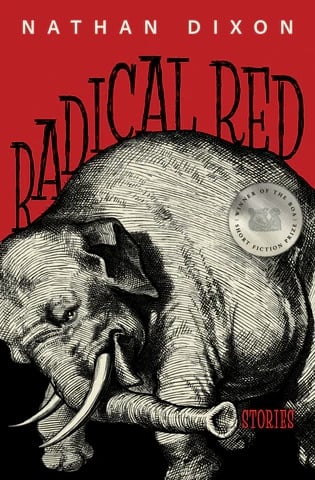
I came to this book looking for right-wing horror. I wanted to giggle at the thing that freaks me out, instead of turning squeamishly away.
Nathan Dixon has made up a cast of characters who recur from short story to short story in this collection. Some of them could probably be identified with real figures from our public life. For example, there is the radioman, who hosts a long-running right wing talk radio show, who you could imagine as Rush Limbaugh. I’m not going to spoil for you what happens to the radioman. Suffice it to say that much of this book is body horror, carried out against media figures. (It is media figures more than elected officials who represent the Right in this book.) When characters use rhetoric that condemns people for their sexual and reproductive behavior and focuses on personal responsibility, what can an all-powerful author do to those characters to take control away from them, humiliate them, and drive them over the edge?
In an interview on the publisher’s website, Dixon says he has told writing students to “ruthlessly destroy their characters.” Writers are often afraid to do this, and I think it’s a great goal, especially when a writer is using fantastical materials. Dixon says, “What moral universe—I keep asking myself—have I tried to create by taking the Right’s words seriously, by bending the laws of so-called reality to accommodate their absurdity?” Dixon does a good job of forcing his characters to face the unfaceable, and it always destroys them.
There were things I liked less well in this book. The language is often impressionistic. “Prayer group on Wednesdays, church on Sundays. A green fort. A yellow beach. A pink room.” In a book where characters are called after their roles instead of being given names, this style draws attention to itself and increases the feeling of symbolism.
These choices can also sometimes be confusing. Most white woman characters who are not identified with a job are given the name Martha. This is kind of funny, but also was a real problem in a book where characters recur across different stories, because the second time I was introduced to a Martha I didn’t understand that she wasn’t the same person I’d met before.
All of this was so distancing from the characters, who face a further problem of being extremely unsympathetic. Dixon reserves his own sympathy for characters who sympathize with others. There are a couple of people in these stories who suffer not because they are getting what’s coming to them but because they live under legal and social regimes that make them suffer—the “Unidentified Black Male” of the first story, and the nameless Mexican wife of the final story. This Mexican wife, whose husband is collateral damage in the bad things that are happening to one of the right-wing characters, loves her husband and, through her attention, brings all his good qualities into the light for us to see. Another character, the apprentice, is a college conservative who notices the sexualization of women in his movement and whose loyalties seem to be with those women rather than with the predatory men in power. He has what he labels a crush on a young female leader of his organization, but it sounds much more like love. His ability to sympathize with others distinguishes him; everyone else remains self-obsessed to the end.
There is a bigger question, outside the confines of this particular book. What are we doing here, when we’re reading and writing protest literature? These are literary short stories, published by a small press, with a small audience. These are not YouTube clips from The Daily Show. We are not communicating these visions outside our small community. Are we like kids passing notes to each other in the back of the class?
According to its website, BOA Editions, Dixon’s publisher, receives support from the National Endowment for the Arts. I recently listened to an episode of the Three Percent Review podcast about the history of the NEA and controversies around its grantees. The hosts pointed out that past challenges to NEA funding of publishers were reactions to specific books that lawmakers thought were immoral. But the letters that grantees recently received from the NEA rescinding their funding just categorically declared that the current administration had other priorities. In other words, said the hosts, the content of the books doesn’t needle the people in power anymore.
So what are we doing here?
One thing we’re doing is giving ourselves permission to ruthlessly destroy, as Dixon says, through play. His characters aren’t exactly effigies, because the people depicted are types, rather than explicit fictionalizations of real people. But the book is a dollhouse, and he does what I did with my Barbies when I was a kid—put them in compromising positions, make them jump on each other’s heads, etc. It’s fostering a culture, among those of us who read and write this kind of thing, of daring and bad taste.
This book is also one more place where history that the powerful would like to wipe out is still written down. Some of the stories have as epigraphs quotations from right-wing figures from Joseph McCarthy to Donald Trump, so it’s full of familiar names (Pat Robertson, Lee Atwater, Mike Huckabee) talking about 20th and 21st century issues (abortion, crime, immigration).
But slavery also haunts these characters, with their nostalgia for America’s revolutionary era, and some of the epigraphs go back farther. One of the chapters begins with several quotations on the subject from Thomas Jefferson and Abraham Lincoln. One of Jefferson’s was vivid enough I had to look it up: “[T]he separation of infants from their mothers too would produce some scruples of humanity. but this would be straining at a gnat, and swallowing a camel.”
I found a reference to this letter on the Monticello website, which links to the full text on the website of the National Archives. It is from a letter Jefferson wrote in 1824 to historian and Harvard president Jared Sparks, about the idea of deporting Black Americans, perhaps to Haiti. Jefferson thought that the most practical way to do this would be to get enslavers to voluntarily surrender any new babies born in their custody, keep those babies with their mothers for just as long as necessary, and then put them to work in “industrious occupations” until they were old enough to get on ships and go away. Over a 25-year timeline, “the old stock would die off,” and then for “our happiness and safety” we will finally have gotten “rid of them.”
Our current presidential administration, which fears the public display of any object or document that makes America look bad, doesn’t like the National Archives. By including this quotation in his book, Dixon has snuck out a little bit of contraband from that archive and spread it around like a whisper. Perhaps, if small presses like BOA Editions continue to publish books that sexually humiliate stand-ins for right-wing cultural leaders and quote unflattering letters written by our founding fathers, someone in power will notice and be annoyed enough to try to starve them of funding because of the content of their books, and not just because books don’t matter.
Radical Red, by Nathan Dixon. Rochester, New York: BOA Editions, June 2025. 206 pages. $19.00, paper.
Ashley Honeysett’s debut book, Fictions, won the Miami University Press Novella Award and the Chicago Writers Association Book of the Year Award. If you want to be a more adventurous reader you can subscribe to her newsletter at ashleyhoney.substack.com.
Check out HFR’s book catalog, publicity list, submission manager, and buy merch from our Spring store. Follow us on Instagram and YouTube. Disclosure: HFR is an affiliate of Bookshop.org and we will earn a commission if you click through and make a purchase. Sales from Bookshop.org help support independent bookstores and small presses.
 Heavy Feather Review