

In Rocky II, Adrian is pregnant and while moving a heavy can of dog food at the pet shop, she over-exerts herself and ends up slipping into a coma. Rocky is understandably beside himself. Waiting beside Adrian’s hospital bed, when Rocky was at his most vulnerable and needing to steel himself, he didn’t go to Mighty Mick’s to spar or pump iron. He didn’t run the Philadelphia Museum of Art steps.
He wrote a poem.
It’s an eloquent, stuttering reminder that out of all the sports, boxing has the most intimate relationship with literature. Novelists from Jack London, Ernest Hemingway, Norman Mailer, Joyce Carol Oates, and Katherine Dunn have all written enthusiastically about the sport. A. J. Liebling, W. C. Heinz, Budd Schulberg, Gay Talese, George Plimpton, and dozens more helped elevate sportwriting from a newspaper column to a literary sub-genre. To this day, boxing is well-represented when it comes to Best Of awards for sportswriting.
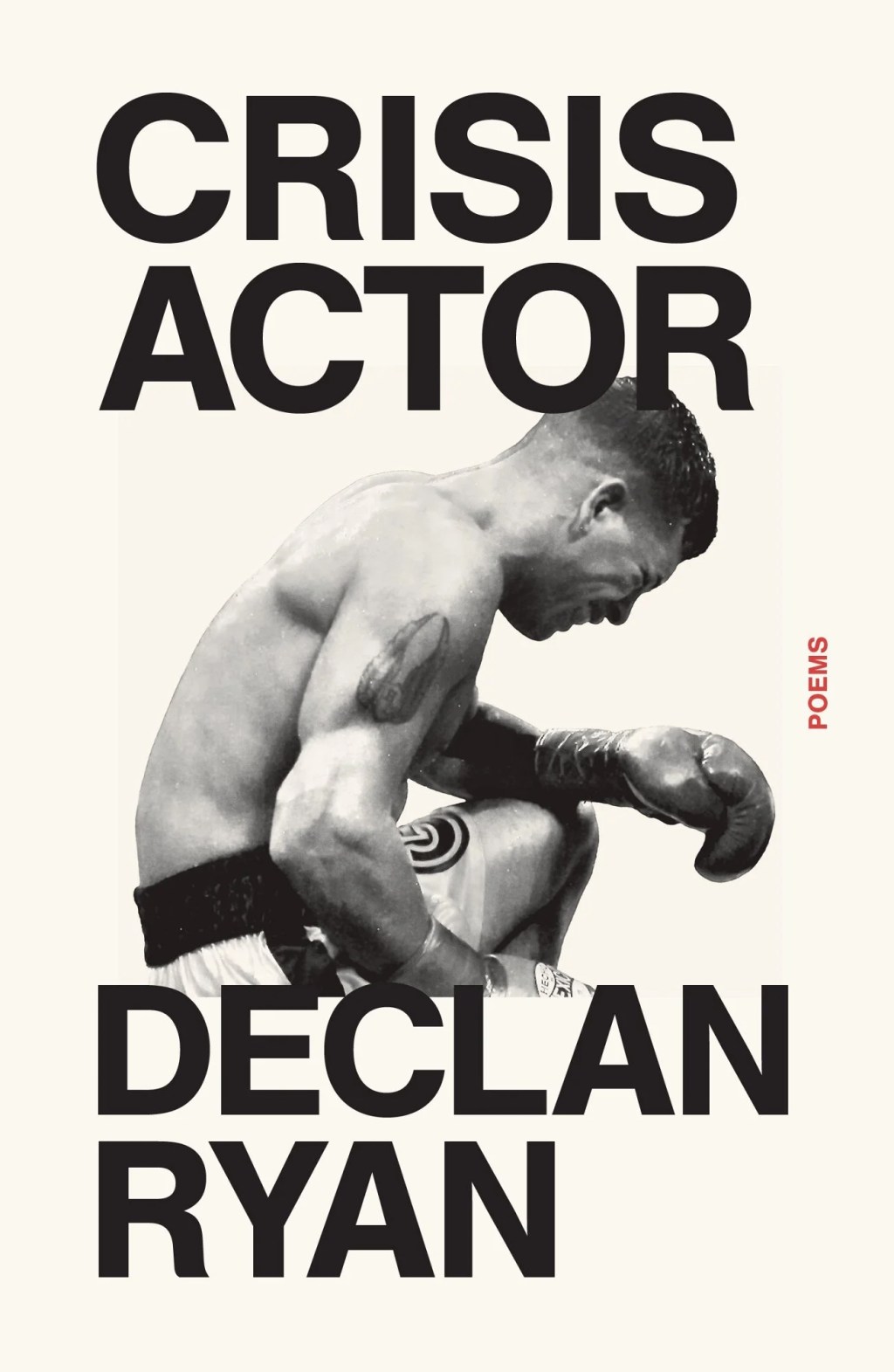
Still, it is a rare thing to stumble across a book of poetry with a photograph of a boxer on the cover.
Declan Ryan’s 2024 Crisis Actor is one such rare book.
On the cover is Arturo “Thunder” Gatti. His image has been cut from its context, but I recognize it immediately. It’s from his 2002 battle with “Irish” Micky Ward, their first of thee matches, this one in Uncasville, CT. The photo is from round nine. Ward delivered a left hook that sent Gatti crumbling to the canvas on one knee, wincing in pain. That’s when the photo was snapped.
There’s a poem in Ryan’s book about Gatti and Ward, but it isn’t about their fight in Uncasville. It’s an elegiac poem. Gatti had died, likely murdered by his wife, and Micky Ward lived on. “Walking past the coffin, Ward touched it with a hook: / ‘I got you last.’”
Memories and the relationships we carry long after they have ended are pervasive to Crisis Actor. So are the boxers: Joe Louis, Muhammad Ali, Diego Corrales, Mike Tyson, Rocky Marciano, Primo Carnera, and Jonathan Rendall (a boxer turned writer whose This Bloody Mary Is the Last Thing I Own is a classic in its own right).
Yet Crisis Actor is not a boxing book. Or at least, not only a boxing book. The boxers become a foil to Ryan’s main poetic thrust (or jab?), which is personal and introspective. Resonant images, they are an external gauge for Ryan to measure his own more personal, more internal, stories. They are a sounding board of sorts, a means to consider himself, as we all do, by way of others.
The book’s opening poem, for example, begins with the narrator looking outward, “A lookout on the world: next door’s wisteria” before moving inward a few stanzas later with the musically alliterative line “I was the future once, for a week, a while ago.”
Ryan’s poems do not feel constrained or rigid on the page. They flow with a decided unresolvedness. Reading them, I was often struck by the sense that Ryan was having a conversation with someone else, not necessarily the reader. The poems move in and out of earshot like snippets of conversations we are allowed to overhear. It is an interesting sensation to read as part voyeur, part inquisitive detective.
The sense of continuance, or ongoingness, struck most clearly in the title sequence, the multi-page poem “Crisis Actor,” which contains both lineated sections and prose sections. Like most of the poems, it is run through with dialogue. A line like “‘Projected books, half thoughts, the children’s birthdays,’ / then something urgent, all else dissolved away” might reasonably stand for the book’s own multiplicities.
Crisis Actor is Ryan’s first collection of poetry, but he has also proven himself a more than capable essayist, reviewer, and critic. As with his poems, Ryan’s prose is considered, insightful, and pays close attention to detail. He has written about figures such as Robert Lowell and Seamus Heaney as well as boxers from Daniel Mendoza to Oleksander Usyk, and plenty in between.
Regardless of the subject, Declan Ryan is listening closely.
“There will always be boxing,” he writes in one essay, “and it will always be watched while there are people who can’t otherwise say what fighters’ punches allow them to.”
Crisis Actor, by Declan Ryan. New York, New York: Farrar, Straus and Giroux; February 2024. 80 pages. $16.00, paper.
Andrew Rihn is a multi-genre boxing writer from northeast Ohio. He is the author of a collection of prose poetry about Mike Tyson, Revelation: An Apocalypse in Fifty-Eight Fights (Press 53, 2020), and an upcoming pulp-genre boxing novel Aboard the Old Buoy (Cornerstone Press, 2026). His essays have appeared in The Fight City, The Cleveland Review of Books, The Public Domain Review, Sport Literate, The Spit Bucket, The Saturday Evening Post, and elsewhere.
Check out HFR’s book catalog, publicity list, submission manager, and buy merch from our Spring store. Follow us on Instagram and YouTube. Disclosure: HFR is an affiliate of Bookshop.org and we will earn a commission if you click through and make a purchase. Sales from Bookshop.org help support independent bookstores and small presses.
 Heavy Feather Review