
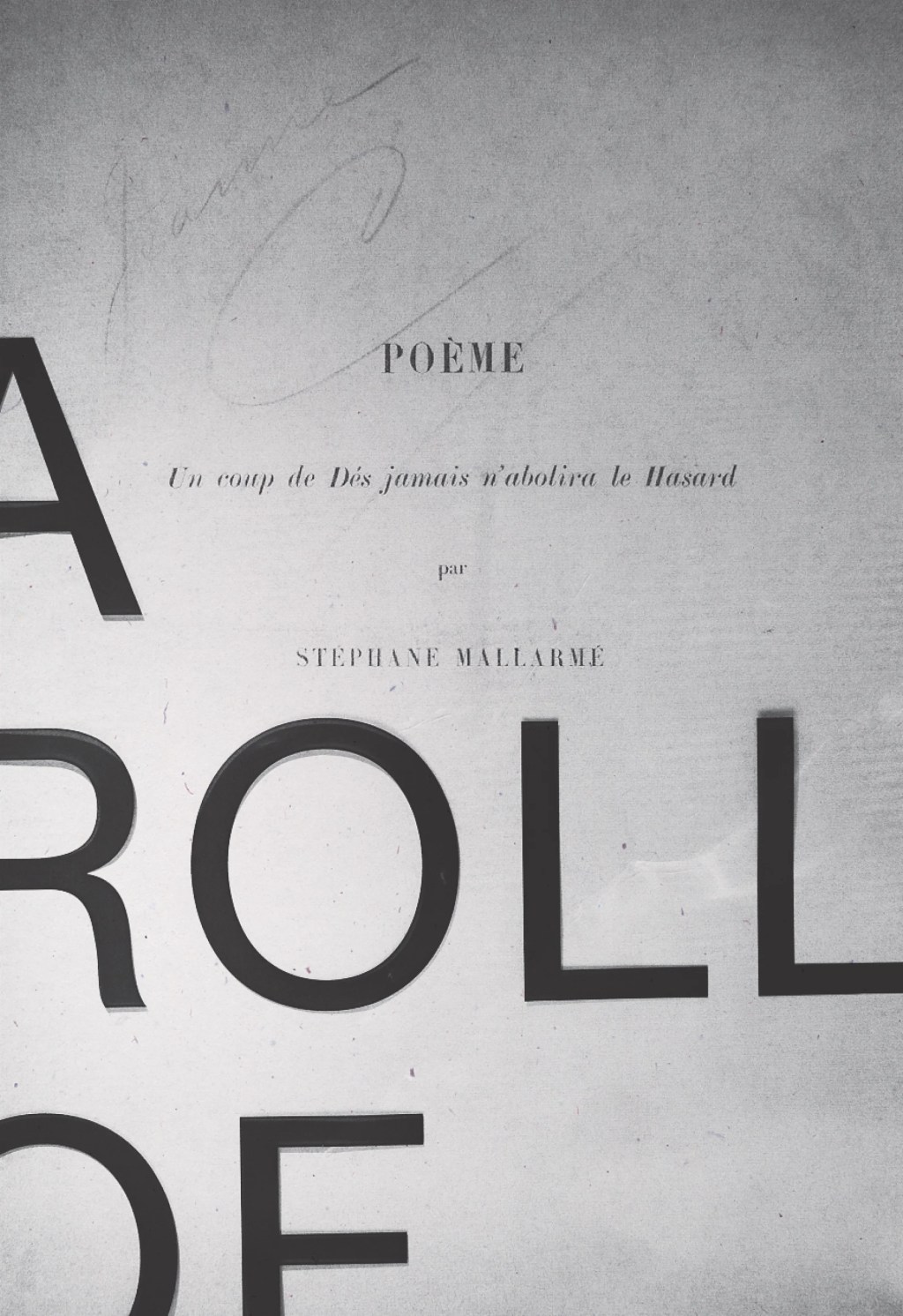
My introduction to Stéphane Mallarmé was unique. My college courses that touched on literary Modernism never mentioned him. Nor did my theory courses—despite his looming, spectral influence of Derrida and De Man—ever even say Mallarmé’s name. And what’s more, when I finally did “discover” Monsieur Mallarmé, it was not via his most famous work, A Roll of the Dice Will Never Abolish Chance.
A number of years ago, I made a pilgrimage to Seattle’s Open Books, one of only two US bookstores devoted solely to poetry, and there I came upon Mallarmé’s The Book, a text pre-dating yet somehow fulfilling Jorge Luis Borges’ most bookish, meta-literary fantasies. According to the back cover of the Exact Change translation I picked up that day, The Book is a book-length outline of a “total artwork, a book to encompass all books.” In other words, it was an impossible text meant to encompass the world and all its knowledge and imagination. Here one finds poems and equations, measurements and plans, advertising strategies and edits, all existing together in The Book that is not the book, per se, but a book about the unattainable book, an incomprehensible herald to what was to come.
In its own complicated manner, The Book is not so different from Mallarmé’s most famous work: A Roll of the Dice Will Never Abolish Chance. Both texts were never, in Mallarmé’s lifetime, published in completed form (more on that in a minute), and both remain incredibly open to interpretation, a kind way of saying A Roll of the Dice Will Never Abolish Chance is difficult to understand. To be blunter, there’s a reason the Deconstructionists, giddy about undecidability, liked Mallarmé so much, as his texts are either meaningless or overly meaningful, depending on how full or empty a deconstructed glass of water appears to be for each individual reader.
The poem itself—and indeed, A Roll of the Dice Will Never Abolish Chance is one longish poem, the English translation taking up nineteen pages sparsely laden with text—is about a shipwreck, a highly metaphoric sinking of a boat that seems to symbolize the difficulties of thinking and knowing. Here, for instance, are Mallarmé’s opening two-and-a-half pages, quoted in their entirety:
A ROLL OF / THE DICE //
WILL NEVER / EVEN WHEN THROWN UNDER ETERNAL / CIRCUMSTANCES / FROM THE DEPTHS OF A SHIPWRECK //
THOUGH / the Abyss / whitened / spreads / furious / beneath the flat tilt / despairingly …
The Abyss in A Roll of the Dice Will Never Abolish Chance is literal and symbolic. Admittedly, associating the dark depths of the sea floor with the unknowing darkness of death is not a difficult interpretation to reach. The deep darkness is where meaning and understanding die, thus even the argument that the opening stanzas imply soon moves into incomprehensibility, losing track of itself in a flood of language. But Mallarmé’s articulation of these truths follows the wild truth-hunting of Melville’s Ahab, a blasphemous raging against the metaphysical elements that keep us under their thumb. Here, for instance, is page 12:
AS IF / A simple insinuation / in silence wrapped in irony / or / mystery / hurled / howled / in some nearby whirlwind of hilarity and horror / flutters above the abyss / without scattering it / or fleeing / and so soothes the virgin sign / AS IF
Well before Yeats, Mallarmé saw the ceremony of innocence drowned beneath the weight of a god or universe that either hates, mocks, or simply fails to care for us. We are left to our own wiles, our own intelligence. But even there, he concludes, we are in trouble: “All Thought is a Roll of the Dice,” a stance that feels just a little like the author is ribbing would-be interpreters just as he challenges the presence of God.
No wonder Derrida and De Man loved his work!
Before going further, I should note that the quotations I’ve provided thus far do not do the book justice, as it is not simply poetry but a work of visual aesthetics. Jeff Clark & Roberto Bonnono sought to fulfill Mallarmé’s complete vision for the book, something never done in English. Accordingly, they translated not only the words, but also the words’ appearance on the page, something that mattered greatly to Mallarmé. The poems begin at or near the top, left-hand side of the left page, then slowly make their way down toward the bottom right; they do so, though, in a rocking motion, much like an item dropped into the water—or, ahem, a sinking ship—listing as it drops into the depths. Here, for example, is page 20:
NOTHING
Clark & Bonnono’s translation includes pictures, too; photographs of waves and the ocean floor start and end the book. The original plan during Mallarmé’s lifetime was that the book would include original, water-themed lithographs from Odilon Redon—swoon!—so the translators, in addition to matching the language and typography more to Mallarmé’s intentions, thought aquatic photography would be a close second. And while I did not find that the pictures added much to the poem, I can appreciate the gesture and enjoy having them there nonetheless. Speaking of gestures to approve of—Wave Books made what I imagine to be a bit of a gamble, producing this book in hardcover in 2015 and now (2024) in paperback. Sure, Mallarmé is a known entity, but I can’t imagine it was not cost effective producing this gorgeous text, full of images and white spaces, sometimes having pages with literally half a word. But it’s the sort of risk I hope readers will reward by buying the book. It’s all too rare to see publishers take chances, but when they do, we find ourselves with the opportunity that book lovers really enjoy: holding a book that is a work of art on multiple levels. Wave Books, Clark & Bonnono, and Mallarmé have achieved that here. A Roll of the Dice Will Never Abolish Chance is a joy to hold. It is a joy to read. It does not give away a full picture of its meaning in one read, but it is the sort of literary work that rewards re-reading. And isn’t that exactly what a good work of literature should do? A Roll of the Dice Will Never Abolish Chance, by Stéphane Mallarmé. Translated by Jeff Clark & Robert Bononno. Seattle, Washington: Wave Books, April 2024. 96 pages. $25.00, paper. Matt Martinson teaches honors courses at Central Washington University, and occasionally reviews books for Heavy Feather. Recent fiction and nonfiction appear in Lake Effect, 1 Hand Clapping, and Coffin Bell; his piece, “Trout and Trout Remain,” received a Notable mention in Best American Essays 2024. Check out HFR’s book catalog, publicity list, submission manager, and buy merch from our Spring store. Follow us on Instagram and YouTube. Disclosure: HFR is an affiliate of Bookshop.org and we will earn a commission if you click through and make a purchase. Sales from Bookshop.org help support independent bookstores and small presses.
of the memorable crisis
or if it were
the event
 Heavy Feather Review