
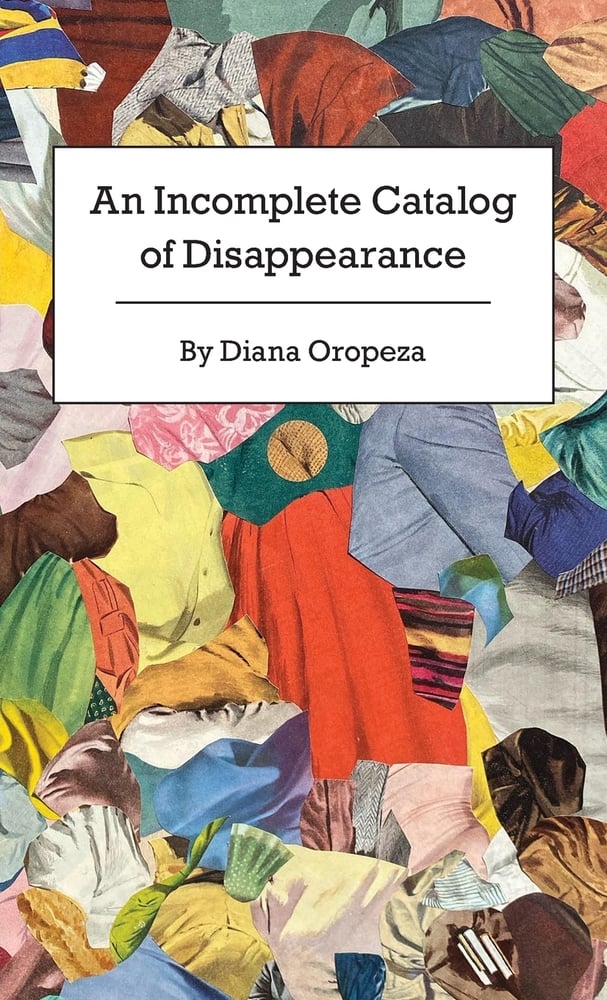
An Incomplete Catalog of Disappearance by Diana Oropeza arrived by mail, slipped out of the envelope, through my hands, and onto the hallway floor. The size of a passport, it landed next to a banana peel and a pile of junk mail and I worried that this treasure would, like the subject it ponders, disappear. Instead, it fit perfectly in my pocket, letting me get lost at the playground, on the subway, and in line at the grocery store rereading passages like, “Sometimes a mother is a distant planet and a father is only his word.”
Oropeza’s debut collection is at home in the “fuzzes out” space between things that are visible and disappearance. She welcomes us to live in this place where more is unknown than known, more is unreliable than true, more is vaporous than sturdy. Like in the story “Pfeilstorch” about the history of human knowledge of bird migration, “… we can never understand their movement because there isn’t a language for it, because the more we know, the more we become unfixed.” The result is an insatiable discomfort coupled with the determination to just keep reading and un-fuzz the whole thing. Or as the narrator in the story “Lenz” said of the mystery of disappeared cyclist Frank Lenz, “We need to know exactly what had been said, not just for closure, but for the purpose of survival.”
In the surreal world of the story “Jamais Vu” the narrator wakes up to the sound of a string quartet that’s actually jet engines playing a song they think they know, “Except no, there’s a different song in there, or under it, that isn’t being spoken. It’s not voiceless, just unnamed, and not quite acknowledged. Or we just haven’t heard it fully.” The fuzz here is real and vast and there is hope present too, that to speak, to name, to acknowledge might bring us closer to figuring out the song.
The craft choices Oropeza makes around the book’s form and structure also embrace the fuzz. The work is flash but with poetic undertones. It’s fiction but often with a strong nonfiction storyline. Although the pieces have the same structure; all caps, bold faced, usually one word titles, that too creates ambiguity towards the end on whether sections like “Acknowledgments” are flash stories. Although there is a clue to that, in all the stories until “[Unfiled]” the final sentence ends without punctuation. Which again, is another way to leave space for wonder around the finality and the desire for the visible.
The titles are also structurally captivating, often one-word, they act like clues to unlock the mystery of the story. Which, okay, yes, perhaps that is the very purpose of a title, to introduce the subject at hand like in “Cooperfield” or “Raphael” about the famous illusionist and painter respectively, or provide description like in “Housekeeper” and “Economy.” But it is different when the reference of the title is unknown and therefore the relationship to the story does not become apparent without the works references, the bibliography, and a little research. By embracing the fuzz in this way it again demonstrates how, for some, there is a deep desire to un-fuzz, and for others this connection will remain unseen.
Like “Seow & Lai,” the story of M, who disappeared to the streets after being scammed by friends, goes to a McDonald’s, chats with another woman, falls asleep, then wakes up to emergency personnel confirming the woman has been dead for hours. M is interviewed by a reporter, her son reads the article and is reunited with her. Oropeza plays off the true story of Mary Seow, noted in the bibliography, who was found by her son when she was featured in an article about people who sleep in McDonald’s, written after a woman named Lai died and went unnoticed in a McDonald’s until the next day. It is not just the interplay between fiction and nonfiction, the questioning of a true reality, the desire to find the truth, it also exposes how comfort seems to be found more in certain kinds of disappearances, as was so aptly said in the story “Bermuda Triangle,” “… there are just as many vanishings in this non-place as there are anywhere else in the world.”
Which brings me to my little part of the world, Washington D.C., where there have been the disappearance of people, of jobs, of entire federal government agencies, of gender affirming care, of the idea of a sanctuary city. The normal we have known for so long has slipped through our fingers. Each tiny treasure in Oropeza’s debut collection not only strives to capture that disappearance but with agitating honesty also admits that this has never been done and with surprising inspiration reminds us to keep trying to remember, to understand, and to acknowledge.
An Incomplete Catalog of Disappearance, by Diana Oropeza. Portland, Oregon: Future Tense Books, November 2024. 82 pages. $12.00, paper.
Tara Van De Mark is a recovering attorney now writer based in Washington, D.C. Her work has been nominated for a Pushcart, Best Small Fictions, The Best of the Net, and has recently appeared in BULL, Lincoln Review, GoneLawn, Citron Review, and Tiny Molecules. She can be found at taravandemark.com and lurks around X/Twitter and Bluesky @TaraVanDeMark.
Check out HFR’s book catalog, publicity list, submission manager, and buy merch from our Spring store. Follow us on Instagram and YouTube. Disclosure: HFR is an affiliate of Bookshop.org and we will earn a commission if you click through and make a purchase. Sales from Bookshop.org help support independent bookstores and small presses.
 Heavy Feather Review