
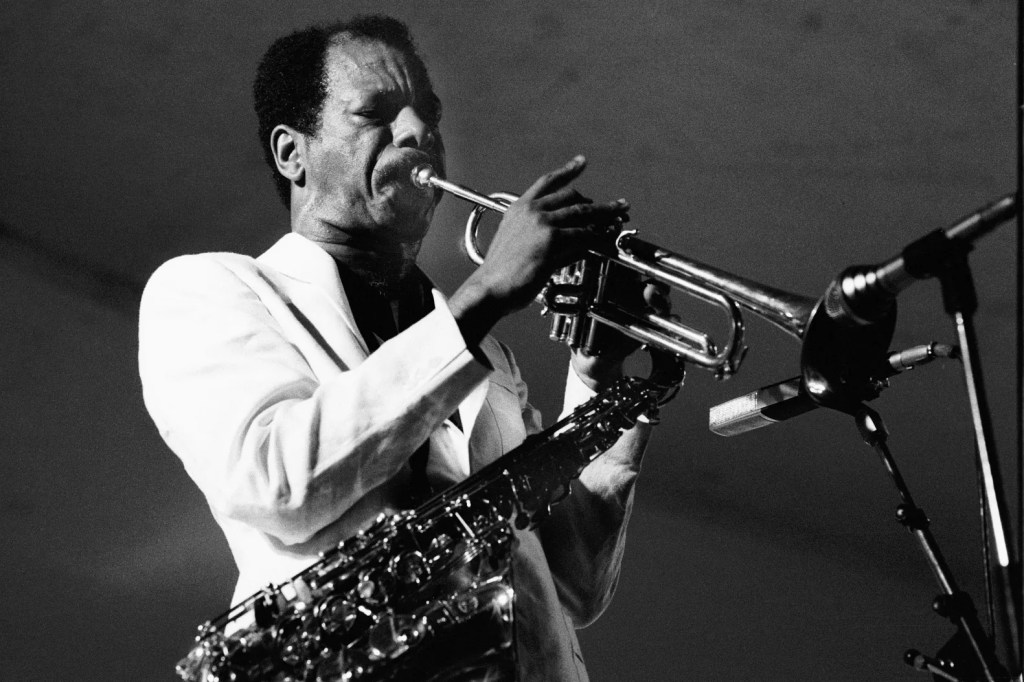
I remember as a teenager living in Fairview, NJ, and going down to the corner store and finding a cassette of Ornette Coleman’s Art of the Improvisors. I grew up listening to classical music and opera and I knew there was something about the sound of free jazz that I liked but it would be years until I fully understood the music. There would also be cassettes of Mozart and Bach, and as they were very cheap, I picked them up also. I mention this early incident because this was the beginning of a musical journey that led to the very outer reaches of Sound.
I also remember listening constantly to a boxed set of classical LPs; I think it was one of those Time Life sets; it was a series of LPs with titles like “The Romantic Movement” and “Modernism” and came with color booklets and essays on the music. So during my early and late teens, I was exploring classical music and opera, going to Academy Records in NYC, and sampling the music on vinyl. I also had that wonderful EMI set on the history of opera singing which I absolutely loved.
But as the 80s progressed, the new wave music took over my focus. The club scene had begun in NYC and I was often going to the various records stores in Jersey (Things from England) and NYC, such as Tower, Bleecker Bob’s, Generation Records. I was listening to a lot of new wave music and goth: The Smiths, Killing Joke, The Stone Roses, The Lightning Seeds, Echo & the Bunnymen, The Cure, The Cramps, Specimen, even some Bauhaus, but the list is endless. I also listened to some hardcore, bands like Black Flag, Minor Threat, the Exploited, Charged GBH. There also was the primitive raw energy of punk: The Sex Pistols’ Bullocks is a classic, the Clash’s first album and London Calling, Buzzcocks, 999, Eater, The Damned, Wire (especially Pink Flag), and many others. That energy, and the “three chord” power opened a door to free improvisation. But I would like to point out three records that were especially important to me: The Birthday Party’s Junkyard, The Jesus and Mary Chain’s Psychocandy, The Sex Gang Children’s Song and Legend, and Throbbing Gristle’s Third and Final Report. Nick Cave’s Birthday Party had an explosive, noisy, unhinged sound; Psychocandy made creative use of noise, guitar feedback, and remote almost disembodied vocals; Song and Legend experimented with sound in a kind of World Music context; and Throbbing Gristle, these early pioneers of what would later be branded as “industrial music,” made experimental use of noise and vocals, dispensing with all the trappings of melody and “song structure.” I should also mention Coil and their album Horse Rotorvator and their creative use of noise, tribal drumming and sampling. When I think of my love of freely improvised music I think of these five albums since they showed me the possibilities of “noise,” the use of non-Western music, sampling, and Nick Cave’s early screams, growls, and explosive sound that were almost an embodiment of Peter Brötzmann’s aesthetic.
When the 90s came to a close, and the club scene ended, I further explored opera; I listened to the classic opera recordings made for EMI in the 50s, and the live recordings on the Opera d’Oro label; some of my favorite singers were Elizabeth Schwarzkopf, Renata Tibaldi, Beniamino Gigli, Jussi Bjorling, and among the historical figures, Bruna Castagna, among many others; I never caught the Callas bug but I do think she is a great singer. Among the composers of operas: Verdi, Puccini, Wagner (I remember having Solti’s Ring Cycle), Richard Strauss, Britten, but my favorite of the 19th century composer was Gaetano Donizetti. I also love Debussy’s Pelléas et Mélisande, Berg’s Lulu, and Leoš Janáček’s Jenůfa. I remember listening to Schubert’s songs, Beethoven’s late string quartets, Mahler symphonies, but also branching out into the New Music with Morton Feldman’s Piano and String Quartets and some of those other hatART recordings. And of course, Cage, both the music and his writings based on chance operations.
Then came a period when I was exploring soul music with eventually an emphasis on Northern Soul. I remember discovering the Numero label out of Chicago and their fabulous Eccentric Soul series, which collected music from small soul labels. The music on these volumes never got widespread play on radio stations if any. The music was rawer and more intense than the music that was released at the time on Motown and Stax, but even more sensuous and lyrical than their best ballads. In a rush to release a hit song, record companies released thousands of 45s, and the smaller labels could obviously could not compete. The music on the Eccentric Soul volumes was a less “whitified” version of soul; this soul music was recovered and played during the Northern Soul scene in Britain during the 60s and 70s, at such venues as the Wigan Casino and Blackpool Mecca. Northern Soul dance nights began after midnight and lasted until the early morning; dancers, fueled by the raw and powerful soul blaring from the speakers and drugs like amphetamines (to stay awake) danced all night in these large halls. Northern Soul music (so named because it was a music popular in the North of Britain) was the music that collectors, looking feverishly through the record bins throughout the U.S. for that special 45, brought back to Britain and became the music played in these venues. The songs categorized as “stompers” contained a driving beat that fueled the unique and acrobatic dancing of the Northern Soul dancers; northern soul dancing was as much influenced by the Bruce Lee kung fu movies of the time as it was by the dancers in the disco clubs. These Northern Soul fans would come from all over Britain, often travelling long distances on buses to attend these “all-nighters.” Ironically, these were largely white working-class kids. But the music spoke to them and their lives. Even to this day, collectors and fans of the music form a tight knit group and hold Northern Soul nights throughout the U.K. so I listened to Soul, Funk, and the Blues. But also Lee Perry’s Sound System Scratch, and that LP of Electronic Soul that came out a couple of years ago.
But I also listened to Detroit Techno. Techno musicians, in the mid 80s, conceived of sound as evoking interplanetary dimensions; they imagined a futuristic city, as spatial as it is temporal. The writer, theorist and filmmaker Kodwo Eschun writes in New Thoughts on the Black Arts Movement (edited by Lisa Gail Collins and Margo Natalie) “that Cybotron’s (the brainchild of Juan Atkins and Richard 3070 Davis) track, “Techno City” (1984) is a futuropolis of the present, planned, sectioned and elevated from station to studio, transmitting from a Detroit in transition from the industrial to the information age: Cybo [rg] + [Elec] tron [ic] = Cybotron … Cybotron is the electronic cyborg, the alien at home in dislocation, excentered by tradition, happily estranged in the gaps across which electronic current jumps.” It is like the Big Sonic Machine coming apart, re-programmed, hacked, to create a new language from the burned circuits of Western diatonic music. It is still idiomatic, but the idiom is from a stranger land, another dimension. This rich, vivid music opens up a network of passages into other space stations of sound. There are connection points, drifting subatomic explosions of sound. Gravity is at time suspended. There are halts, a sense of weightlessness during transport. Then signals, signals to turn, enter Elsewhere. New dances form new bodies. During his life, Sun Ra would also evoke the idea of a futuristic city in space at a time when the civil rights movement was coming up against the dominant powers. Sun Ra and his Arkestra would claim in the 1974 film Space is the Place: “Outer Space is a pleasant place. A place where you can be free. There’s no limit to the things you can do. Your thought is free, and your life is worthwhile. Space is the place.” Thus, in Techno there was the ability to sonically imagine space travel and the emotive capacities of new industrial technology. Soul, Funk and Techno with their raw unbridled experimental energy was another gateway to my love of free improvisation.
In the early 2000s I explored the old-time music, country, and early rock and roll. I was buying boxed sets from the great German reissue label, Bear Family. I was listening to the Carter Family, Bill Monroe, Sons of the Pioneers, Lefty Frizzell, Jerry Lee Lewis’s late recordings from the 70s, the Sun records series of volumes from Bear Family, Johnny Burnette’s rockabilly records, the Collins Kids, Tex Ritter, Don Gibson and many others. There was that great cd series on Bear Family called “That’ll Flat Git It!” that released rockabilly recordings from smaller labels. Strange to think that all this great American music is licensed to a German reissue label that releases lavish boxed sets with full color LP sized booklets. I guess America record company don’t value their own music. Though there are the JSP and Proper label out of the UK that releases some of this music in bargain boxed sets. But once again it’s a European label and not an American label that is interested in their musical history. It’s probably not profitable to release boxed sets of the music. And so profit is at the center of everything. Harry Smith’s Anthology of American Folk Music was also important to me. One favorite Bear Family set was Around the World to Poor Vally which collected Bill Clifton’s wonderful recordings.
This exploration of early American music naturally led to my interest in jazz, the other great American music. I began, as most people who get into the music do, with Charlie Parker’s Savoys and Dials, Monk’s and Powell’s Blue Notes, Basie’s Decca recordings, and all of Ellington. But there was also the piano work of Herbie Nichols. Then the saxophonist players: Lee Konitz’s Atlantic recordings and Motion, Stan Getz’s Roost recordings with Jimmy Raney on guitar, Sonny Rollins, David Murray, Sonny Stitt, Art Pepper, Paul Desmond’s recordings with Jim Hall, and many others; the singers: Ella, Anita O’day, Sarah Vaughn, Billie Holiday, Chet Baker, the exciting Betty Carter and so many others. That record Anita O’day did with Oscar Peterson is a classic. Gerry Mulligan’s quartet in the sixties. And Bill Evans’ Village Vanguard recordings and even the later stuff. Woody Shaw. Mal Waldron. Later, Horace Tapscott. And Thad Jones & Mel Lewis’ big band records. I used to get Mosaic Box Sets. Some of my favorites were the Anita O’day Verve recordings, the ones Sarah Vaughn did with Roulette, Gerald Wilson’s big band Sounds, the complete violinist Stuff Smith’s Verves, the Tal Farlow Verves, the Django Reinhardt Hot Club of France recordings, and the great Mildred Bailey Columbia recordings with Red Norvo. This is a rough sketch of the jazz sounds I was listening to in the early 2000s.
But eventually I turned to different sounds. The gateway to this new universe was Albert Ayler’s Spiritual Unity. His was the sound of New Orleans going wild; it was In and then way OUT. He was stretching the Sound to the breaking point. The Ornette Coleman Atlantic recordings came soon after. As well as Coltrane’s duets with Rashid Ali. I’ve only recently discovered Mile’s electric period which is some pretty Out there stuff. I never followed Coltrane’s or Miles’s early careers. But those Miles Davis Plugged Nickel recordings are fascinating as they show the new path that Miles and Shorter were exploring; Miles’ thoughts are meandering, Shorter is honking on the horn, and the young Tony Williams is on fire; it’s he who takes down the safety net and allow Miles and Shorter to stretch out.
Then I explored the Rova saxaphone quartet; the album they did for Atavistic, Electric Ascension, is a wild, cacophonous and glorious noise fest. Soon I was exploring Christian Marclay’s sound world (his Records on Atavistic); his work with damaging records on purpose and combining sides of different records to each other and playing them on turntables creates an exciting deconstruction of rhythm, harmony, and melody in his fantastic and noisy soundscapes. Marclay was important to me and led me to explore the nature of Sound. Then came Cecil Taylor and the floodgates opened. I explored Derek Bailey and Evan Parker and the Incus label. For me, the central text on free improvisation was Derek Bailey’s Improvisation: Its Nature and Practice in Music. Jacques Attali’s book Noise: The Political Economy of Music, was also useful as an examination of “noise” as a political tool. Often, in the early stages of the development of free improvisation there was an anti-capitalist stance among the musicians. The dominant system always preserves a recording of its power to preserve itself, and so these musicians who practiced free improvisations were against recording a performance on record. There would be no documentation, no trace, the music would vanish in the air. This is idealism, perhaps. But then free improvisation was a deeply personal music, and like underground film, belonged to a secret utopia, that flourished in the 60s and 70s, and still continues to exist in certain quarters because of the musicians who keep it alive. It is the only music that has not been branded by corporate interests like “free jazz.” Search the traces, the fragments, they will lead you to the secret place, rather than relying on logic, reason, convention, the accepted path. That Space Sun Ra talks about is everywhere but nowhere. That’s the reason. Real pleasure doesn’t encourage capitalist production.
Then it was on to exploring the great FMP label. There I discovered Brötzmann’s Machine Gun, the Schlippenbach Trio (with Schlippenbach on piano, Evan Parker on reeds, and Paul Lovens on drums), Irene Schweizer and Marilyn Crispell, Peter Kowald, and the Globe Unity Orchestra. During this period, I would often go the Downtown Music Gallery in NYC. (I was also listening to the music on these great labels: Emanen, Intakt, Black Saint, and Soul Note. Listening to all these sounds, I started to think about the nature of free improvisation. There was something about free improvisation that was truer to lived experience. John Cage taught us that ambient noise is a kind of music. Listen to the birds. Tune into their frequencies; slowed down you can actually hear birds producing more than one note at the same time naturally. When done with a monophonic instrument, like a soprano, this technique is called multiphonics. (Evan Parker’s solo soprano record, The Snake Decides, is a great example of this.) There is music everywhere hidden in nature. (I think of Harry Smith holding turning on his microphone to capture the everyday sounds of the world). But is most of it noise? What in fact is noise? John Cage: “Every noise is music.” I admit some free improv records are dull when the musicians simply play a variety of familiar sounds, or their group interaction is not interesting because they are not listening to each other. But it’s just like after you’re heard the 1000th traditional blowing session, it gets tiresome. It’s a matter of listening and forgetting about everything you’ve been taught about music. Go out. Walk around. Listen. Sound is everywhere. The sounds will never let you down.
I think that my exposure to all the different kinds of music helped me to appreciate the Total Music. Free improvisation is not bound by any rhymical, harmonic, or melodic chain. It goes where it wants to go, where it is driven, where the heart and mind lead it. Think of Cecil Taylor; a solo contains so much music one can’t retain it all at once on the first listen; but on the third or fourth listen we realize that it contains all the music. There is so much in his music to hear, and it is such a joy to immerse oneself in his sounds. Free improvisation is open to all the sounds. Once you step out of the 4/4 rhythm of jazz and the blues, then you’re free to open up to the sounds of free improvisation. There are also “compositions” in free music: but often they are made up of brief suggestive phrases for the musicians to play with; you can harness the sounds, but you can’t cage them.
I think of that cassette of Ornette Coleman’s Art of the Improvisers that I picked up when I was a teenager; in a sense my journey started there, and I circled back to a consideration of that same improvised music but now with a greater understanding of the sounds at play.
Peter Valente is a writer, translator, and filmmaker. He is the author of fourteen full-length books. His most recent books are a collection of essays on Werner Schroeter, A Credible Utopia (punctum, 2022); his translation of Nerval, The Illuminated (Wakefield Press, 2022); and his translation of two books by Antonin Artaud: The True Story of Jesus-Christ (Infinity Land Press, 2022) and The New Revelations of Being & Other Mystical Writings (Infinity Land Press, 2023). He is also the author of a collection of essays on Artaud, Obliteration of the World: A Guide to the Occult Belief System of Antonin Artaud (Infinity Land Press, 2022). His most recent book is a translation of Nicolas Pages by Guillaume Dustan (Semiotext(e), 2023). He has a forthcoming book of essays, Selected Essays 2019-2023 (Punctum books, 2025), a book of essays on filmmaker Harry Smith that he edited, The Occult Harry Smith: The Magical and Alchemical Work of an Artist of the Extremes (Inner Traditions, 2025), and a translation of Artaud, The True Story of Artaud-Momo (Infinity Land Press, 2025). Twenty-four of his short experimental films have been shown at Anthology Film Archives.
Image: rollingstone.com
Check out HFR’s book catalog, publicity list, submission manager, and buy merch from our Spring store. Follow us on Instagram and YouTube. Disclosure: HFR is an affiliate of Bookshop.org and we will earn a commission if you click through and make a purchase. Sales from Bookshop.org help support independent bookstores and small presses.
 Heavy Feather Review