
On the front Napoleon refused to eat Russian bread
dark and heavy as a mantle it was du pain pour Nicole
he said before feeding it to his horse this story is of course
too delightful to be true but I do confess I like keeping it
alive in the telling are bowing under heavy snow outside my window
tonight men are bowing to kiss a ring on my screen
and somewhere in the vast wilderness there’s an otter
stashing a favorite rock in its pocket for safekeeping
which is magical but not a myth just another marvelous
fact of nature in the past I might have put myself to sleep by slowly
naming flowersazalea begonia clematisbut tonight
my body’s humming with questions like How did this start?
Where will it end? I want to know what makes a man
forsake a crust of bread while his countrymen starve
I used to say I’ll sleep when I’m dead but now
that peace eludes me all I want is rest and to resist
the current griftbe less unwitting even
knowing the machine will grind along
without me as night’s dark mantle descends
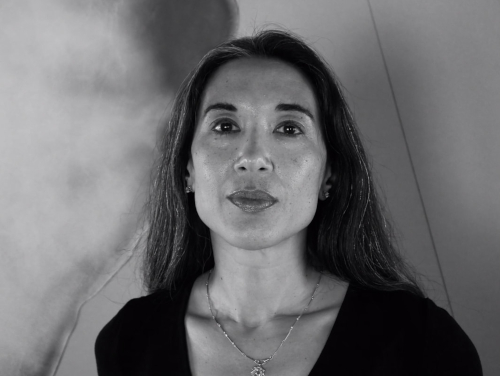
Mini-interview with Tina Cane HFR: Can you share a moment that has shaped you as a writer (or continues to)? TC: I am thinking about the time my beleaguered sixth grade French teacher at I.S. 70 in New York City went straight-up Pavlovian, and brought a chocolate cake to class as a way to get us to pay attention and participate. We were a difficult bunch, and resented her ruse. Most students also probably hated French more than they cared about the cake, which remained intact, as the class sat in stubborn silence. I, however, was transfixed by its glistening frosting, and charmed by our teacher’s approach. When she finally reached my row, she wanted to know: “Who can say ‘I would like some cake’—using the conditional tense?” Within a second, I shot up my hand and blurted out, “Je voudrais du gateau!” She smiled, paused for dramatic effect, and then waved me up to her desk. “Oh, snap!” my classmates shouted. I was just as shocked by my response, since I had no clue what she meant by “the conditional,” didn’t even fully understand what I had said. Still, my pride and anticipation were palpable, as she cut into the layers with a plastic spatula, and slapped a piece onto a paper plate. It didn’t take long for everyone else to begin jumping up and raising their hands to answer questions she had yet to ask . I returned to my seat with my slice, having broken the ice, and feeling a little bit like a legend. I wasn’t a writer yet, and couldn’t really speak any French, but that moment helped me understand something about language in the body, and the will to summon it. It made believe that if I needed the words, they would come—and that the right words could make stuff happen. Such a small seed of trust born of a seemingly banal moment, but one that would become increasingly important, years later, when I did begin to write. It’s taken me half my life to fully recognize the role that trust plays in creative practice. As a result, even though I find writing quite difficult, I rarely feel stuck. Waiting for words to arrive through the body is part of my process. HFR: What are you reading? TC: I just finished Your Steps on the Stairs by Antonio Munoz Molina, which reads like a new novel thriller, in which the action is almost entirely psychological. The translation by poet, Curtis Bauer, is precise, taut, and visual—a cinematic experience. I just began a trio of novellas by Andre Aciman called Room on the Sea. Summer is a season of fiction for me, but I have also been revisiting Rimbaud and June Jordan, because certain O.G.’s never get old, only ever more relevant. HFR: Can you tell us what prompted “Mantle of Bread”? TC: I have always loved that anecdote about Napoleon, pumpernickel, and his horse, Nicole. Like I write in the poem, its veracity is up for dispute. Nonetheless, I remain determined to believe the story—a fact, which I acknowledge is irrational, and therefore seems connected to our current cultural moment. American society—and the whole globe—is in crisis around the concept of truth. Ironic, since the age of the internet was all set to democratize access to information and facts. Turns out access can be corrosive where capitalism is involved. This poem is part of a series I am writing called Cake Theory, which is a Chinese economic theory about wealth distribution. I am still making my way through the thinking around all of this, but am eager to explore some of these concepts through poetry—as well as language, unrest, my sense of helplessness, and my concern for humanity. HFR: What’s next? What are you working on? TC: I am working on finding a publisher for my new collection, Search Engine, on these Cake Theory poems, am writing a new verse novel for middle grade readers about grief, and an editing an anthology of essays about The Clash. I am also looking to publish a short collection of epistolary poems called Dear Diane: Letters to a Revolutionary, which I wrote in the six days following the most recent presidential inauguration, and which are responses to Diane Di Prima’s first thirty-four Revolutionary Letters. Most importantly, I am working on sending 2/3 of my children off to college. HFR: Take the floor. Be political. Be fanatical. Be anything. What do you want to share? TC: I can only share the obvious inescapable: That we are living through the harrowing effects of what happens when a malignant narcissist takes the helm of a society in the throes of extreme capitalism. That this moment is a mirror reflecting back at us what our comfort and complacency have wrought. That the current “leader” is not just a particularly egregious specimen of human failings, but an almost too-perfect manifestation of what ails our culture. That sexual predation is being sanctioned as unapologetic “masculinity.” That wealth and power are being wielded purely as instruments of status and control. That humiliation is humor, expertise is threatening, that education is elitism. That anger is only acceptable for whites. That people’s bodies are for controlling. That a woman’s worth is based on her attractiveness and capacity for reproduction. All the fragilities have converged and come to bear on us—more so on those not male/white and/or wealthy. The goal is submission and the healthiest response is revolution. It doesn’t have to be bloody, but it does have to be everybody—in whatever capacity they are able. Teachers need to teach. Preachers need to preach. Artists and writers need to make work that addresses this situation in any manner they see fit. If we welcome this crisis as an invitation to identify and act on our values—to resist even in the smallest ways—we may salvage enough of what’s good. The work of a generation starts now. Tina Cane is the author of the poetry collections Year of the Murder Hornet (Veliz Books, 2022), Body of Work (Veliz Books, 2019), and Once More with Feeling (Veliz Books, 2017). She has also published the chapbooks Dear Elena: Letters for Elena Ferrante (Skillman Avenue Press, 2016) and The Fifth Thought (Other Painters Press, 2008), as well as the young adult novel Alma Presses Play (Penguin/Random House). Cane serves as the Poet Laureate of Rhode Island where she is the founder and director of Writers-in-the-Schools, RI. She is the creator/curator of the distance reading series, Poetry is Bread. Check out HFR’s book catalog, publicity list, submission manager, and buy merch from our Spring store. Follow us on Instagram and YouTube. Disclosure: HFR is an affiliate of Bookshop.org and we will earn a commission if you click through and make a purchase. Sales from Bookshop.org help support independent bookstores and small presses.
tonight trees
on a night like this
 Heavy Feather Review