
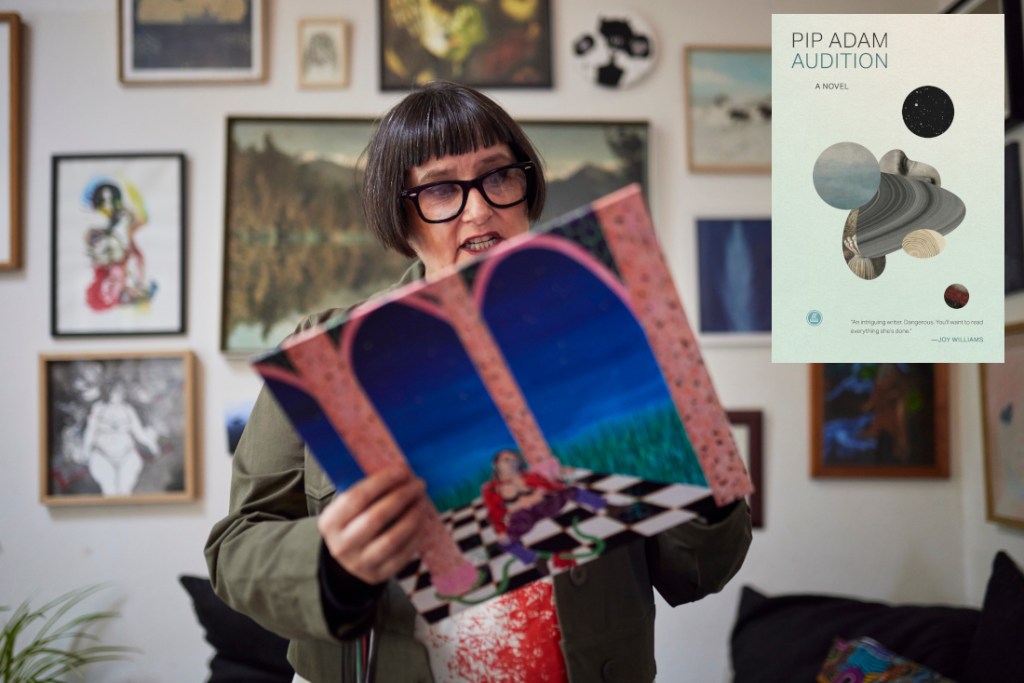
Pip Adam is the celebrated New Zealand/Aotearoan author of four novels, including New Animals (2018), which won the Acorn Foundation Prize for Fiction, and her latest, Audition, which was published in the U.S. by Coffee House Press in June. The novel is a profoundly strange but deeply moving exploration of life in the margins of society, the prison industrial complex, identity, and extra dimensional travel. I corresponded with Pip, and our conversation has been edited for length and clarity.
Adam Camiolo: One of the many things I admired about Audition was the way the story and genre seemed to unfold and grow in so many different dimensions (much like the characters). How do you go about crafting a story like this, and what other works did you draw inspiration from?
Pip Adam: One of things I tried very hard to do with Audition was suspend any decisions about the structure or story or genre of it for as long as possible. I think there’s a temptation for me to try to put a novel “in a box” structurally very early. I think I do this because I get anxious. A novel is quite a big undertaking and I always have a fear—right up until the end—that I don’t have the skill to finish the book. To counter this fear, I noticed I was often trying to say, “Oh. It will look like [insert conventional story or genre structure]. This is a thing, right? Then this also will be a thing.” However, with Audition every time I felt the temptation to go one way structurally, I’d go the opposite way. I think a good example of this is resolution. I think if I am listening to the conventional story inside myself I am writing toward resolution. With Audition I tried to abandon that. It reminded me a bit of that game you can play with a balloon, where you try to keep it off the ground. I think this helped keep the book expanding and expanding in weird ways.
I think there is a lot of “narrative noise” in my head. I am often reading or watching so I think I have this rhythm built in me for a conventional storyline—and I am always fighting it. I love plot. I love things happening. And, also, I am really interested in exploring what “plot” looks like if you disregard conventional rules about plot. I recently saw Totem by Lila Avilés and I loved how it told the story so tangentially. How it reinvents what is at stake. I found myself inconsolable, crying my eyes out over a cake. That is the sort of thing that inspires me, what if the story is told from another room? What if the story is told by someone intimate with it to another person intimate with it?
I guess one question is why bother? We have these really good structures to communicate emotions and experience with each other, why make that more difficult? I think often I am trying to make the world we live in strange. I think the conventional story and genre structures can lull us into thinking the world is a certain way. I think a lot about the idea of conflict where this is concerned. A challenge I set myself was to try and avoid conflict once they get to the new planet. It is surprisingly hard to surrender that tool from the story toolbox.
AC: The characters Alba, Stanley, and Drew make a fascinating trio, and watching their identities merge, separate, and transform in the first section is one of the most memorable pieces of writing I’ve seen in a long time. What is your process for developing characters like these?
PA: So much of my process for developing characters is, embarrassingly, playing make-believe with my imaginary friends. I think, maybe, I carry the characters with me wherever I go. So I might be in the supermarket and think, “What if Drew were here? What would I say to Drew?” Of course one of the characters is always me—in this case Alba—so the conversation turns into, “What if I were Alba and Drew was here? What would I say to Drew as Alba?” So yeah, I think it is often, I am one of the characters (or there is a “Pip” character in the book) and I meet the other characters of the book as that character. When I say, I am one of the characters, it is always a facet of me or an exaggeration of me, or me if things had turned out differently. But I need to have some kind of anchor like this in the book.
What this also means is that some characters are invisible to me as a writer. I only see their outsides. Very much like life. So this also helps me from appropriating experiences that aren’t mine. In this book for instance, I know what it is to love a trans person but I am not a trans person. So, I wouldn’t/couldn’t go inside that character in the same way I am “inside” Alba. I really want to write characters that reflect the people in my life, so this is a way I have found to do this without pretending to speak for any experience except my own. I’ve had people say this is limiting but actually it’s incredibly productive. Story is often about the hidden and the unhidden and when I only have what a character says or does, it just leads to really expansive writing in my experience.
AC: You’ve written in other publications that Audition is explicitly an anti-prison book. When did this become a major cause for you, and how do you feel science fiction allows you to explore this idea?
PA: I’ve been visiting prisons for about 30 years. To begin with I was visiting friends and relatives on a very casual basis. Then about ten years ago I started working with a group who facilitated writing workshops with people who live in prisons. The whole time I’ve been visiting prisons there has been this voice in me that says, “I really don’t think this is working for anyone.” That voice would get louder and quieter over the years. Often I would quieten it because it was too painful to think head-on at the idea that so much pain and effort was going into a system that didn’t work. Then a friend who was part of an anarchist group was involved in an alternative justice action. Someone in a community had committed a crime and instead of reporting it to the police the community decided to try alternative forms of justice. This got me reading some books and I started to see how there could be other ways. One thing that really hit me was that I had always kind of considered prisons as a natural part of society but I started to see how they were actually as contrived as capitalism—the system that brought them about. What I like about the prison abolition movement is it is a really intersectional movement. Our present systems exist to protect capitalism, the patriarchy, and the rich. In a lot of ways here in Aotearoa | New Zealand the abolition movement is about returning land that was never ceded to Tangata Whenua.
I think sometimes, it’s hard, maybe impossible to think ourselves out of the current power structure using stories of the current power structures. In these dominant power structures I also include things directly relating to the book: the cannon, dominant structures in fiction (the three-act structure), the commercialization of writing, the book, the very present use of pirated intellectual property to train large learning models for the profit of large corporations. So yeah, as well as creating a new world in the content of the book, I was also interested in creating a way of telling the story which was perhaps at odds with some of the conventional “saleable” aspects of writing.
If Audition has a thesis statement that statement would be, Is there another model of justice that is fairer and more effective?
To imagine this I needed to invent a new place and a new politics—like we hadn’t seen before. The “people” I imagined which you have read in the second excerpt have evolved on a planet with a different physics and atmosphere and a different history. As I looked back into the evolutions of life on the planet I was particularly interested in the Cambrian explosion and the shift from passivity to aggression. They were evolution leaned toward hunting. So I imagined a planet where there had been no shift to hunting or violence and instead the inhabitants of this planet had found new ways to protect themselves from attack. These ways included quarantine and some of the things I have learnt about different forms of justice including—restorative justice, distributive justice, and abolitionist justice.
AC: Now that your book is making its way to American shores, are there any specific New Zealand nuances in Audition you’re worried Americans won’t pick up on? Is there anything you want Americans to take from Audition that’s different from when you first published it?
PA: Unfortunately, and I say this with an extremely heavy heart, experiences of the harm and misuse of incarceration are almost universal at this moment.
I believe a book is written in the reading. I love the idea that we bring our lived experience to a book. It is one of the greatest things about books. That being said, I do always introduce a bit about myself if I ever get to talk to people overseas.
I’m Tangata Tiriti which means I’m not indigenous to Aotearoa. My family are from Mexico and Scotland and my grandmother is Romany. I came from somewhere else. I’m able to be here because a treaty was signed in 1840. During this Treaty Māori did not cede sovereignty. I really believe that living here as a “visitor” slash “settler” slash “colonizer” is probably the greatest influence on my work. I think Audition in particular grapples with my thoughts, concerns, and hopes around what it is to be living on land which is not my own.
AC: You mentioned in past interviews that you’re a working author, meaning you work in addition to writing. How do you go about creating a balance between creative work and your day jobs?
PA: This is possibly the hardest part about writing—how to keep a roof and eat. It is a strange job because the labor put into writing isn’t very often compensated for with money. So the balance of it is never sorted—I’m always doing at least two jobs in the time we need to do one job. The other, associated, perhaps harder part is that not being paid for my work can lead to resentment and I can get distracted by this resentment. Not writing is always easier than writing (because no one is waiting for it, because it is hard, because I am tired from my other jobs). So any excuse to not write I will take. This lack of financial reimbursement also leads to another death knell in sustaining a writing practice which is to isolate me from the people I need the most—other writers—by setting up a system of competition for limited resources.
I have not figured out a solution to all this. My solution so far has been to separate writing from income. This means having a second, third, fourth job. At the moment Aotearoa is facing really tough times financially. Jobs I used to be able to do aren’t there anymore. At the end of last year, I applied for 12 jobs and got one interview and no jobs. The government has laid off 7,000 people in my home city alone. I feel like everywhere I look in the world there is a crisis of capitalism. Sometimes I wonder if we are living in the end-days of capitalism—but that might be wishful thinking. So, a big talking point in my communities at the moment is alternative systems of economics. There are a few people experimenting with radical reciprocity. My friend, the writer Helen Lehndorf, defined it like this, “Giving generously, receiving with gratitude and humility, and trusting that there is more than enough to go around if we can all learn to do both.”
I have been working since I was about 15 years old. Working is a huge part of my identity. Writing never feels like a real job but over the last few months, I’ve had to face the prospect that I may have had my last “real” job. That I may need to change the way I think about writing as a vocation. That being said, I’m looking at going back to hairdressing. You know that thing they say about “Trust God but tie up your camel?” As an atheist I always think of it as “Work for revolution but tie up your camel.”
AC: What books are you reading right now?
PA: The novel I’m trying to get in everyone’s hands at the moment and the one I am re-reading over and over is Walking Practice by Dolki Min. It’s astounding. I’m also re-reading Mariana Enriquez’s short stories because I am chairing her session at Auckland Writers Festival. I’m also re-reading my friend Brannavan Gnanalingam’s novel The Life and Opinions of Kartik Popat.
Adam Camiolo (@upandadamagain) is a writer, and occasional firefighter, who lives in New York. He has reviewed books for Heavy Feather Review and Five South. His work can be found in the Schuylkill Valley Journal, The Daily Drunk, and The Foreign Policy Book Review. Adam Camiolo is a member of the Five South Critic Pool.
Check out HFR’s book catalog, publicity list, submission manager, and buy merch from our Spring store. Follow us on Instagram, Bluesky, and YouTube. Disclosure: HFR is an affiliate of Bookshop.org and we will earn a commission if you click through and make a purchase. Sales from Bookshop.org help support independent bookstores and small presses.
 Heavy Feather Review