
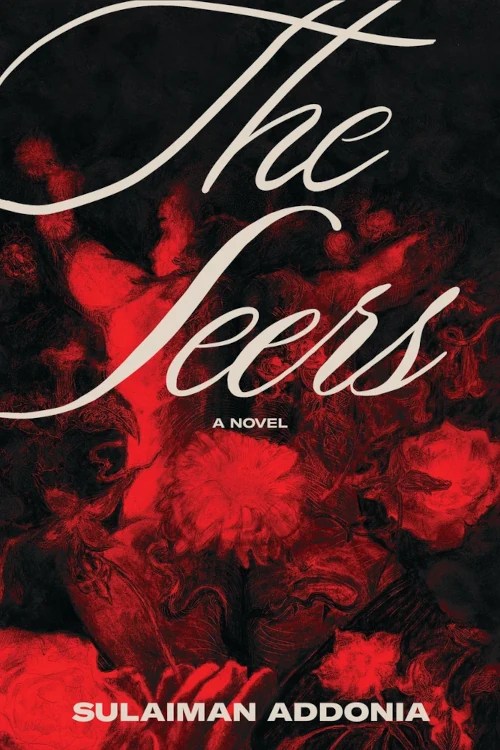

What’s the power of a paragraph? What does a paragraph do to the sentences it binds? A paragraph break, surely, is always ideological—it carries a meta-narrative about what is connected, what is disconnected. It sifts space and time into discrete, navigable units, seeding the text with white spaces like driftwood which we might grasp amid the ocean of a text. And so the refusal to break—the insistence on the single, long, continuous paragraph—carries a meta-narrative as well. Everything is continuous, contiguous; space and time are too strange to be so easily subdivided; and some stories, some voices, permit no driftwood—all you can do is be carried breathlessly through their currents and swells. Such, at least, is the implication of Sulaiman Addonia’s hypnotic and erotic new novel, The Seers. Consisting of a single, 160-page paragraph, The Seers follows Hannah, a seventeen-year-old Eritrean refugee who has recently arrived in London as an asylum seeker. For much of the novel, Hannah lives in a foster home in Kilburn as she waits for the Home Office to review her case and determine whether or not to grant her asylum. Trapped in this limbo, unable to study or work, Hannah finds agency in the form of a bold and blossoming sexuality. “My room turned into a laboratory where I experimented with my desires,” she declares. These desires take many forms and find many avenues of expression, most notably in fellow refugee Bina-Balozi. The book’s opening line narrates their coupling, a scene which the narrative returns to again and again throughout its 160 pages: “My mother gave birth to me in Keren, but I rebirthed myself in London that spring night as I topped Bina-Balozi on a bench in Fitzroy Square.” Throughout Addonia’s impassioned paragraph, all such encounters burst with a queer ecstasy, a subversive exuberance, a radical and joyful power. Sex, for Hannah, is a way of being seen, of making a home in the country of her lovers’ bodies. Home becomes “something beyond a land,” manifesting instead in a nipple, a bellybutton, an anus. As Hannah enters Bina-Balozi with her strap-on, she reflects that he has expanded to “fit me and all my memories,” and she discovers that by making love to him, she is telling him her story—the true version of her story, as contrasted with the version which lies in a case file in the Home Office building. That version has been altered—despite Hannah’s protests—by her lawyer and caseworkers, so as to better appeal to the sensibilities of the Home Office staff. Whether Hannah can stay in the UK depends upon this story’s persuasiveness, and her true story has been deemed “too complex … unbelievable, untranslatable.” It’s this true story that she pours into the bodies of her lovers, however, receiving their true stories in return. In this way, Addonia’s narrative blurs the boundaries between the material and the semiotic—flesh has language, language has flesh. Barthes: “Language is a skin: I rub my language against the other. It is as if I had words instead of fingers, or fingers at the tip of my words.” The single paragraph of The Seers evokes this sensual nature of language as well. Unbroken, it accretes energy, tumesces and expands, like a phallus and also a womb. It is a riveting, spellbinding block of text; reading it, one finds oneself hurtling towards the end even while wishing lustfully to delay, to prolong the pleasure. The novel’s momentum is achieved through Addonia’s lithe, nimble style; he eschews scene at what would conventionally be considered the most climactic moments of the plot, staying instead in a brisk, matter-of-fact summary. But the sense of momentum does not translate to a linear structure. On the contrary, Addonia moves cyclically through time. A series of refrains recur throughout the novel, whirpooling us round and round and evoking the limbo Hannah finds herself in. Cyclical time is full of grief for Hannah: “How ridiculous memory becomes when you’re sad,” she laments. “Like a rope you grasp to save your sanity, but then discover that its strands are made from the same sadness engulfing you, like a noose around your neck.” Yet memories are what she’s made of. Cyclical time is where she lives. The single paragraph conveys the way in which Eritrea’s colonial past continues to haunt Hannah’s present: “I’m here because the British annexed my country to Ethiopia and that led to the war I fled,” she tells her caseworkers. The caseworkers, of course, excise this fact from the story they submit to the Home Office, but Hannah does not forget it. The Seers becomes her chance to tell her story “as it is”—namely: ecstatic and enraged, tender and bestial, sexy, irrepressible, unapologetic, electric. Bound as they are in the single paragraph, all of these qualities coexist, bedfellows less strange than deeply human. Like her lover’s orifices, like her bedroom in Kilburn, the unbroken paragraph offers Hannah a home: a place where every bit of her story—where every bit of her body—can unfurl.
The Seers, by Sulaiman Addonia. Minneapolis, Minnesota: Coffee House Press, April 2025. 164 pages. $18.00, paper.
Alyssa Quinn is the author of the novel Habilis (Dzanc Books, 2022) and the chapbook Dante’s Cartography (The Cupboard Pamphlet, 2019). Their short work has appeared or is forthcoming in Denver Quarterly, Beloit Fiction Journal, Southern Humanities Review, Mid-American Review, Copper Nickel, Passages North, Ninth Letter, The Pinch, and elsewhere. They are an Assistant Professor of Creative Writing at Kenyon College. Find them at alyssaquinn.net.
Check out HFR’s book catalog, publicity list, submission manager, and buy merch from our Spring store. Follow us on Instagram and YouTube. Disclosure: HFR is an affiliate of Bookshop.org and we will earn a commission if you click through and make a purchase. Sales from Bookshop.org help support independent bookstores and small presses.
 Heavy Feather Review