
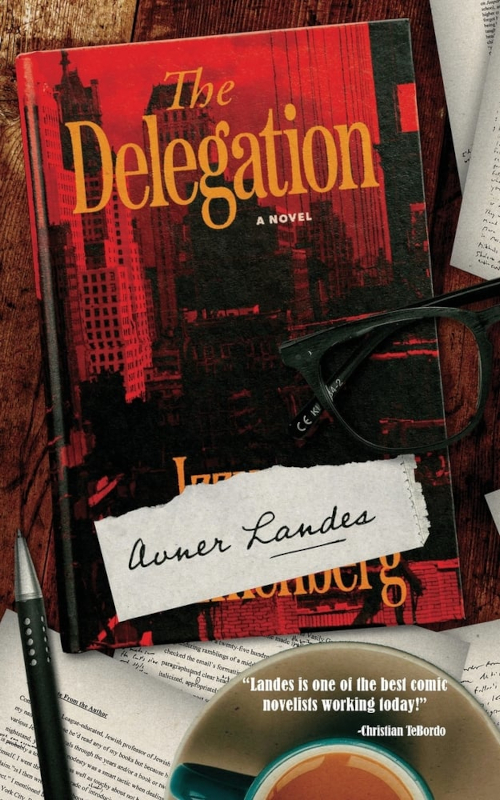
We might start by asking: what is the goal of the Jewish historical novel? Once diaspora, pogrom, and Shoah have been commemorated, if not commodified, into narrative tropes, what is the Jewish novel beyond formal pastiche? And what would a parody of the Jewish novel look like? Is the parody of the Jewish novel, just the Jewish novel? If those tropes defining the form—the anxiety, the search for assimilation while clinging to identity, the humor, the scatology, the fury and doubt or the furious doubt—appear the same in both the Jewish novel and its parody, the difference might be that one is trying to say something about the lives of Jews, and the other about the formal life of the novel? In The Delegation, Avner Landes, author of Meiselman: The Lean Years, has produced a traditional novel of Jewish precarity inflected by postmodern narrative paratext, which, in its engagement with history and a consequent anxiety about what history can possibly represent, seems primed to do both.
On its surface, then, The Delegation is a historical novel dramatizing the real life visit, in 1943, of two Soviet Jewish emissaries—the poet, editor, and party apparatchik, Itzik Feffer, and the actor Solomon Mikhoels—to the United States to drum up support from American Jews for the Soviet war effort against Hitler. It’s a fraught premise—the appointment of these two Jewish emissaries in itself reveals the antisemitism at the heart of Stalin’s vison: he believes that because Jews have an outsized influence over world affairs, they can exert pressure on the US government. The question haunting the book, though, is what the men themselves, namely Feffer—whose close third person point of view (more on this in a moment) guides the narrative—think about their role as spokespeople for Jewish life in Stalinist Russia:
Mikhoels, like many of their co-nationalists, believed that there was a Jewish situation still in need of a solution. But Feffer thought such an outlook hysterical. They’d grown up too comfortable with the story they’d told themselves for millennia, one of perpetual victimhood, of a perpetual need for protection—physical, cultural, spiritual.
In Feffer’s disdain and in the suggestion of a “solution” (with all its gruesome echoes) to the implied Jewish problem, Landes reminds us that Feffer’s commitment to Soviet assimilation is always a delusion: both of these men will be executed by Stalin not long after the book ends. And this is where the historical record is especially damning—before his execution, Feffer, who had long been an NKVD informer, will provide false witness against over a hundred others.
In his depiction of these men covering their eyes while suspended over the abyss of Jewish history, Landes’ tone remains ironic; he never strays into either the elegy or sentimentality that might characterize “Dead Jews Books,”—a phrase coined by Izzy Shenkenberg—a character from Landes’ first novel—and the ostensible author of The Delegation. Here we arrive at what is most compelling about this book. Thanks to publisher Operation Dodecahedron’s innovative typesetting, the novel we read is in fact three parallel narratives: the text of The Delegation, a historical novel about Feffer and Mikhoels fills about three quarters of each page; below it appears Shenkenberg’s Author’s Note serving as a hilarious, insecure, and aggrieved commentary on the primary text; and, below that, we find Shenkenberg’s footnotes to his own Author’s Note. This commentary, rich in structural contradiction and formal ambivalence—and where Landes seems to be having the most fun—condemns an assimilated readership (“the three times-a-yearers”), uncomfortable with religion but desirous of an identity of victimhood, who demand that the Jewish novel transform tradition into either maudlin tragedy or “Borscht Belt humor … noses, neuroses, overbearing mothers … Nazis, Freud, Nazis, Freud, Nazis, Nazis, Nazis …” And yet, destabilizing Shenkenberg’s critique of these clichés is that my characterization above of the historical novel’s close third person point-of-view was inaccurate—the narrator of Feffer’s story is indeed close to Feffer: the novel is narrated by the immortal roving consciousness … Feffer’s hemorrhoid.
And here, in the sluice (trust me) of this exploded trope, I arrive back at where I started: what can the parody of the Jewish novel say about Jewish history? Certainly, Landes is at his ribald best when crafting parodic setpieces (an excerpt from a different Shenkenberg novel where a man searches for change on the ground while his rabbi lectures—at a crematorium—is especially fraught). But this strength also displays the book’s fundamental reticence toward, and perhaps ambivalence with, its historical material. One of the best scenes—based on a real encounter—occurs when the emissaries meet with Albert Einstein whom Landes renders fundamentally satyric: while Einstein jabbers about women, especially the joys of sleeping with a dying woman, Feffer sneaks off to hide his soiled underwear in the laundry. Clearly, Landes wants us to remember that even historical figures are people, that bodily urges and simple human frailty shape history just as surely as ideas do. At one point, Shenkenberg’s former agent notes that “‘readers equate funny with unserious … The takeaways, the lessons, need to be obvious, not buried under layers of jokes.’” Meanwhile, Feffer, hack ideologue that he is, asserts, “the day they take me for a poet who is there to make them laugh is the day I throw my pen in the gutter.” Thankfully, Landes ascribes to neither of these paradigms; The Delegation—simultaneously experimental and accessible—provides an original, raucous, and not unserious vision of the human delusions undergirding twentieth century apocalypse.
The Delegation, by Avner Landes. Operation Dodecahedron, April 2025. 364 pages. $18.99, paper.
Morris Collins’ novel The Tavern at the End of History is forthcoming from Dzanc Books. He is also the author of Horse Latitudes (Dzanc). His work has been awarded an O. Henry Prize for 2024 and a Massachusetts Cultural Council Fellowship in 2020. He lives in Boston.
Check out HFR’s book catalog, publicity list, submission manager, and buy merch from our Spring store. Follow us on Instagram, Bluesky, and YouTube. Disclosure: HFR is an affiliate of Bookshop.org and we will earn a commission if you click through and make a purchase. Sales from Bookshop.org help support independent bookstores and small presses.

