
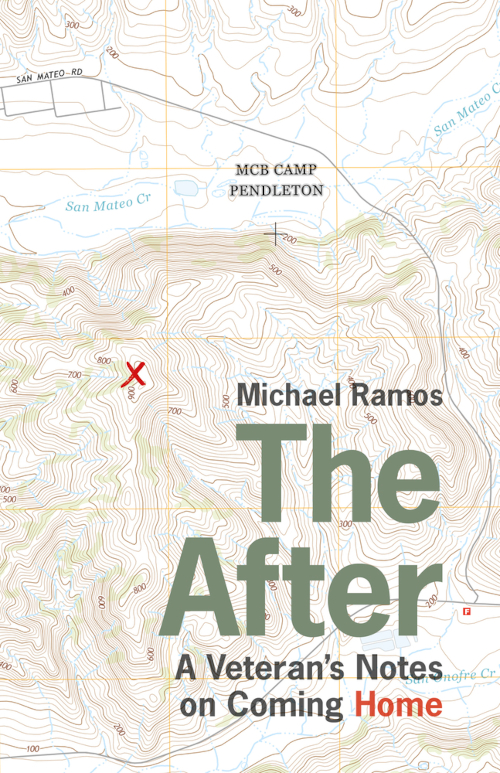
Thirteen days before 9/11, Michael Ramos enlisted in the Navy and was assigned to serve as a chaplain’s bodyguard. He had no clue he would be sent to Iraq, and he embraced the posting as well as his combat service until the military determined his skillset was no longer needed. However, after his military career ended, life did not: Ramos divorced, remarried, watched has his son enlisted in the Marines, and navigated the loss of friends to war, suicide, and the various pitfalls civilian life frequently poses for veterans. In the twenty-four essays house in his stunning, complex collection The After, Michael Ramos journeys with us through stateside duties, family life, Iraq, and the post-military challenges he faced in which his people-focused skill set became a valuable tool he used to help and educate others.
When we begin reading Ramos’ collection, we definitely must heed a warning gently placed in the book’s introduction, titled “Comm Check.” “This story goes against what we as Americans are taught in school about patriotism,” Ramos writes. “My story also goes against what society—and maybe even you—think our veterans and warriors should feel about wartime experiences and coming home.” This discreet disclosure establishes the collection’s tone, and rightly so. Ramos’ The After is bold, brave, and blunt, and just as Brian Turner established a high bar for contemporary war poetry, Michael Ramos sets one for contemporary war nonfiction.
First and foremost, The After centers on people—soldiers, veterans, families, posers, students, civilians. This focus reminds us that military careers are extremely interconnected and interpersonal, and they require a selflessness beyond civilian explanation. Ramos’ reflections about his relationships with fellow soldiers are deeply intimate and personal, crafted using military lingo and slang that engrosses us and makes not only the relationships depicted, but also the many uncomfortable scenarios war presents, more real. Nonetheless, in essays like “Hazelnut,” Ramos gives us a brief snapshot of how, in the military, the best of friendships and working relationships are founded on deep respect. The touching element in “Hazlenut” is that Ramos’ interactions with Sergeant Major Ellis begin thanks to a simple morning ritual—sharing coffee. While Sergeant Carlson always took his coffee black, Ramos writes, “Not Sergeant Major, though, he took it with cream—he even told me to make sure I stocked plenty of hazelnut creamer in my coffee mess for him, which I did.” As the essay continues, as brief as it is, we see the interactions between Sergeant Major Ellis and Ramos expand and contract as Ramos reveals that Sergeant Major Ellis “got killed in Bawanah on the pump I missed in ’07.” The essay’s brevity works so that, at this revelation, the essay constricts. It is the closing paragraph that captures how memories from one’s military can be triggered from even the smallest reminder: “… still I can’t help but smile whenever I smell hazelnut creamer. I still hear his voice all these years, and I remember the lesson.”
“Boots” is another profound, emotionally rollicking essay. “I wore Doc Martens eight-holes to boot camp,” writes Ramos. “Nine weeks later, after graduation, I asked my wife for my Docs. Shed’ thrown my civvies and my boots away, she said. They smelled awful, she said.” The wife’s discarding of the Doc Martens is a significant action, one representing the shedding of civilian life. This shedding becomes even more pronounced as the essay continues. Ramos describes receiving boondockers and utilities in Navy bootcamp, as well as his first pair of combat boots and the efforts he made to maintain their “Marine spit shine or else.” The ownership of black jungle boots gives way to the ownership of desert combat boots. “They told me to put a dog tag in my left boot. We were going to Kuwait and, if things went sideways, to Iraq,” writes Ramos. As the essay continues, Ramos reveals the grief, the rage, the anguish at losing friends and fellow soldiers in combat. He also reveals that—like those emotional memories—war and its accoutrements are not always physically unforgettable. “I still have those combat boots. I keep them in my footlocker, where I keep old uniforms and mementos from Iraq,” he writes. The suede is “almost completely rubbed off,” and Ramos reflects, “But my feet remember them, and when I put them on they fit like I never took them off.”
The After also holds many moments of post-military self-awareness that might shock some. In “Hip-Pocket Lecturer,” Ramos explains how his military service informed his approach to the civilian, and the academic, world. He begins this journey as a college student, dabbling in creative writing, encouraged by the TA, Alison, to take more classes. Juxtaposing this encouragement is the unspoken animosity his peers exhibit: “My fellow students didn’t like my poem about the pajama people and their lack of hygiene. I couldn’t figure out why students couldn’t wear real clothes to class, show up on time, or shower regularly, but I was the weirdo because I wrote about Iraq.” He also dares to jab at the stories people want to hear from veterans. He writes, “But all people want to hear is how messed up we are. How monstrous we are. How detached. How broken. I don’t understand why. And I don’t understand why my story has to be what someone else expects.” Here, Ramos adeptly addresses a unique, yet disturbing trend not only in literature but also in society—the commercialization of suffering. Ramos powerfully transitions the essay, too, to veer onto another course—about how “Marines love to fight. Marines also love to teach.” This transition is an inspiration, really—one that encourages us to find our niche, but while doing so, learn to make people understand that they matter. One of the essay’s—and the collection’s—most passionate moments is when Ramos discusses how his students feel invisible and “undervalued;” how they introduce themselves over email, and how the civilian world “makes its children feel anonymous.” The anonymity opposes the Marine Corps principles of that teach one “to be confident and competent and humble enough.” Most of all, the message is that, even after his military service, Ramos took his talents and continued to serve—in a vastly different, yet much needed, capacity.
The After is one of the most gripping and necessary veteran-written nonfiction works to be published in a very long time. Ramos’ unique writing style firmly—and in the best ways—sets The After apart from so many works of literature—and specifically military-focused literature—today. More significantly, it is a book of complete and utter transformation, of immense vulnerability, and of an intense search for self and meaning in a society where expectations frequently do not meet reality.
The After, by Michael Ramos. Chapel Hill, North Carolina: University of North Carolina Press, March 2024. 156 pages. $20.00, paper.
Nicole Yurcaba (Нікола Юрцаба) is a Ukrainian American of Hutsul/Lemko origin. A poet and essayist, her poems and reviews have appeared in Appalachian Heritage, Atlanta Review, Seneca Review, New Eastern Europe, and Ukraine’s Euromaidan Press. Nicole holds an MFA in Writing from Lindenwood University, teaches poetry workshops for Southern New Hampshire University, and is the Humanities Coordinator at Blue Ridge Community and Technical College. She also serves as a guest book reviewer for Sage Cigarettes, Tupelo Quarterly, Colorado Review, and Southern Review of Books.
Check out HFR’s book catalog, publicity list, submission manager, and buy merch from our Spring store. Follow us on Instagram and YouTube. Disclosure: HFR is an affiliate of Bookshop.org and we will earn a commission if you click through and make a purchase. Sales from Bookshop.org help support independent bookstores and small presses.
 Heavy Feather Review