
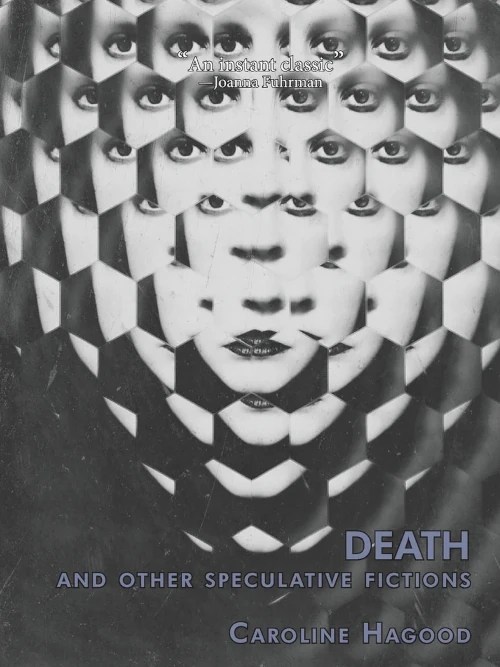
There are ghosts and then there are ghosts. Caroline Hagood writes about the latter. Not the ghosts of vengeance, or the kind that make walls sweat, but ghosts of love, heartbreak, longing, the ghost within us, the ghosts lined up along the viewing stand of our unconscious minds, that both cheer and haunt us, the muse ghost. Death and Other Speculative Fictions is a mosaic of prose poems—subtle, subjective, otherworldly—that spirals into speculative theories of death driven by the death of the narrator’s father, where one amazing, beautiful, outrageous speculation follows and out speculates the one before, thinking extending itself to the boundaries of the unthinkable, to a “beyond that lives past thought, to “something greater, more capacious than language, time, space as they stand,” and so she decides to look at those stark truths through the lens of speculative fiction. It’s by way of fabrications, the coming at it all from outlandish angles, unthinkable perspectives.
Indeed, Hagood tries to write her father back into consciousness through her own imaginative speculative writing, setting out with her usual daredevil imagery, dropping off her words as if she were dropping off her “children at some wild unpredictable babysitter’s house, a master of surprise,” and unpredictability, of verbal rollercoasters and crazy funhouses. “Writing has always been a way of coping with difficult realities and even trying to transform them,” she says. “I hope my father can find an after-life inside me. And I don’t mean ‘in my memories’ but literally build a city out of my ribs and make garbage can fires at night to keep himself warm.”
Death and Other Speculative Fictions is life and death as we know it and don’t know it and vice versa. Hagood’s mind is a vortex of vice versa. In this world she lives in Hamlet’s busy yet bounded nutshell as mother, professor, commuter; yet through speculative fiction, through an unbounded imagination, she can live in many alternate worlds and realities, be king of infinite space, of the macro- and microscopic, “of planets far away, (of) some of miniscule things seen under a microscope.”
At times she’s the eagle soaring above heaven and earth where she looks for those “things” Hamlet (that morbidly ironic philosophically playful yet deadly serious prince) looks for; at other times she is a patient in the mundane world of an optometrist’s office, “attempting to focus on a little red barn,”where, along with the “golden hay” and the “cattle of the sun,” perhaps, her dead father is living. Or maybe, she speculates, he is hidden in a place beneath her eyelids, “a shelter and peace under all the chaos.”
In Death and Other Speculative Fictions, Hagood becomes once again that Art Monster she celebrates in Weird Girls, an object of her own speculative fiction, both creator and created, controller and controlled, the writer and her words, constructing, deconstructing, then constructing again.
“Each day,” Hagood writes, “as I make my way to the college, I watch commuters step over people sleeping on the subway platform like they were plastic bags. My heart breaks a little each day and I spend some time every evening rebuilding it, using various pieces of food from the subway tracks. I believe this makes me more open to various perspectives, that such a central organ of mine is constructed from countless pieces of city refuse, mall with different backstories, colors and textures that look the same under a telescope or microscope. If you were to reach out right now to stroke my heart … you would find something startling—a kitchen. If you look at it from far away … it resembles a broken-down city.”
At one point, on the way to visit her mother on the train, she comes to “a flash of enlightenment,” perhaps an apt description of many of Hagood’s fictional flash-like chapters:
I love all these people crumpling newspapers and drinking from water bottles. We are all linked, made from the same stuff as stardust. My dad died, dispersed into all that nature that I can see outside the train windows. One day I will die and all my particles will also fly into all that—same with everyone on this train. So, there aren’t as many distinctions as I once thought.Everything is permeable.
Reflections, speculations, descriptions of life and death, of all the ugliness and beauty of the world merging into one “shattering miracle,” I am soothed by it all, drawn to her pain, her joy, her mesmerizing imagination, as “her “terrified children,” she says, are “soothed by the smell of (my) skin.” Finally, when I come to the end of this remarkable book, which very well could be the beginning or the middle, or really beyond the finality of chronology all together, I think, or rather speculate again, about Hamlet in some alternate world, dead but not really dead, fictional but maybe nonfictional, meeting Hagood’s father, by chance, in a red barn, and maybe they talk about the dos and don’ts of “dream-galaxy surfing,” or Hamlet speaks of his father, how he will never see his like again, and Hagood’s father says to him, smiling, knowingly, “You’d be surprised.” Death and Other Speculative Fictions, by Caroline Hagood. Brooklyn, New York: Spuyten Duyvil, March 2025. 116 pages. $18.00, paper. Mitch Levenberg has published fiction and non-fiction and literary reviews in several journals including The Common Review, Pank Magazine, Fiction, The Saint Anne’s Review, Local Knowledge, The Cream City Review, The Same, Fine Madness, and others. He has also published Write Something, a collection of personal essays and a collection of short stories entitled Principles of Uncertainty and Other Constants. He teaches Literature and Writing at St. Francis College in Brooklyn Heights. Check out HFR’s book catalog, publicity list, submission manager, and buy merch from our Spring store. Follow us on Instagram and YouTube. Disclosure: HFR is an affiliate of Bookshop.org and we will earn a commission if you click through and make a purchase. Sales from Bookshop.org help support independent bookstores and small presses.
 Heavy Feather Review