
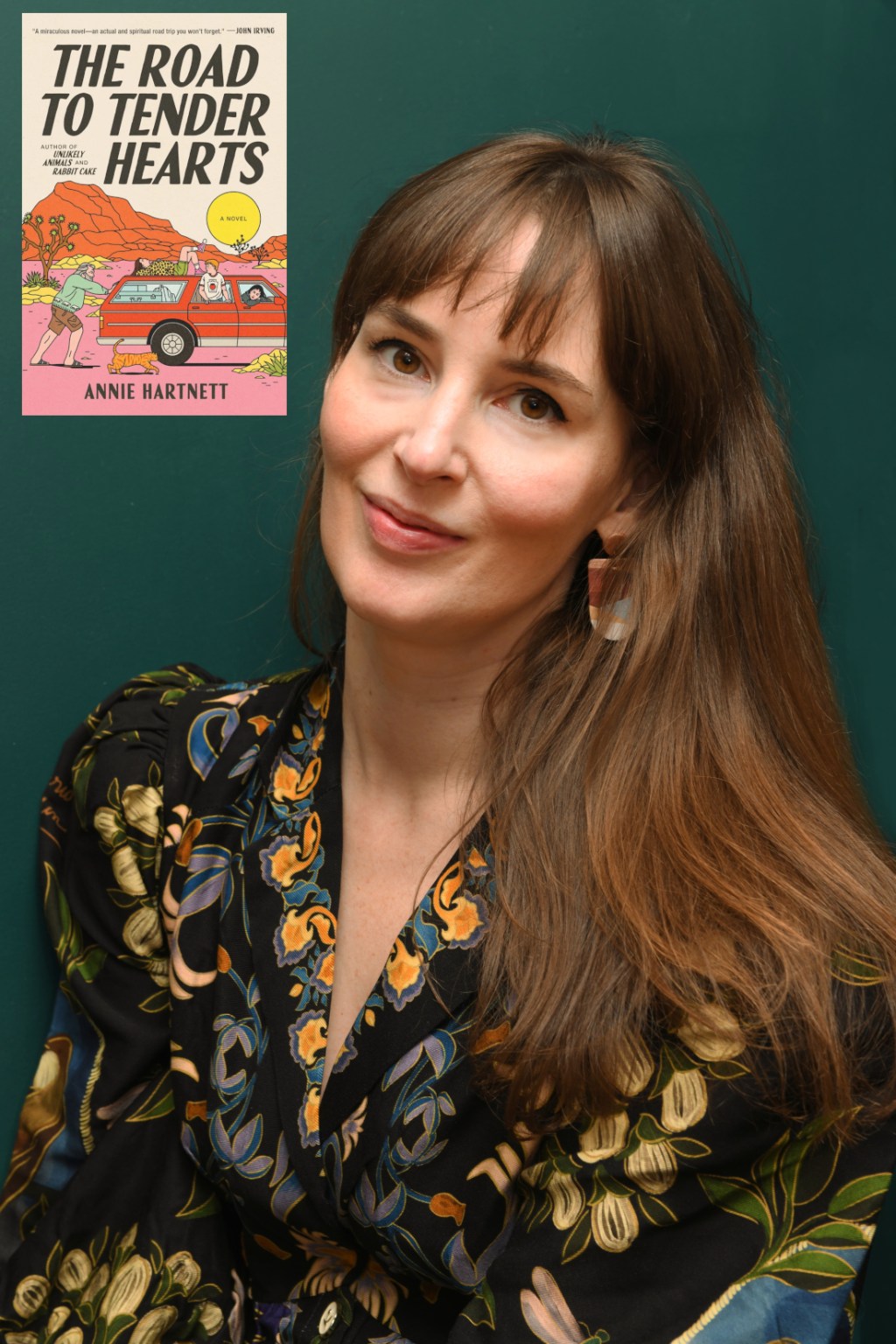

Annie Hartnett is the kind of writer that makes you laugh when you shouldn’t. The kind of writer that, in one moment, has you hoping no one is looking over your shoulder as you crack up over utter tragedy, and, in the next moment, has you welling up over the most perfectly executed joke. Nothing is ever what it seems in Hartnett’s books—no feeling, no event, no relationship is ever what you, the reader, naively assume it must be. It’s not always easy to define what humor is doing, how it’s operating, why it works. After reading Hartnett’s third novel, The Road to Tender Hearts, here’s what I’ve (maybe) figured out: Hartnett’s work looks pain/cruelty/loss in the blackest part of its eyes and then, when you aren’t looking, reaches in to squeeze its shoulders, cup its face and say, you look like you could use a good laugh.
This kind of humor in our kind of world is something medicinal. A balm you didn’t see coming. The Road to Tender Hearts, which was published by Ballantine/Random House in April of 2025, is exactly this. A darkly comic story that follows two newly-orphaned children, their estranged grand-uncle PJ, and a cat that accurately predicts death as they journey across the country in search of healing, connection, and distraction from their individual and shared traumas.
Like always, Hartnett makes the morbid hopeful, the grotesque gratifying, and the senseless full of wonder.
For the publication of The Road to Tender Hearts, I talked with Hartnett via email over the course of two months, about humor as a mode of art, the way that motherhood and caretaking shapes a writing practice, what “inspiration” really looks like, and, of course, tenderness.
Rachel Reeher: For starters, what is it like to write a third book? How has the process or approach changed for you since your first book?
Annie Hartnett: I’m going to mix up the children’s taunt for this answer: first is the best, second is the worst, third is the one with the polka dotted chest.
I loved writing and revising my first book, Rabbit Cake. It went through so many iterations, but I had the patience and the time to play around to see what worked.
Unlikely Animals was my hardest to write—partially because of life circumstances (a baby, COVID lockdown, no childcare, waking up at 3:30 a.m. to write), and partially because that book was a really complicated puzzle. Anyone who has read that book probably can understand why it was hard to write.
The Road to Tender Hearts took me less time to write than the other two books did (two years, which feels like it should be a world record) because I have a better understanding of how a novel works and what I aim to do with a book, but also the speed with which I wrote this one gave me more self-doubts about it (and yes, I know two years is not that fast, no one is actually coming to my house with the world record). So on one hand, it was easier to write, and on the other hand, it’s the only book I’ve ever cried about on the phone with my editor.
I am constantly looking for the way for writing a novel to be a completely mentally healthy activity, but I think it’s a damned-if-you, damned-if-you-don’t situation, meaning that I’m depressed if I’m not writing, but I am kind of … um, unhinged … when I’m in the middle of a novel.
But here are some things that I have found that help!
1. Turn off your internet while you’re writing
2. Track your progress—I used to use an excel spreadsheet, now I’ve graduated to keeping a sticker chart in my kitchen which I stole from the writer Catherine Newman (500 words = 1 sticker, aim for 5 stickers a week),
3. Schedule a writing retreat. Especially if you have kids. Some of the most important work on The Road to Tender Hearts was done in two writing retreats: 10 days at MacDowell (my favorite place in the world), and then 4 days at an airbnb 20 minutes from my house. I wrote 26,000 words in those 4 days. And took 4 baths and read an entire book.
4. Have some kind of writing group. I’m in a writing group with the writers Tessa Fontaine, Clare Beams, and Rufi Thorpe, and we meet every two weeks to talk about writing and publishing problems. We don’t read each other’s work until the book is done, but those meetings really keep me on track.
And, I do have to plug here, if you don’t have a writing group, please come join The Accountability Workshops, where Tessa and I help writers with all of the above…how to fit writing into their life and keep a healthy relationship with their art. Because those who struggle most, teach best!
RR: The heart of this story, as the title hints, really is the dichotomy of tenderness—the way that it can be both healing and destructive. PJ, the central character, is in many ways bumbling and disastrous, but also full of this refreshingly naive hope. Can you speak to the role of tenderness and how it developed over the course of writing the book?
AH: I named the book The Road to Tender Hearts early on in the draft, and sometimes the title sets me up for what sort of exploration I want to do. I don’t know how writers manage writing a book without naming their drafts, actually … I always name the books early on. Rabbit Cake was titled on the first day I started the book. Unlikely Animals was originally titled The Creatures We Love the Most, which is actually still the title I prefer, but my dad told me he could never remember a title that long, and he got in my head, so I changed it.
I think that question of tenderness is something I like to explore generally in fiction—how the difficult things that happen to us can make us closed off to loving, or can teach us how to love more. I guess I like to pummel my characters into tenderness. You know, I would like to pummel a lot of people into being more accepting and loving, but I’m only allowed to do that in fiction.
RR: Two of your three novels center around children, and the way that you write child characters always has this deep sense of knowing. The narration gives their perspectives and experiences a validation that the world doesn’t often afford children. What is your approach to writing children and how do you accomplish that?
AH: I love writing children, they’re much more fun than writing adults. Children say exactly what they think, they don’t have a filter, and they can be honest and even mean without being cruel. They say funny things all the time. Children have clear interests and hobbies. Over time, we become watered-down versions of who we were as children—less emotional, less honest, less loving, and also, often less interested in our true passions and hobbies because we have to make time for all our responsibilities. Every child is an expert in their hobby. For me, I was obsessed with horses. Too much other stuff is in my brain now for me to remember the entire anatomy of a horse, but one time I knew it. Now I just remember random words. Forelock. Frog. The dock. Gaskin? Is that one? Not sure.
RR: Do you find that a lot of your own life ends up in your writing?
AH: Yes and no—I do write about my real feelings about the world, but I don’t write directly about my own life. Mostly, I take scraps and emotions from my real life and put it all in the imagination machine and it comes out totally mangled and that’s fiction.
So here’s a true scrap for example: my grandparents really did make lollipop trees when I was a kid. My grandpa would use twist-ties to hang lollipops from the branches of a tree. I used that in the book, but in fiction, you make it bigger.
RR: You co-host a podcast about the intersection of parenting and writing, and mothers feature heavily in your novels, often as catalysts of major plot. Has your own experience of motherhood shaped the way you write mothers?
AH: I think parenthood has deepened my love of people in general, especially children, and I think empathy is good for fiction. This book was born from my anxiety about parenting, and how anyone can care for children when you have so many things to worry about all the time … but it’s usually not the mother characters in any of my books who are doing the caretaking. The mothers usually die or run away? If we’re talking the literal mothers and not the mother-figures. The mother-figures are more where I explore my feelings about caretaking, because it’s easier to explore deep feelings from a slant angle.
RR: In the book there are moments where we briefly hear the thoughts of animals or inanimate objects. It creates a kind of chorus throughout the book. Kate’s hat, the buzzards, the cat. Can you talk about the decision to incorporate these voices?
AH: I love magical realism and I just generally look for ways for a fictional world to be MORE than our regular world. I also want to delight the reader—what’s more delightful than a group of buzzards hissing a prayer of protection for the two children to stay alive?
RR: What is your relationship to “inspiration”? Is it something you believe in? Wait for? Does it impact your writing life?
AH: I do believe in it! I get hit over the head with it sometimes. When we drove to see this house we live in now, I said to my husband, if we move here, I can write another book about this place. I’m very inspired by place. And then I write about scraps from my past, movies I’ve seen, music I listen to, and mix it all together in my brain. Every novel is like a soup of inspiration and memories and whatever happens when you sit in the chair for long enough and just type.
RR: So much tragedy befalls these characters, not only within the book, but long before it begins. And at the same time, the novel is full of so much silliness and fun. How do you strike that balance?
AH: There was a review of my first book, Rabbit Cake, (which was, in its whole, a lovely review and I feel like I should apologize to the reviewer every time I bring this up because I’m not mad at her) that had one line that bothered me in it—“Sometimes Hartnett veers toward the silly.” It bothered me because it’s something I think is true of my work, and then became something I was self-conscious about, but eventually, I decided to own it. I am not a serious person. I am very sensitive and aware of all the real badness that is happening in the world, but I’m also just a person who reaches for the joke to help us all cope. My friend Rufi Thorpe said to me—“yes, you always make us laugh. But that’s when you slide the knife in.” Or vice versa!—I’ll slide the knife in but I’ll tell you jokes all the way to the hospital and by the time we get there you will have dropped charges and we’re in love and planning our wedding. That’s what I hope for, for us to be deeply connected by the end.
RR: Is that connectedness something that you’re making conscious decisions about throughout the writing process, or something you find your way into? I guess I’m asking whether that’s a defined target that guides you, or if you look back when you’re finished and find that it’s there.
AH: I’m always trying to heal broken characters by the end, and trying to teach myself/and the reader to look at the beauty in the world, and to keep finding joy and amusement even in darkness. I went to see the school therapist once in college, and she asked me when was the last time I felt joy, and I was so haunted by it. I thought it was a crazy question—Joy? Who feels joy? And since then, I’ve noticed, I feel joy all the time. But it happens in bursts. You don’t walk around in joy all the time. So throughout the book, there are bursts of joy. And that’s why, when the little girl asks the cat what’s going to happen to her and her brother, the cat answers: “Suffering. And joy.” That’s my favorite line in the book. That’s really what I write about. Suffering, joy, and the human connection around both.
Rachel Reeher is a writer and editor from the Carolinas, living in Central Pennsylvania. Her work can be found in SmokeLong Quarterly, Juked, Nimrod International, Bat City Review, and elsewhere.
Check out HFR’s book catalog, publicity list, submission manager, and buy merch from our Spring store. Follow us on Instagram and YouTube. Disclosure: HFR is an affiliate of Bookshop.org and we will earn a commission if you click through and make a purchase. Sales from Bookshop.org help support independent bookstores and small presses.
 Heavy Feather Review