
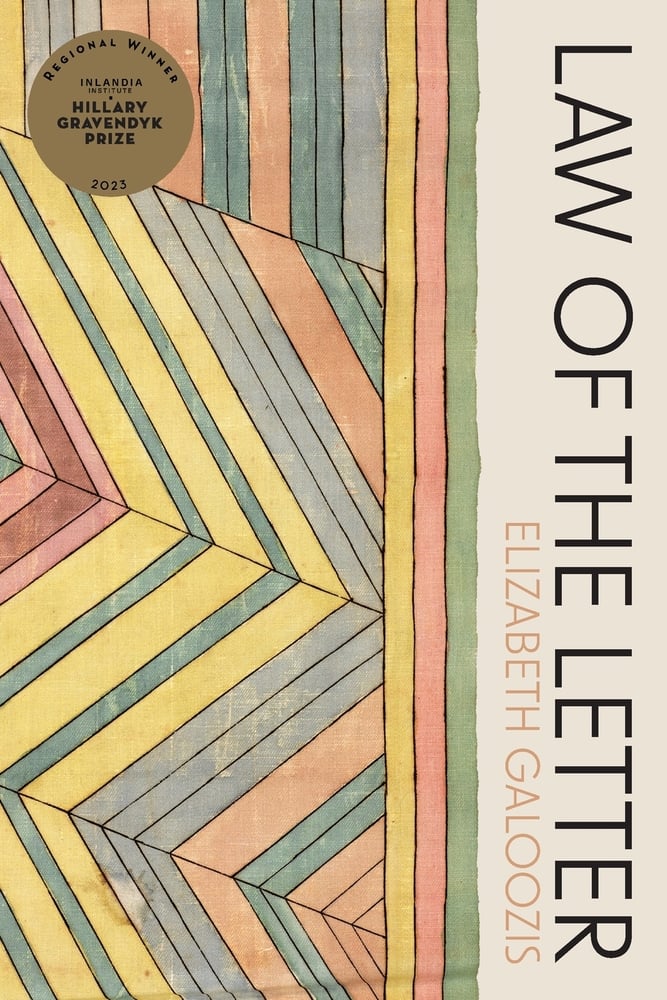
What happens when you combine the literary prowess of a skillful and soulful poet-librarian like Elizabeth Galoozis with the space to reorder understanding, instill voice in silenced letters, expand contractions into new shapes, and infuse original meaning into common language? As Law of the Letter illustrates, there’s the possibility of magic—magic in the form of letters and lists of letters, and re-alphabetized lists of lists, and letters that combine to create poems that linger long after the breath and breadth of the collection’s final line. It’s poetic magic—a blend of pure delight and purely delightful poetic framings that “remember the future” while making “a place in the desert” for all of us.
Law of the Letter artfully and skillfully embodies a love of language alongside a deep respect for meaning beyond the laws of the letters that typically accompany the written word. The pieces engage with etymology, origin, and derivation in a manner both contemplative and probing and that explores the personal and the universal, from questions to secrets with no answers—
Asking questions got me yelled at.
Better, I learned, not to know the secret but to know it existed,
catch the sound of whispers but not their shapes
as tools to inquire and to shape understanding as they create meaning. The collection represents a literary union of many strengths—and a reason to get lost in the pages that comprise its pointed and poignant folds.
The language of the text is both a guide and a gift—a reason to inquire and a ready co-conspirator in curiosity-driven reflection. The strings of syllables that comprise the collection’s individual pieces create tapestries of images that help us imagine and re-imagine the many ways in which a life is, and can be, ordered and re-ordered, by language—across and amongst times that range from origination to ongoing exploration of self, society, and serendipity.
With a deep respect for “the order of letters, so confirmable,” Galoozis both finds comfort in the written word and shares that compass of familiarity with us. From acknowledgements in the collection’s opening piece—
Letters have always soothed me when
my parents couldn’t.
No words that can’t be put into
order.
to one of the collection’s final pieces—
the word deserve means
nothing around here.
the bees and seeds
don’t know their labor
ends in a glass of rum,
in the stomach
of an animal
whose shit can’t even help them
continue the line
Law of the Letter offers language as a stick—in four-wheel drive designed as much for “a dark funnel” as a “perimeter … paved for people like us to drive through and take pictures,” and takes us on a journey through nature and nurture, naming and knowing, ordering and quartering, that digs deep into the past as it dives into the future, all while creating, crafting, and reimagining a fuller vision of the present.
John Muir has said, “And into the forest I go, to lose my mind and find my soul,” while Ralph Waldo Emerson has noted that “The creation of a thousand forests is in one acorn.” These sentiments capture Law of the Letter’s poetic prowess, including layers of learning in a single moment alongside the riptides of living in a tangled web of vines and victories and defeats that sometimes defy and sometimes define the living—
That magic feeling,
nowhere to go. But the months
keep coming around
In Law of the Letter, we enter a tangled web of order in the form of poems, wander through origins and order, and emerge a more rounded, grounded, soulful, and grateful version of ourselves for the thousands of journeys that transpired. From ordered and reordered images of “cities, poets, flowers, skeleton elements, sacred places, systems of belief—anything that can be put into order,” Galoozis provides space to wander amidst “trampled grapes” and waiters who “bear flaming trays to Greeks and exenos alike,” alongside “painful ramifications” and “the dissonant crack across the limbs that was always coming.” Galoozis invites us inside “the grass, the monuments, the pages,” that “lost their sharpness in receding”so as to make meaning of the mundane during extraordinary times (“oat milk in your favorite mug. Into it, I pour the pulled shots. This is known as marking the foam”), all while embracing the momentum that comes with sustained perusal of “time, plus dirt, plus rot, plus fire, plus buckled roads” and a refusal to recede when presented with physical realities of limits such as “the lip of a cliff” and “useless keycards.”
Each of the collection’s thirty-eight poems prompt perusal of the poignant mundanity of the order of things—things such as origins, letters, phrases, punctuation, and turns of periods (both marks of grammar and markings of the passage of time) in varying states of drama:
We wake up cold and go to bed hot,
to dramas of our own
Divided into four sections: Etymology, Silent Letters, Contractions, and Common Language, the collection is as much concerned with etymology as with evolution. Galoozis begins with an inquiry into her own origins—of name and naming. We are trained to question and to revel in the learnings that accompany the act of naming. Poems provide context for orders that we believe we understand—the order of letters and the orders that manifest and emerge from the act of writing poetry.
Throughout the collection, poetry becomes both the documenter and the documented. A tool that orders as it, too, is ordered. A message in a poetic pause, a collection’s page, a primary vehicle through which to pen understanding as it forms, all while embracing the ambiguity inherent to applied meaning and language in its many layers.
The collection reveals language to be both action and tool in the intentional crafting and creating of identity—and a common language of community. In Galoozis’ skillful hands, this tool becomes ever-more focused in its sharp insights on topics including self, queerness, identity, art, the art of community, the monotony of quarantine, genealogy, chosen family, everyday mundanity, and the profound queries that accompany engaged reflection in confusing realities. While Galoozis understands the limits of language, she also understands its power. Galoozis demonstrates that power, a power to pursue, to peruse, to probe multiple truths all while creating space to—
grow out our wild hair
or cut it all off.
listen to
and say
whatever we want,
Including
nothing.
make a table
we all want to eat from.
make dark rooms
to rest in the peak of the sun
Beyond applied laws and layers of lineage, Galoozis understands language to exist in the discovery and interpretation of an ever-evolving identity. We find language to love and a longing to rest in the magic that is the pages of Law of the Letter and, perhaps, a deeper understanding of ourselves. Enjoy the journey through the Law of the Letter’s inventively and artfully ordered vines and vibes—it’s a tangled web of reimagined order, discovery, and interpretation of identity that well worth greeting.
Law of the Letter, by Elizabeth Galoozis. Riverside, California: Inlandia Institute, April 2025. 88 pages. $15.00, paper.
Jen Schneider is a community college educator who lives, works, and writes in small spaces in and around Philadelphia.
Check out HFR’s book catalog, publicity list, submission manager, and buy merch from our Spring store. Follow us on Instagram and YouTube. Disclosure: HFR is an affiliate of Bookshop.org and we will earn a commission if you click through and make a purchase. Sales from Bookshop.org help support independent bookstores and small presses.
 Heavy Feather Review